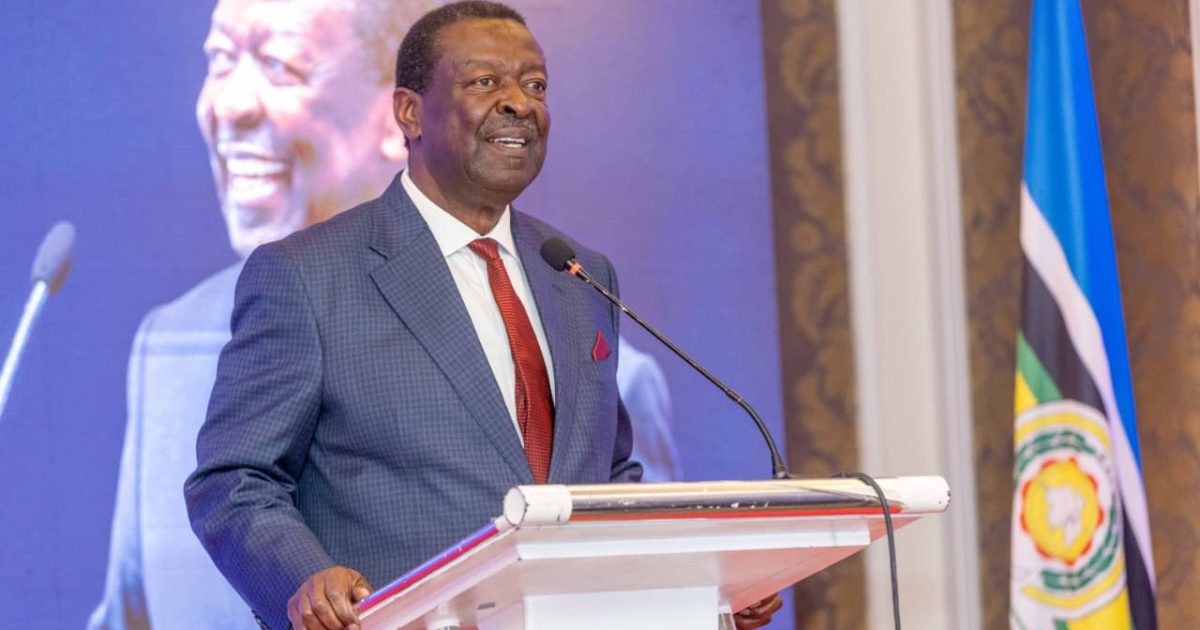
Prime Cabinet Secretary (PCS) and Cabinet Secretary for Foreign and Diaspora Affairs, Musalia Mudavadi, has called for sustained investment in diplomatic training and professional development in Africa.
Mudavadi stressed that Africa must strengthen the capacity of its diplomatic corps to turn representation at international forums into meaningful influence over decisions shaping the global order.
Speaking at the launch of the Foreign Service Academy Resource Mobilisation Strategy 2026–2029, Mudavadi said diplomatic influence should not be measured by the number of seats African representatives occupy at regional and international forums, but by their ability to negotiate effectively, shape agendas, build strategic partnerships, and secure outcomes that advance national and continental interests.
“The question is whether we are going to have a meaningful presence at these tables or simply a presence,” Dr. Mudavadi asked.
He stressed that securing a seat at an international forum is only the beginning. The greater test, he noted, is whether diplomats have the expertise and strategic capacity to influence the decisions ultimately reached.
The Prime Cabinet Secretary said the international system is undergoing profound changes, with shifting geopolitical alliances, pressure on multilateral institutions, evolving regional economic blocs, and emerging security and technological challenges reshaping the environment in which diplomacy is conducted.
He said these developments require a diplomatic corps equipped with deep knowledge of global affairs, technical expertise, sophisticated negotiation skills, and the strategic foresight to anticipate and respond to rapidly evolving international dynamics.
Modern diplomacy, Dr. Mudavadi noted, increasingly encompasses complex negotiations on trade, development financing, climate change, technology, peace and security, and other emerging global challenges.
Diplomats must, therefore, be able to navigate these interconnected issues while protecting national interests and contributing to Africa’s wider objectives of peace, stability, integration, and sustainable development.
Mudavadi challenged the Foreign Service Academy, to expand its ambition beyond Kenya and position itself as a continental centre of excellence for diplomatic training, research and professional development.
“We need to transform the Academy into a continental hub that would create opportunities for African countries to pool expertise, share experiences and jointly invest in the development of professionals capable of advancing African interests in an increasingly competitive global order,” he said.
He said a stronger continental approach to diplomatic capacity building, would enable African countries to share expertise, strengthen professional networks and build collective negotiating capacity.
This, he noted, is particularly important in international institutions, where technical knowledge and strategic coalition-building are increasingly critical to securing favourable outcomes.
The Foreign Service Academy Resource Mobilisation Strategy 2026–2029 provides a framework for supporting this ambition through diversification of the Academy’s financing base, strengthened strategic partnerships, and mobilisation of resources for training, research, digital transformation, infrastructure, and emerging areas of diplomatic practice.
“The strategy is expected to enhance the Academy’s capacity to respond to the evolving demands of modern diplomacy and equip diplomats with the knowledge, tools, and competencies required to engage effectively across increasingly complex regional and global platforms,” Mudavadi noted.
Mudavadi linked Kenya’s diplomatic effectiveness to the country’s constitutional governance as Kenya prepares to mark the 16th anniversary of the promulgation of the constitution, today, on August 27, 2026.
He called on members of the diplomatic corps and development partners to support efforts to assess Kenya’s progress in implementing the Constitution, identify areas where gaps persist, and develop practical interventions to further strengthen constitutionalism, democracy, and good governance.
The Prime Cabinet Secretary challenged diplomats to embrace a broad understanding of national interest, cautioning against narrow interpretations that could undermine human rights, democratic values, and international cooperation.
Kenya’s growing responsibilities in regional peace and security, African integration, and multilateral diplomacy, he said, require an outward-looking diplomatic posture capable of responding to challenges that increasingly transcend national borders.
Mudavadi urged diplomatic missions, development partners, and other stakeholders to support the Foreign Service Academy’s resource mobilisation efforts, describing investment in diplomatic capacity as an investment in Africa’s ability to shape decisions that affect its present and future.
He said the strategy represents more than an institutional financing framework. It reflects a broader recognition that the effectiveness of foreign policy ultimately depends on the quality, preparedness, and strategic capabilities of the people entrusted with representing countries abroad.
“For Africa, the imperative is increasingly clear: diplomatic presence must translate into diplomatic influence,” PCS challenged.
The continent needs diplomats capable of understanding complex global issues, forging effective coalitions, defending African priorities, and negotiating outcomes that reflect its interests.
Strengthening the Foreign Service Academy and expanding its continental reach will, therefore, contribute not only to Kenya’s foreign policy objectives but also to Africa’s broader effort to secure a stronger, more informed, and more influential voice in the institutions and negotiations that shape the international order.
𝐁𝐲 𝐇𝐚𝐬𝐬𝐚𝐧 𝐀𝐝𝐚𝐧 𝐀𝐥𝐢 (PCO)