Over 80 women’s groups in Homa Bay County have benefited from an empowerment program rolled out by the government through the State Department for Livestock Development.
The program encompasses training on modern livestock production practices, as well as financial literacy targeting women to boost sustainable livelihoods.
The women’s groups are among 2,300 groups identified from all the 47 counties to benefit from the programme.
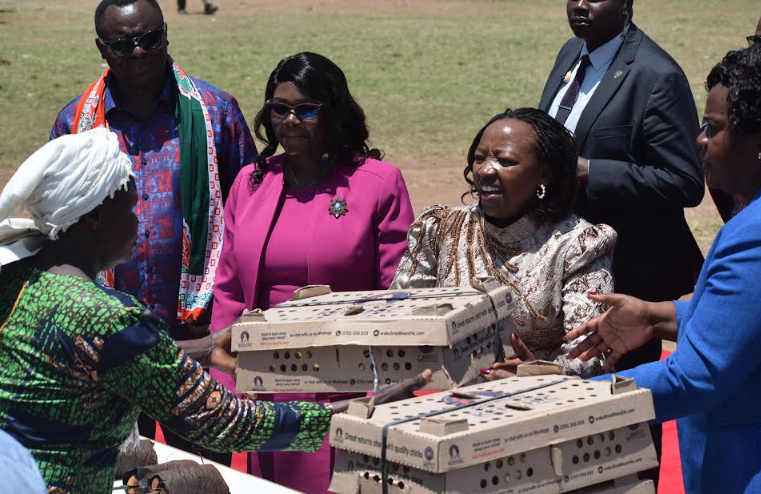
As part of the program, First Lady Rachel Ruto presided over the distribution of 2,300 day-old improved Kienyeji chicks at Oriwo Boys Senior School in Karachuonyo on Wednesday.
Ms. Ruto said the exercise marked an important step in transforming the livestock sector and enhancing food security and incomes for households.
She said her office has collaborated with the State Department for Livestock Development to train women’s groups in all the 47 counties on best practices in livestock production, adding the initiative is meant to ensure vulnerable groups are economically empowered.
“The main goal is not only to train women on how to tend chickens but also to equip them with skills to build viable and sustainable enterprises,” she said.
The First Lady said women should engage in agriculture as a commercial enterprise to create wealth for future generations as opposed to subsistence production only.
Governor Gladys Wanga lauded the initiative, saying it enhances financial inclusion, enterprise development, and food security and is part of President William Ruto’s agenda to improve women’s welfare.
Principal Livestock Production Officer Fred Oruru said production of improved kienyenji chicken had uplifted over 3.6 million households through women and youth initiatives.
He said the birds combine the hardiness of local breeds with faster growth, better egg production, and disease resistance.
They lay 200-280 eggs per year compared to 45 for indigenous birds and attain 2-2.5 kg in 3.5 months versus 1-1.5 kg in eight months for local birds.
He said the State Department will continue providing training, extension support, and market linkages.
“With proper management, chicken farming can become one of the most profitable and sustainable ventures for smallholders in Homa Bay. The handover is not an end in itself but part of a continuous programme to transform the poultry industry nationally,” Oruru said.
By Davis Langat