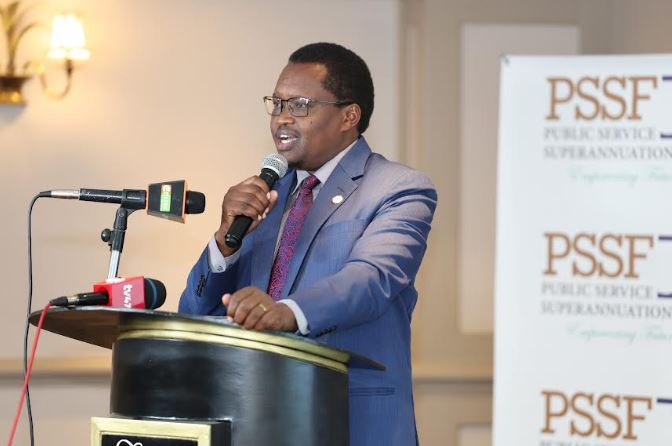
The Public Service Superannuation Fund (PSSF) has grown its membership to 529,635 and expanded its assets under management to Sh340.4 billion, five years after the contributory pension scheme began operations.
PSSF Chief Executive Officer Dr Jonah Aiyabei said the growth had been driven by increasing membership, consistent contributions and a deliberate investment strategy aimed at securing long-term retirement benefits for public servants.
Speaking during a Media Breakfast Roundtable in Nairobi on Thursday, Aiyabei said the scheme, which commenced operations on January 1, 2021, had emerged as one of Kenya’s largest occupational pension schemes.
As at June 30, 2026, teachers accounted for the largest proportion of members at 332,950, followed by disciplined services personnel-including the National Police Service, Prisons Service and NYS-at 120,084. Civil servants accounted for 60,322 members, while county governments had 16,279 members.
The Fund’s investment performance has also remained strong. It recorded a 12-month return of 17.68 per cent for the year ended June 30, 2025, while its three-year annualized return stood at 19.7 per cent.
Aiyabei said the Fund had achieved its long-term investment objective of generating returns equivalent to inflation plus four percentage points over both the 12-month and three-year periods.
PSSF has significantly diversified its investment portfolio in an effort to reduce concentration risk while improving long-term returns.
Government securities currently account for 74 per cent of the portfolio, down from 99 per cent when the scheme was established. Quoted equities account for 14 per cent, corporate bonds five per cent, offshore investments three per cent, private equity two per cent and property one per cent.
The diversification has seen the Fund increase its exposure to quoted equities, including investments in major banking and telecommunications counters.
Aiyabei said the strategy was designed to balance safety, liquidity and returns while protecting members’ retirement savings.
PSSF members have also benefited from improved investment performance where for the year ended June 30, 2025, the Board of Trustees approved a member income distribution rate of 17.89 per cent, compared with 11.9 per cent the previous financial year.
The rate represents income credited directly to individual members’ accounts. The improvement was attributed partly to recovery in financial markets, including strong performance by listed banking and telecommunications companies.
The PSSF operates on a contributory basis, with employees contributing 7.5 per cent of their basic pay while the Government contributes 15 per cent.
He said the Government had met its contribution obligations for the 2025/26 financial year, enabling the Fund to invest members’ savings without delays.
He said timely contributions were critical to the Fund’s ability to invest the money and generate returns for members.
The Fund is also seeking to shorten the time taken to process pension claims through digitization.
Aiyabei said PSSF had simplified the claims process from a lengthy documentation exercise to an online request, with the Fund working towards reducing payment timelines to less than 10 days for clear claims.
He said the Fund was targeting even faster processing in future, arguing that members’ benefits were already funded and should therefore be paid without unnecessary delays.
The reforms are part of a wider digital transformation programme that has seen PSSF convert manual processes into automated systems.
The Fund recently commissioned a pension administration system and is urging members to register on its online portal and update their records to facilitate faster and more efficient service delivery.
Meanwhile, PSSF will host its second Pan-African Pensions Conference from November 18 to 20, 2026, in Mombasa.
The conference will bring together stakeholders to discuss pension policy, retirement security, investments and emerging trends in Africa.
PSSF was established under an Act of Parliament as a statutory contributory pension scheme for public servants, including teachers, police officers, prison officers, NYS personnel and mainstream civil servants.
In five years, its membership has risen from 330,318 to 529,635.
Aiyabei said that Kenya ranks as the third-largest pension market in Africa by asset size, holding over Sh3.17 trillion ($24.5 billion). Africa is led by South Africa ($349.7 billion) and Morocco ($37 billion) in total accumulated retirement savings capital.
By Joseph Ng’ang’a