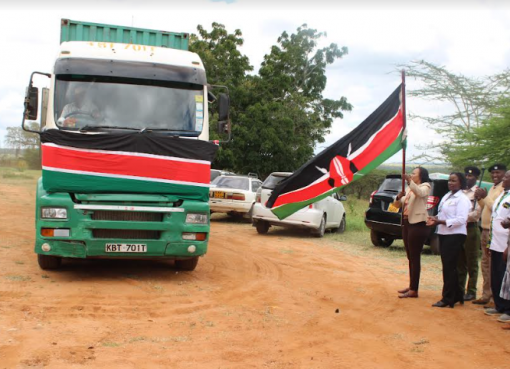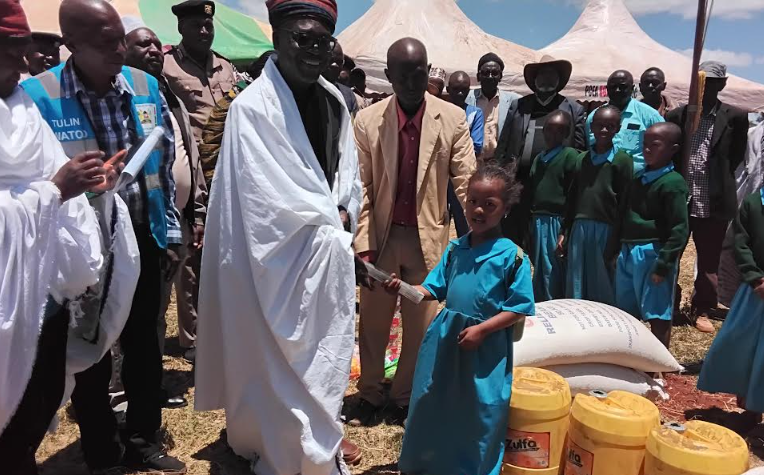
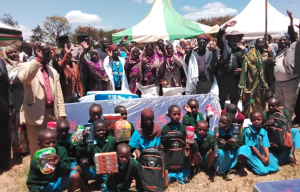
The national government, in partnership with the Oscar Junior Foundation and other stakeholders, has launched the distribution of food and non-food relief items to children and families affected by prolonged drought in Marsabit County.
The relief food distribution was launched at Boru Haro Primary and Junior Secondary School in Sagante/Jaldesa Sub-county and Bubisa Primary and Junior Mixed Day Secondary School in Turbi Sub-county.
The initiative seeks to cushion vulnerable families from the effects of the worsening drought while ensuring that children remain in school and are protected from risks associated with prolonged food and water shortages.
In a speech delivered on behalf by Secretary in the State Department for Children Services, Shem Nyakutu, Cabinet Secretary for Gender, Culture, and Children Services, Hanna Cheptumo Wendot, said the government had heard the concerns of the people of Marsabit and was responding to their needs.
The CS appreciated elected leaders for bringing the plight of affected families and children to the attention of the National government.
She acknowledged the contribution of the National and County governments, National Government Administration Officers, Children Services Officers, community leaders, and development partners, including the Oscar Foundation.
Cheptumo warned that drought should not be viewed only as a food crisis, saying it can quickly develop into a child protection crisis.
“When livelihoods are lost and families are forced to move in search of food and water, children can lose access to school, healthcare, and stable family care,” she said.
She noted that some children could become separated from their families and exposed to neglect, exploitation, abuse, and child marriage.
According to information from the State Department for Children Services, approximately 9,865 children in Marsabit County have been affected by the current situation.
Cheptumo said the figure represented more than just statistics, describing it as thousands of childhoods requiring the attention of government, development partners, communities, and well-wishers.
The relief packages include beans, rice, cooking oil, mattresses, blankets, sanitary towels, mosquito nets, and dignity kits for girls.
She said the assistance would address some of the immediate needs of affected families, restore dignity, and provide measures of stability during the difficult drought period.
However, the CS stressed that resilience cannot be built through emergency relief alone.
She pointed to the government’s Cash Transfers for Orphans and Vulnerable Children (CT-OVC) programme, saying the State Department is currently supporting 1,430 beneficiaries in North Horr Constituency and 1,196 beneficiaries in Saku Constituency.
She said such interventions were part of a wider government responsibility to ensure vulnerable families receive support not only when crises occur but also as they work to recover from their effects.
Cheptumo further revealed that 3,754 child protection cases were reported in Marsabit County during the 2025/2026 financial year through the Child Protection Information Management System.
The cases included 1,041 registration cases of destitution, 710 cases involving orphaned children, 588 cases of neglect involving children out of school, 207 custody cases, and 87 reported cases of child marriage.
She said the figure should challenge all stakeholders’ efforts to protect children.
The CS warned that economic hardship should not be allowed to determine the future of children, particularly girls who may be exposed to early marriage because of poverty.
She called for collective responsibility among government agencies, elected leaders, communities, development partners, and families in addressing the challenges facing children.
Cheptumo said prevention of child protection violations must begin within families, noting that the government is implementing the National Positive Parenting Programme.
The programme seeks to equip parents and caregivers with positive and nurturing approaches to raising children and creating safe and supportive family environments.
She urged parents and caregivers to listen to children, guide them without violence, identify risks early, and seek assistance whenever necessary.
The CS called on members of the public to report cases of missing or separated children immediately and to speak out whenever a child is facing neglect, abuse, exploitation, or child marriage.” Protection delayed can become protection denied,” she warned.
She encouraged residents to make use of existing child protection structures, including the National Child Helpline 116, which is tool-free and available 24 hours a day.
Cheptumo urged communities to work closely with children’s officers, national government administration officers, and police whenever a child is at risk.
In a speech read on his behalf by his personal assistant, Rebecca Sakana, the Marsabit Senator Chute Mohamed Said said the relief distribution demonstrated the national government’s commitment to reaching every part of the country.
The Senator said the initiative showed that no county, ward, or child should be left behind.
The Senator noted that Marsabit is rich in cultural heritage and home to resilient communities but continues to face social and economic pressures that disproportionately affect women, youth, and children.
He called for proper distribution of the relief food and non-food items to ensure that all vulnerable learners and families identified benefit, warning against the diversion of donated supplies.
Said also pledged to support the strengthening of child protection structures in the county, affirmative action initiatives, and efforts to preserve Marsabit’s cultural heritage while ending practices that harm children.
The Senator thanked the Ministry of Gender, Culture and Children Services, the Oscar Junior Foundation, and other partners for supporting vulnerable families in Marsabit.
Deputy County Commissioner for Sagante/Jaldesa and Turbi, Moses Oruma and Daniel Ouma, respectively, thanked well-wishers, Non-governmental Organization and development partners for the assistance.
They said the relief would cushion communities from harsh effects of drought and help children who had been missing in school because of hunger.
They noted that providing food to affected learners could help retain children in school and increase enrollment.
Marsabit County Police Commander, Leonard Kimaiyo, urged parents to take responsibility for the welfare of their children and ensure they attend school.
He warned that parents whose children are found out of school could be required to explain why their children are not attending school while others are in class.
Kimaiyo further reminded residents that Kenyan law protects children from all forms of harm.
He specifically warned against Female Genital Mutilation (FGM), describing it as a form of harm.
The Commander said individuals who perform FGM, as well as those who provide premises for the practice, risk prosecution.
The Kimayo urged communities to protect children’s rights and ensure their safety.
The CS said the distribution of relief items should not mark the end of the response to the drought.
She called on government agencies, elected leaders, communities, development partners, and families to remain engaged and continue monitoring the situation to identify emerging vulnerabilities and respond to them.
She urged the people of Marsabit not to allow drought to determine the destiny of a child.
“No child should have to choose between hunger and school. A girl should not be married off because her family has fallen on hard times, and a child should not be separated from their family and disappear from protection systems because a community is struggling to survive,” she said.
She said the collective response to drought must protect both families struggling today and the children who will inherit the future.
By Anthony Melly