Kenya has been urged to accelerate investment in assistive technology, local production and accessible digital services to ensure persons with disabilities can participate fully in education, employment, governance and economic activities.
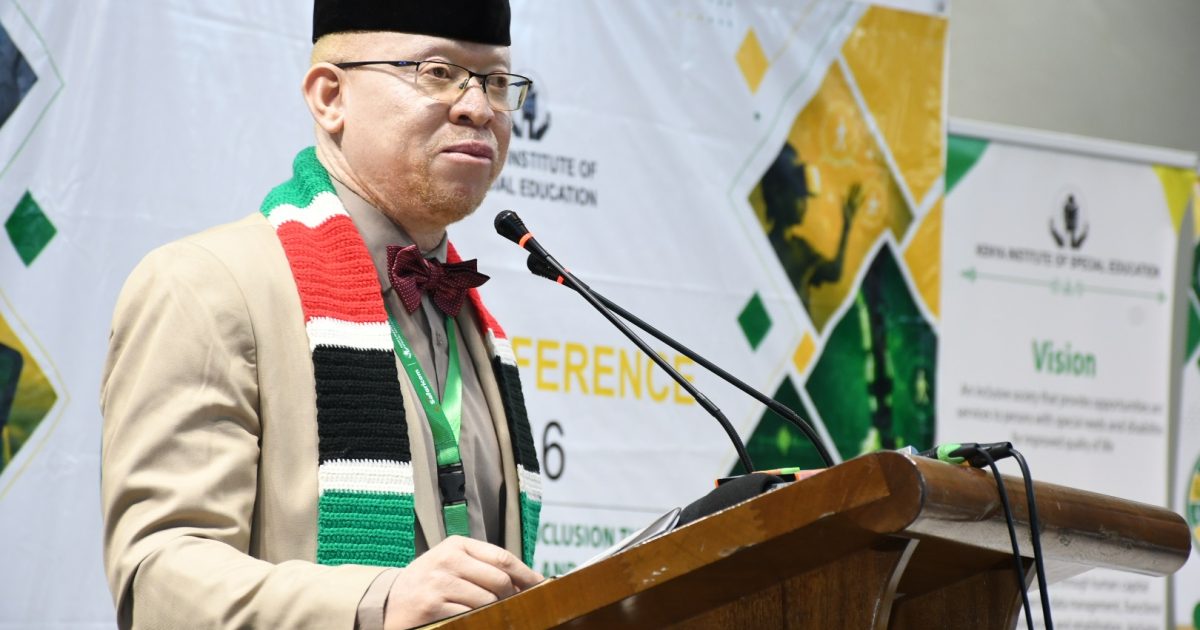
Speaking during the Kenya Institute of Special Education (KISE) 2026 Conference in Nairobi, held under the theme “Advancing Disability Inclusion through Assistive Technology and Innovation,” Dr. Isaac Mwaura, Head of the Office of Diversity, Inclusion and Disability Rights in the Executive Office of the President, said Kenya must move from diagnosing exclusion to implementing practical solutions.
Dr. Mwaura, who spoke from his personal experience as a person with albinism, said stigma and negative attitudes remained among the biggest barriers facing persons with disabilities.
“The greatest barrier to disability is not physical, it is the attitude resident in the mind of many,” he said, adding that assistive technology was not merely about hardware and software but about restoring human agency and protecting dignity.
Dr. Mwaura cited the 2022 Global Report on Assistive Technology by the World Health Organization (WHO) and UNICEF, which estimates that more than 2.5 billion people globally require at least one assistive product, while nearly one billion lack access.
He said Kenya also faced challenges in obtaining accurate disability data, noting that the 2019 Kenya Population and Housing Census recorded disability prevalence at 2.2 per cent.
The figure, he said, could reflect underreporting, stigma and weaknesses in disability data collection, warning that inadequate data could lead to interventions missing the people they are intended to serve.
Dr. Mwaura said Kenya’s legal and policy framework provided a foundation for disability inclusion, including constitutional guarantees on equality, non-discrimination and access to appropriate assistive devices.
He also highlighted the Persons with Disabilities Act, 2025, saying the legislation strengthened the legal framework on disability rights, including digital inclusion and electoral participation.
Despite the legal progress, Dr. Mwaura said the country still faced a major gap between policy and the lived experiences of persons with disabilities.
He cited an estimated 90 per cent unmet need for assistive products in low- and middle-income countries, saying many people who require wheelchairs, hearing aids and communication devices still lack access to them.
Dr. Mwaura called for the strengthening of KISE’s capacity to develop, produce, repair and maintain specialised teaching and learning materials and assistive devices locally.
He said the institution should be adequately resourced to expand its production workshops and embrace technologies such as 3D printing and local innovation to reduce costs and increase availability.
“We cannot continue relying on imported technology that breaks down and demands foreign technicians,” he said.
He also advocated for Universal Design for Learning (UDL), saying educational materials should be developed in flexible formats that enable learners with different needs to participate effectively.
Dr Mwaura further called for greater use of artificial intelligence, robotics and digital accessibility solutions to enhance mobility, communication and independence among persons with disabilities.
He said emerging technologies could help persons with disabilities overcome barriers in accessing public services, education and employment but cautioned that digital platforms must be designed with accessibility in mind.
He proposed the implementation of a Digital Inclusion Charter for Kenya and urged technology companies to involve persons with disabilities from the design stage of digital products and services.
Dr. Mwaura also raised concern over cyberbullying and online discrimination targeting persons with disabilities, saying technology should empower rather than expose vulnerable groups to new forms of exclusion.
He called for stronger representation of persons with disabilities in decision-making institutions, including Parliament, and said it was time for greater representation of Deaf people in the country’s legislative institutions.
“Persons with disabilities are claiming their space at the decision-making table,” he said.
Nairobi Woman Representative Esther Passaris said the conference should result in practical solutions that improve the daily lives of persons with disabilities rather than remaining a forum for discussions.
Passaris said KISE had demonstrated the importance of specialised education services but called for similar facilities to be established across the country.
She said her wish was to see KISE-like institutions replicated across Kenya to enable children and families access specialised services closer to their homes.
Passaris also proposed the establishment of housing facilities and a dedicated transport system near KISE to assist families whose children require long-term specialised care.
She said many families, including those in Nairobi, faced difficulties transporting children with severe disabilities to specialised facilities, making proximity to such institutions an important consideration.
The legislator said assistive devices should be affordable, properly fitted and repairable locally, while communities should have trained technicians capable of repairing equipment to prevent breakdowns from disrupting education or livelihoods.
Passaris said she would examine budgetary allocations for KISE’s proposed assistive device factory, following a request for Sh600 million to operationalise the facility.
“I will go into Parliament and look at the budgets and see what we have put. If there’s a failure somewhere there, you and I together can walk to the relevant committees and officers and see how we can have it put into supplementary,” she said.
She challenged innovators and technology companies to involve persons with disabilities from the beginning of product development and make accessibility part of the design process.
“Let artificial intelligence expand opportunity and ensure that the people themselves help shape its development,” she said.
Passaris also called for accessible learning materials and improved teacher training, saying educators and institutions responsible for teacher management should work together to ensure classrooms provide equal opportunities for learners.
She urged for assessment, guidance and support services for children with disabilities to be made available closer to families’ homes.
The Nairobi legislator further called for stronger protection of women and girls with disabilities, particularly in accessing education, healthcare and justice.
She said persons with disabilities were vulnerable to various forms of violence and discrimination and called for stronger systems to protect them and enable them to seek justice.
Passaris welcomed the call for increased representation of persons with disabilities, including Deaf people, in decision-making institutions.
“Persons with disabilities belong at the decision-making table,” she said.
She called on stakeholders to translate discussions at the conference into affordable assistive devices, accessible digital services and meaningful employment opportunities.
“Nothing about us without us,” Passaris said, urging stakeholders to innovate, include and empower persons with disabilities.
by Aron Kinyamasyo