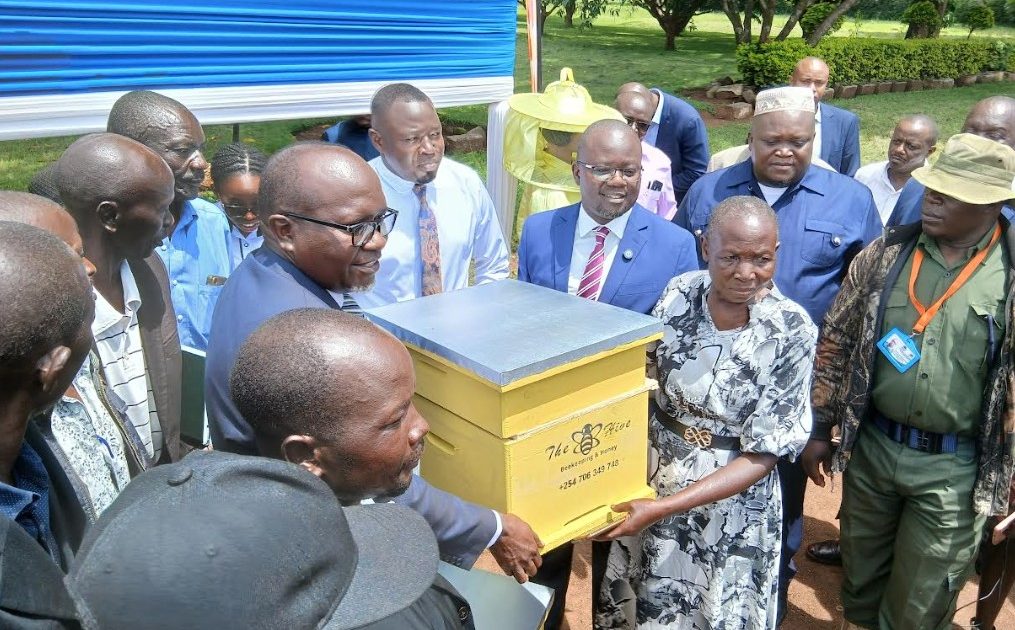
The Lake Basin Development Authority (LBDA) has partnered with The Hive Limited to implement a beekeeping project targeting more than 600 farmers in Homa Bay County.
The deal, signed at LBDA headquarters in Kisumu, seeks to support beekeepers operating within Wire Forest under the Wire Forest Management Association (WIFOMA), with a focus on boosting production, improving incomes and enhancing environmental conservation.
LBDA Managing Director (MD) Wyclife Ochiaga said the authority will spearhead the initiative by coordinating partners, providing infrastructure and ensuring farmers have access to reliable markets.
“As you are aware, our mandate is to promote and coordinate socio-economic development within the Lake Victoria catchment area. One of our roles in this arrangement is to coordinate development partners to support bee farmers,” said Ochiaga.
He said LBDA will invest close to Sh 4 million in the project, largely to support infrastructure, including the provision of 600 modern beehives.
“As an organisation, we are going to support infrastructure by availing 600 beehives to this group. We will procure them from The Hive Limited because they are the experts in developing this kind of infrastructure,” he said.
Ochiaga noted that the authority will also provide a ready market for the produce through its refinery plant in Ndhiwa, which will off-take honey and other bee products.
“We have a refinery plant in Ndhiwa and we are going to offtake honey and other products. The Hive company will also be an off-taker. So, there is enough market for the produce,” he said.
He said the partnership is anchored on a three-year renewable Memorandum of Understanding, which will allow for assessment of the project’s sustainability and the durability of the infrastructure.
“We have signed an MOU of three years, renewable. This period will help us assess whether the infrastructure will still be stable,” he said.
The MD added that the project will serve as a pilot, with plans to scale it up to other parts of the region once it proves successful.
“In Homa Bay we have already identified farmers. We are working towards identifying some in Kisumu, in the western counties and also parts of the Rift Valley. This is an ongoing exercise,” he said.
Ochiaga further linked the initiative to national environmental conservation efforts, noting that apiculture thrives in well-preserved ecosystems.
“Another thing that we do is conservation of natural resources, where the greening programme comes in. There is a national campaign to plant 15 billion trees, and 30 per cent of these are expected to be fruit trees,” he said.
He explained that fruit trees play a crucial role in supporting bee forage and sustaining production.
“For beekeeping, fruit trees provide critical raw materials for bees. We are developing tree nurseries at our offices and regional centres and working with communities to build their capacity to support this effort,” he added.
The Hive Limited CEO Christopher Nzuki said farmers will receive hands-on training on modern apiculture practices, including site selection, hive installation and harvesting techniques to minimise losses and protect bee colonies.
“We are going to offer training to farmers and guide them on practical aspects of producing quality bee products,” he said.
He added that farmers will be supported to produce a range of high-value products, including honey, pollen, propolis, royal jelly, wax and bee venom.
According to Nzuki, the diversity of bee products presents significant income potential for farmers.
“For example, honey goes for between Sh. 350 and Sh. 500 per kilogramme, while royal jelly is bought at Sh. 33,000 per kilogramme. Pollen is about Sh2,800 per kilogramme,” he said.
By Chris Mahandara