The Retail Trade Association of Kenya (RETRAK) has raised a national alarm over the surging volume of illicit trade, warning that counterfeit and smuggled products are threatening consumer safety, crippling compliant businesses, and draining billions of shillings from the national treasury.
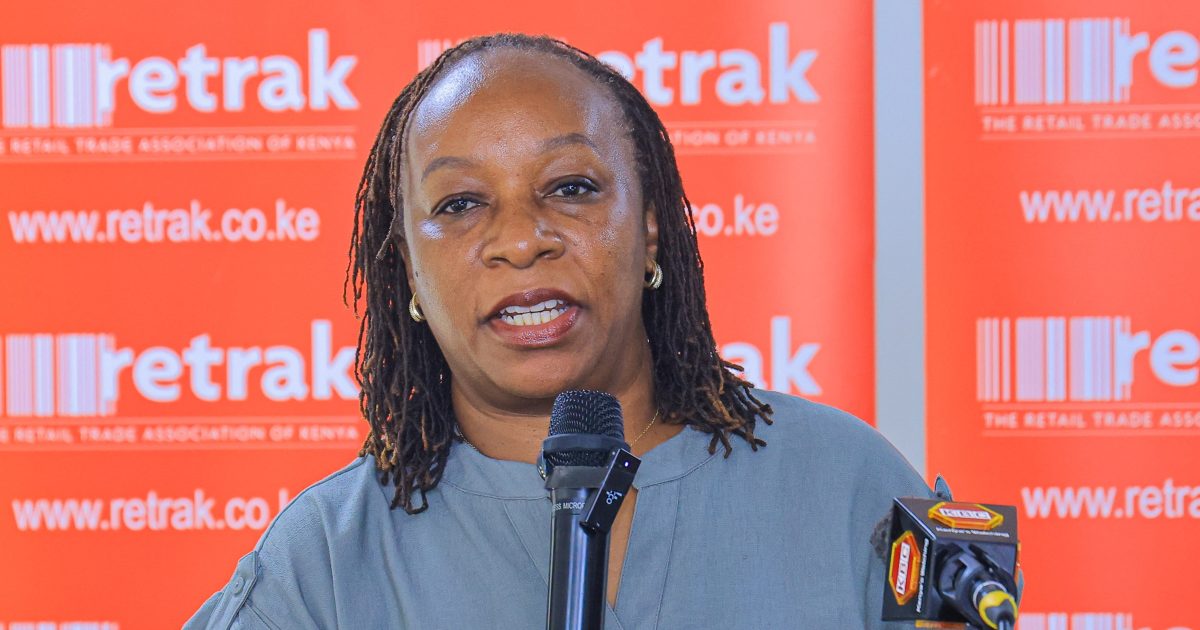
Speaking during a press briefing in Nairobi, RETRAK Chief Executive Officer (CEO) Wambui Mbarire called for an immediate shift in enforcement strategy, urging state authorities to target multi-million-shilling supply networks at their origin rather than focusing primarily on retail shopfronts.
She noted that illicit trade is no longer confined to hidden markets but has infiltrated everyday commerce across cigarettes, alcohol, cosmetics, clothing, and motor vehicle spare parts.
“We cannot build a competitive economy while allowing illicit trade to undermine legitimate businesses. We cannot continue asking legitimate businesses to comply with increasingly demanding regulations while allowing illegal operators to enjoy an unfair competitive advantage,” the CEO declared.
Notably, the Association highlighted alarming statistics outlining the scale of market penetration across critical commercial sectors.
Citing research by Kantar, RETRAK noted that illicit cigarettes accounted for 45.1 per cent of Kenya’s market in 2025, up from 34.1 per cent in 2021. This equates to approximately 1.9 billion illicit units consumed in a single year, resulting in an estimated Sh10.2 billion in lost excise duty and VAT in 2025 alone, bringing total lost tax revenue between 2021 and 2025 to Sh47 billion.
Further, the situation in the alcohol sector remains equally severe. Figures from the Anti-Counterfeit Authority (ACA) indicate that illicit alcohol represents roughly 59 per cent of total consumption volume, costing the economy Sh71 billion annually while posing deadly public health risks.
On the other hand, overall counterfeit penetration averages 18 per cent across surveyed sectors, rising to 21 per cent for automotive spare parts and 19 per cent for alcoholic beverages.
To this regard, Mbarire stressed that compliant retailers bear the burden of high regulatory costs, licensing fees, and tax obligations, only to be undercut by illegal operators selling untaxed goods at drastically lower prices.
She emphasised that when legitimate businesses lose market share, jobs and household incomes are threatened, adding that a counterfeit vehicle spare part or illicit alcoholic drink carries fatal consequences for consumers.
While acknowledging ongoing efforts by the Kenya Revenue Authority (KRA), ACA, Kenya Bureau of Standards (KEBS), and the National Police Service, the CEO reiterated that seizing goods at the retail level fails to address the root causes of the crisis.
To address the problem, the Association outlined five priority interventions, including establishing a structured, intelligence-led inter-agency team combining KRA, ACA, KEBS, and police forces; focusing enforcement upstream on manufacturers, importers, and financiers; equipping retailers with digital authentication tools; strengthening public-private intelligence collaboration; and introducing public metrics to track supplier prosecutions and recovered revenue.
“Enforcement must move beyond the retail shelf. When illicit products are discovered in a shop, investigations should not end with the retailer. We must establish who manufactured or imported those products, who distributed them, and how they entered the legitimate supply chain,” urged Mbarire.
Meanwhile, RETRAK reiterated that its members remain committed to exercising due diligence across their inventory operations but called on the government to treat retailers as strategic partners in restoring integrity and fairness to the national marketplace.
By Zipporah Odionyi