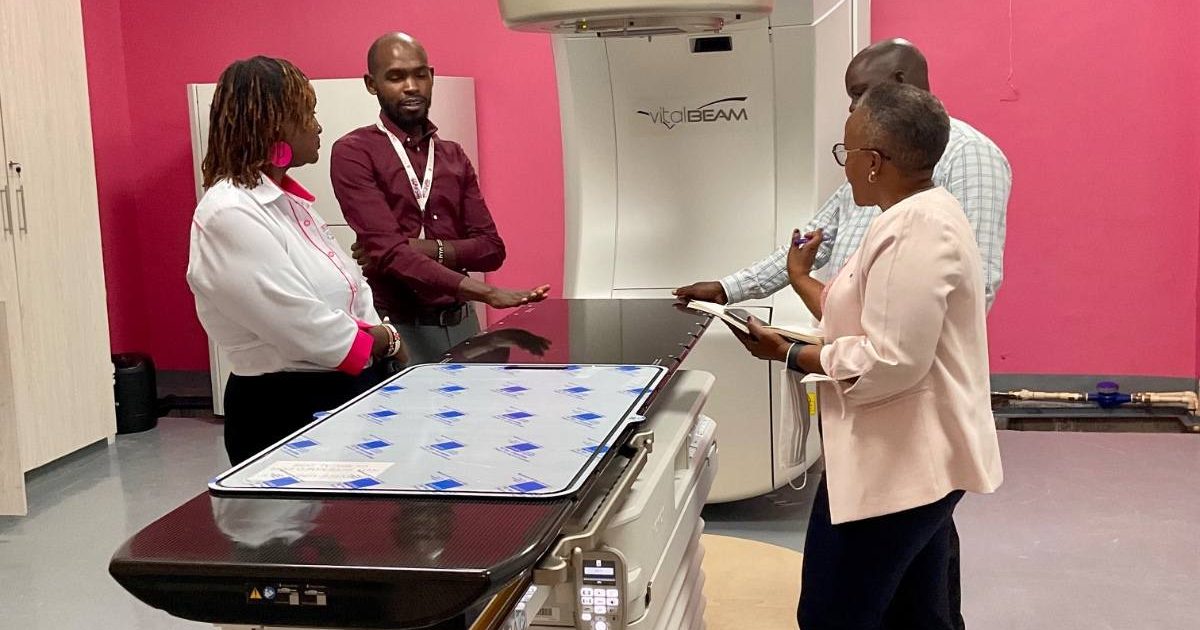
Nakuru County is in the process of installing its third high-tech cancer diagnosis and treatment machine that will enhance treatment efficiency by reducing radiotherapy treatment side effects.
The County Executive Committee Member (CECM) in charge of Health Services Ms Roselyn Mungai said the equipment donated by the International Atomic Energy Agency (IAEA) through the Ministry of Health would enhance oncology services for patients across the region.
She explained that the Linear Accelerator (LINAC) radiotherapy machine was designed to treat a broad spectrum of cancers adding that the equipment would offer high-energy X-rays through linear accelerators that help burn cancerous cells much faster compared to cobalt units, which have previously been in use.
According to Ms Mungai, cancer patients would spend less time undergoing radiotherapy treatment after the installation of new technology that shortens the average session by half.
Noting that Governor Susan Kihika’s administration remains actively engaged with the National Government to secure sustained support for the Cancer Centre, the Health Executive elaborated that the new technology would not only serve Nakuru County but also neighbouring counties.
“Efforts are underway to ensure optimal staffing for the efficient operation of LINAC machines, further strengthening service delivery,” stated Mungai.
She was happy that the new technology had fewer side effects as it only targets the cancerous cells and explained that the old technology burnt normal cells together with harmful ones, leading to longer healing periods, nausea and unnecessary weight loss.
While indicating that the Cancer Centre at the Nakuru Teaching and Referral Hospital currently serves at least 60 patients per month, the CECM explained that unlike the usual radiation therapy equipment, this latest model offers precision by directing the rays to the actual tumor.
Ms Mungai said the new technology would treat the cancer with high doses of radiation while sparing other structures of the body by basically hitting the tumor hard while minimizing side effects.
The CECM indicated that the new equipment offers radiation within three minutes compared to the old model where a patient had to spend almost 40 minutes under the machine.
“With this advancement, there is less anxiety experienced by patients. This also means you can handle a bigger volume of patients depending on the number of staff,” she pointed out.
The new LINAC technology also employs VMAT (Volumetric Modulated Arc Therapy) and IGRT (Image Guided Radiotherapy) which cannot allow a radiologist to do any radiation before an image is taken to determine the patient’s progress hence reducing incidences of error as much as possible, added the County Health Executive.
She said the LINAC equipment would enable better accuracy in tumour targeting by oncologists with the protection of the critical surrounding structures hence improving the treatment outcomes for patients and reducing radiotherapy treatment side effects.
Saying that the new machine would be instrumental in bridging the quality and accessibility of proper health care for cancer patients, Ms Mungai assured cancer patients of the best treatment outcomes adding that the machine would also reduce the overall patient sufferings while undergoing the treatment.
She also assured patients that the new technology would ensure they access the best outpatient oncology care in the country and the entire region.
Most oncology units in private and public facilities have solely been relying on Cobalt-60 radiotherapy machines before gradually embracing digital Linear Accelerator Machines (LINAC) which have gained popularity worldwide due to their advanced features.
With a cobalt machine, the radioactive element (cobalt) releases gamma rays which are used to destroy cancer cells. Since the rays are emitted as the cobalt gradually decays, the amount of radiation released decreases over time. The radiation dose is high when the cobalt is “new”, but as it ages, the dose decreases, Ms Mungai further explained.
If the machine initially offered radiotherapy treatment to patients for 20 minutes, doctors would gradually increase the duration in order to attain the required dose, Ms Mungai explained and added that this had contributed to the long queues at oncology facilities.
She added that hospitals using this technology were required to change their radiation source (cobalt) after five years. The LINAC machine, on the other hand, she said uses electricity to produce x-rays which destroy cancer cells.
Ms Mungai explained that since its energy levels are higher, the LINAC machine is better suited for treating deep-seated cancerous tumors than the Cobalt one. It also has electron beams which enable doctors to adequately treat superficial tumors without harming organs such as the liver, lungs and kidneys. Tumors
The beams can be used to treat cancers found in various skin regions. It also treats tumours that affect limbs such as melanoma and lymphoma. The CECM noted that the high-tech LINAC machines protect patients from adverse effects of radiation treatment.
A survey by the MOH indicated that cancer was the third leading cause of death in Kenya after infectious diseases and cardiovascular diseases accounting for 8 per cent of overall mortality with 42,000 cases and 27, 000 deaths annually.
The study also revealed that the majority of cancer patients are diagnosed at late stages when treatment outcomes are poor and therefore, thousands of people succumb to cancers that would often be treatable.
By Esther Mwangi and Mary Ochieng