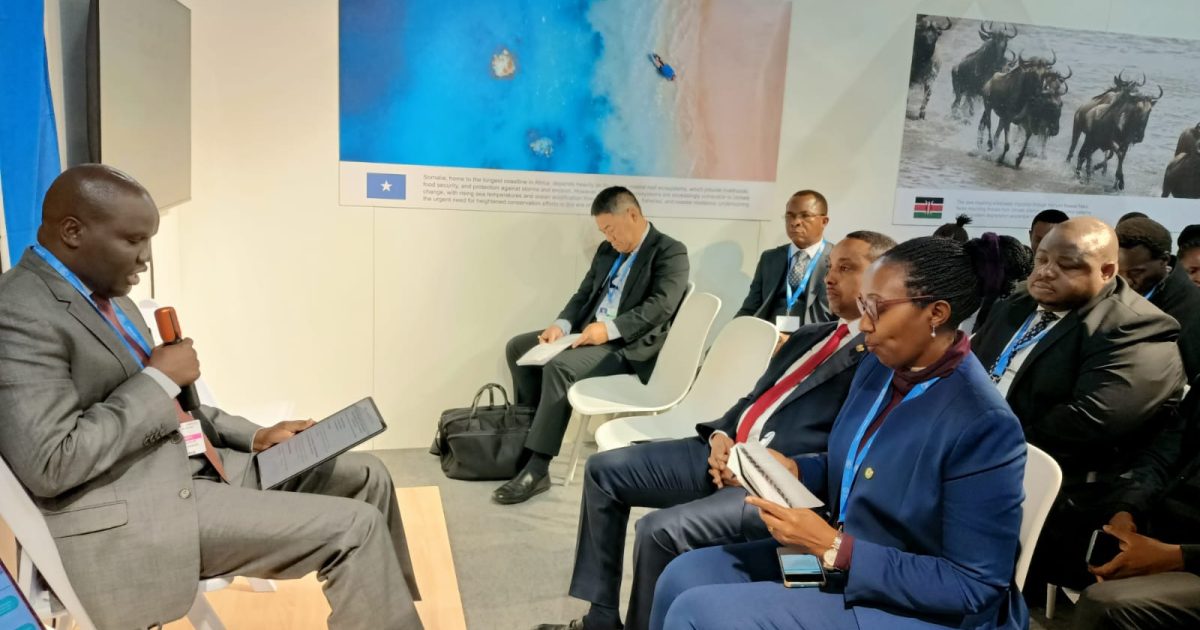
The East African Community (EAC) delegation has arrived in Belém, Brazil, to present a united regional position at the 30th United Nations Climate Change Conference (COP30).
Head of the delegation, EAC Deputy Secretary General in charge of Infrastructure, Productive, Social and Political Sectors, Andrew Ariik, said the regional bloc is participating in the global climate summit to champion East Africa’s collective commitment to climate resilience, transboundary cooperation, and sustainable development.
“COP30 is a defining moment for East Africa to demonstrate that regional cooperation is key to building climate resilience. Our unified position ensures that Partner States speak with one voice on the global stage, showcasing shared priorities and common solutions,” Ariik said in an interview with KNA.
The EAC delegation, representing all eight Partner States, he said, has taken to the global stage under one banner focusing on four key priorities: scaling access to climate finance for Least Developed Countries and vulnerable communities, advancing nature-based solutions to enhance community resilience, strengthening transboundary water cooperation in shared basins such as Lake Victoria and Lake Tanganyika, and accelerating implementation of nationally determined contributions (NDCs) through regional coordination.
Ariik said these priorities were consolidated during a preparatory experts’ meeting organized by the EAC with support from the German Development Cooperation (GIZ), which harmonized positions of the Partner States ahead of the global talks.
He noted that East Africa’s participation demonstrates not only the region’s vulnerability to climate change but also its leadership in crafting data-driven, sustainable responses to the crisis.
A major highlight of the EAC’s presence at COP30 is the unveiling of the Preview Edition of the Lake Victoria State of the Basin Report 2025, prepared by the Lake Victoria Basin Commission (LVBC) with support from GIZ.
The report provides comprehensive insights into the ecological health, socio-economic conditions, and governance of the Lake Victoria Basin, which supports more than 45 million people across five partner states.
Ariik said the EAC stand at COP30 will also showcase flagship programmes in renewable energy, sustainable agriculture, and biodiversity conservation aligned with the EAC Climate Change Master Plan (2023–2033).
“Our goal is to amplify East Africa’s voice in global climate negotiations and ensure that the region benefits fairly from climate finance and technology transfer,” he said.
“This is East Africa’s moment to show that when we work together, we can deliver tangible results for our people and for the planet,” he added.
According to LVBC Executive Secretary Dr. Masinde Bwire, the report is a key policy instrument that will inform planning, investment, and cross-border cooperation in managing the shared resource.
“The State of the Basin Report provides evidence-based insights that are critical for policy and action,” Dr. Bwire said. “It strengthens transboundary cooperation and supports communities who depend on Lake Victoria for their livelihoods.”
The report also highlights the contribution of German Technical and Financial Cooperation through the €60 million Lake Victoria Basin Integrated Water Resource Management Programme, financed by BMZ via KfW.
The programme has supported the establishment of the Water Information System (WIS), a digital platform for data collection and analysis to guide decision-making in basin management.
Speaking on behalf of the Federal Ministry for Economic Cooperation and Development (BMZ), Julia Kronberg, Head of Development Cooperation in Tanzania and the EAC, emphasized the importance of data-driven climate action.
“Germany is proud to partner with the East African Community in promoting data-driven climate action,” she said, adding, “The Basin Report will serve as a basis for selecting and financing green infrastructure, cross-border water management, and climate adaptation projects,”.
Kronberg, commended the partnership with EAC, saying Germany remains committed to supporting regional efforts in sustainable water management and climate adaptation.
As world leaders, scientists, and advocates converge in the heart of the Amazon — a global symbol of environmental stewardship — the EAC delegation is positioning East Africa not as a passive recipient of aid but as a proactive contributor to global climate solutions.
By Chris Mahandara