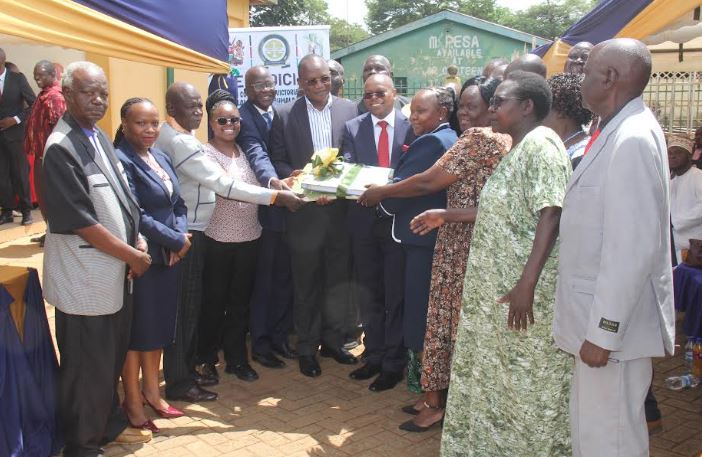
The judiciary has launched Alternative Justice System (AJS) registries in Busia County in a move aimed at enhancing access to justice and reducing the growing backlog of cases in the county’s four courts.
Speaking during the launch at the Busia Law Courts on Wednesday, Chairperson of the National Steering Committee on the Implementation of the AJS Policy (NaSCI-AJS), Justice Prof. Joel Ngugi, noted that a significant number of Kenyans rely on alternative mechanisms to resolve disputes rather than formal courts.
“Research shows that only 17 per cent of Kenyans seek justice through courts, while 19 per cent have no access to justice at all despite having grievances. The remaining 64 per cent turn to alternative justice systems. If we are to achieve meaningful social and economic transformation, we must work towards reducing this justice gap from 19 per cent to zero,” he said.
Justice Ngugi urged the Judiciary, in collaboration with the Busia County Government, to develop a County Action Plan to guide the implementation of AJS, saying it will play a critical role in improving justice delivery at the grassroots level.
“We have now established 27 AJS registries across the country. Busia County alone has four at Busia Court, Butula Court, Port Victoria Court, and Malaba Court, making it the only county in the Western region with such a presence.
This is a clear step towards expanding and strengthening access to justice and redefining how justice is administered in our country,” he added.
He observed that the formal judicial system has not fully served all citizens due to various barriers, emphasizing that AJS offers a complementary approach that is more accessible, timely, and culturally responsive.
“AJS is about providing additional pathways to justice that uphold dignity and are responsive to community needs. It ensures disputes are resolved in a timely and inclusive manner while still adhering to the Constitution,” he said.
However, Justice Ngugi emphasised that AJS must strictly operate within the legal framework, noting that certain cases, including sexual offences, will not be handled under the system.
“The first step for all AJS practitioners is to understand and uphold the Constitution. The system must observe the two-thirds gender rule and remain voluntary. Serious offences such as sexual crimes will continue to be handled by formal courts,” he stated.
The principal judge of the High Court, Justice Eric Ogolla, described the launch as a major milestone in the country’s journey towards a more inclusive, accessible, and people-centered justice system.
“This initiative will enhance access to justice by providing fair, timely, and effective dispute resolution mechanisms. By opening multiple pathways to justice, we are ensuring outcomes that are not only legally sound but also responsive to the realities of our communities,” he said.
Justice Ogolla added that AJS complements the formal court system by reducing case backlog, while promoting reconciliation and social cohesion within communities.
“This is a recognition that justice can and should be delivered through multiple channels. However, all AJS processes must strictly adhere to the Constitution and uphold fundamental rights. Justice must be fair, consistent, and in line with the rule of law,” he emphasised.
He further warned that failure to follow constitutional principles while implementing AJS could undermine public confidence in the justice system.
“These safeguards are essential to ensure that AJS strengthens rather than weakens the administration of justice,” he said.
Justice Ogolla also reaffirmed the Judiciary’s commitment to working closely with community elders, local leaders, civil society organisations, and other stakeholders to ensure the successful implementation and acceptance of AJS across the country.
Busia Deputy Governor Arthur Odera called for increased investment in mentoring and sensitizing young people on alternative justice systems to build trust and confidence in the mechanism.
“We must bring young people on board, build their confidence in AJS, and ensure communities trust the system as a legitimate avenue for justice. It must be a system that delivers justice, not one that is used to conceal wrongdoing,” he said.
He raised concern over the rising cases of sexual and gender-based violence in the county, attributing it to lack of justice for victims and prevalence of out-of-court settlements.
“We are witnessing increasing cases of defilement and rape, yet many victims do not receive justice due to cover-ups and informal settlements.
This leaves perpetrators unpunished and encourages further offences. We need firm action and stronger enforcement to address this challenge,” he said.
By Salome Alwanda and Rodgers Omondi