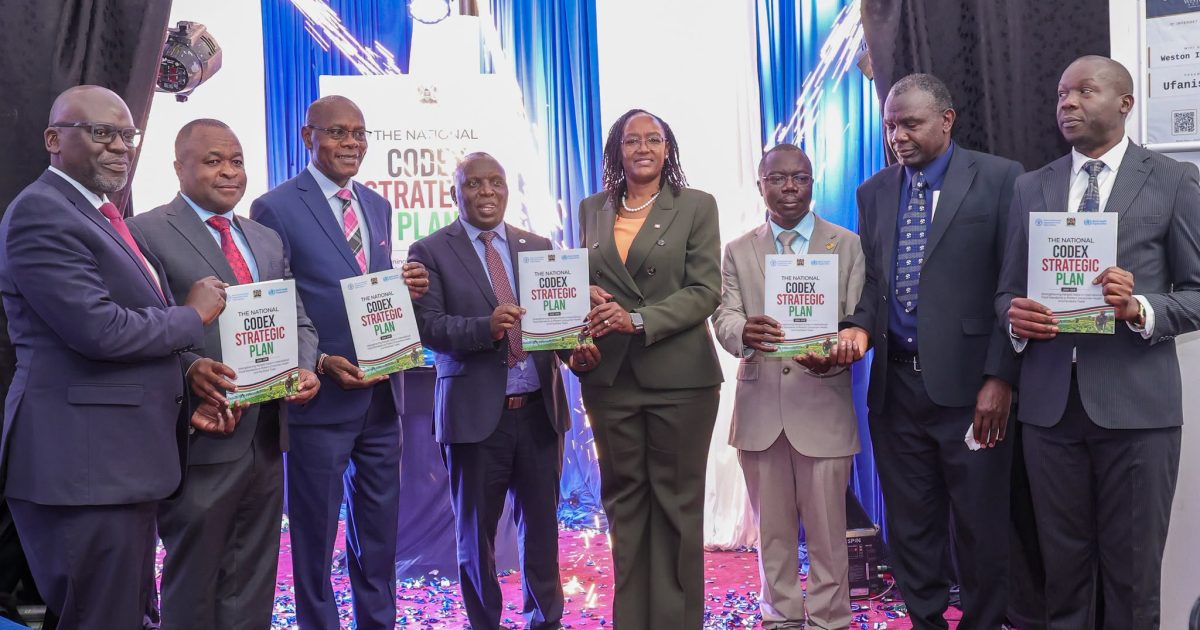
Kenya has taken a major step towards strengthening its food safety systems following the launch of a five-year strategic plan by the Kenya Bureau of Standards (KEBS).
The new National Codex Strategic Plan 2026–2031 seeks to safeguard consumer health against unsafe food, strengthen national food control systems, trade and enhance Kenya’s influence in the international food standards stage.
The framework will guide efforts to tackle emerging food safety challenges, strengthen scientific capacity and ensure locally produced foods meet international standards, while positioning Kenya as a key player in shaping global food safety policies.
Speaking during the National Codex Committee (NCC) High-Level Policy Makers Breakfast Meeting in Nairobi, KEBS Director General Esther Ngari said the strategy, whose implementation is estimated to cost Sh760 million, aims to strengthen Kenya’s capacity to address emerging food safety challenges affecting food chain ecosystems.
She said the plan would ensure that internationally recognised food safety standards are adopted and effectively implemented locally, protecting consumers, facilitating trade and boosting confidence in Kenyan food products.
Ngari called for stronger multisectoral coordination, increased investment in scientific research, enhanced technical capacity and closer collaboration among government agencies, the private sector, research institutions and development partners.
She noted that food standards were central to national development, particularly in protecting consumers from unsafe food, promoting fair trade and enabling Kenyan agricultural producers and processors to access international markets.
“Food safety is both a public health responsibility and an economic imperative that we cannot move without, so that is why Codex matters to Kenya,” she said.
DG explained that Kenya’s participation in the Codex Alimentarius Commission, the international body responsible for developing food standards, had evolved over the years from ordinary participation to regional and global leadership.
Kenya joined the commission in 1969 and subsequently assumed key roles including regional leadership responsibilities, between 2015 and 2021 through the FAO/WHO Coordinating Committee for Africa.
Between 2021 and 2024, the country served as vice-chair of the Codex Alimentarius Commission before progressing to its current chairmanship.
Ngari said the progress demonstrated Kenya’s growing influence in international food standards development and presented an opportunity to translate that leadership into tangible benefits for local consumers and businesses.
She said the new strategic plan would provide a structured framework for strengthening the country’s participation in international negotiations and ensuring that decisions made at the global level inform national food safety policies.
The five-year framework is anchored on three strategic pillars: science-based standards, strengthened National Codex Committee management systems and sustainable practices.
Under the first pillar, Kenya intends to strengthen its technical contributions to international food standards development, improve scientific risk assessments and accelerate the adoption of relevant Codex standards into national regulations.
The country also targets 100 per cent submission of relevant national positions and responses to applicable international calls for food safety data by 2031.
Other targets include training at least 160 food safety experts and undertaking at least seven commodity-based risk assessments beginning in 2027.
The second pillar focuses on strengthening institutional coordination, governance and accountability within the National Codex Committee.
Ngari said effective participation in international standards-setting processes required commitment from institutional leaders, particularly chief executives responsible for allocating resources and providing policy direction.
She challenged government agencies represented in the committee to establish dedicated budgetary allocations for Codex activities to ensure that Kenya’s international obligations were adequately supported.
The Director General observed that institutions could not effectively participate in international meetings, technical consultations and scientific assessments without making corresponding financial provisions.
She said the strategic plan would require approximately Sh760 million, equivalent to about US$5.9 million, to implement over the five-year period.
The funding is expected to come through government budgetary allocations, development partner support, private sector contributions and strategic partnerships.
Ngari urged government institutions to mainstream Codex activities into their annual budgets, noting that sustained financing would be essential in achieving the plan’s objectives.
She also called on development partners, including the Food and Agriculture Organization (FAO) and Trademark Africa, to support technical capacity-building, scientific research, risk assessments and Kenya’s participation in international standards-setting processes.
The private sector was similarly urged to contribute through partnerships and appropriate financing mechanisms.
Under the third pillar, the strategic plan seeks to integrate sustainability considerations into Kenya’s food safety agenda.
This will include addressing climate change-related food safety risks, antimicrobial resistance, emerging technologies and promoting sustainable food production and processing practices.
Ngari said the country was targeting the integration of sustainability considerations into all national food standards by 2031.
She emphasised that food safety challenges required coordinated action across different institutions and sectors, including national and county governments, industry players, academia, research organisations and consumer representatives.
The plan also establishes three enabling foundations: institutional and risk assessment capacity, technology adoption, and stakeholder engagement.
To strengthen accountability, implementing institutions will be required to submit quarterly performance and resource mobilisation reports, while annual reviews will assess progress against the established targets.
Meanwhile, the committee revealed that Kenya had submitted 58,000 data points on aflatoxins in cereals and cereal-based foods to the Joint FAO/WHO Expert Committee on Food Additives (JECFA).
The DG said the data would contribute to the international scientific evidence base used in assessing food safety risks and developing appropriate standards.
The submission reflects the work of the National Codex Committee in generating and sharing scientific information to support international food standards development, particularly on the management of aflatoxins in nuts and cereals in Kenya.
The committee affirmed that aflatoxin contamination remains a significant food safety and public health concern, with implications for food security, consumer health and access to international markets.
The policy recommendations are intended to strengthen surveillance, prevention and control measures through coordinated interventions involving regulatory agencies, agricultural institutions, research organisations and industry stakeholders.
Ngari said the success of the strategic plan would ultimately depend on the willingness of participating institutions to move beyond commitments and invest in practical interventions.
She maintained that Kenya’s growing international leadership in food standards-setting must be matched by stronger domestic systems capable of protecting consumers and supporting the competitiveness of local producers.
The National Codex Strategic Plan 2026–2031 is expected to provide the framework for coordinating these efforts and strengthening Kenya’s contribution to global food safety standards.
By Ian Chepkuto