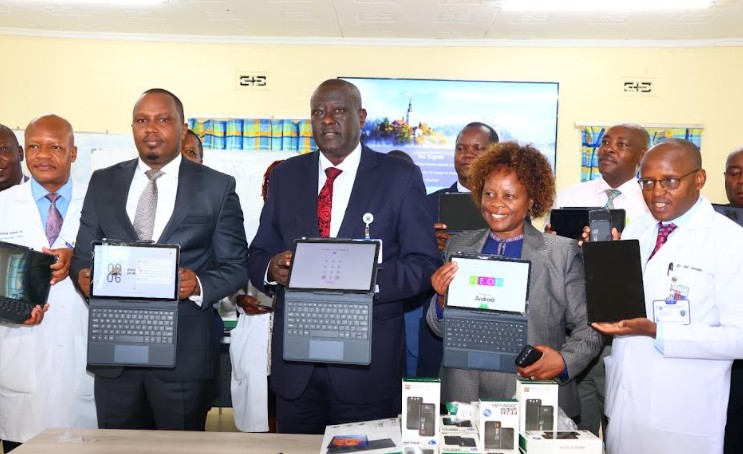
Kenyatta National Hospital (KNH) has launched a new digital health system aimed at transforming patient care through automation, faster service delivery and improved efficiency.
The system, known as the Taifa Afya Apex platform, will digitise and integrate all hospital services, marking a major milestone in Kenya’s healthcare modernisation agenda.
Speaking during the launch at the facility, Kenyatta National Hospital Chief Executive Officer (CEO) Dr. Richard Lesiyampe affirmed that the platform will eliminate manual processes and ensure seamless management of patients from admission to discharge.
“This system will automate, digitise and computerise all our services. What it means is that we are going to have the journey of a patient, from registration to triage, to admission, to laboratory services, radiology and imaging, all handled electronically without a patient carrying paper,” Dr. Lesiyampe explained, saying the move is expected to significantly reduce delays in treatment and improve patient outcomes.
According to the CEO, the digitisation process will enable faster interventions by healthcare providers, ultimately saving lives.
“This is going to bring fast treatment to our patients and very quick interventions, which will help us save lives, which is the core purpose of this institution,” he added.
Notably, the launch of the system was supported by the Digital Health Authority, which is spearheading the automation of healthcare services across the country.
Further, the Authority is working to ensure that all health facilities adopt digital solutions to enhance service delivery and data management.
On the other hand, Dr. Lesiyampe noted that the Taifa Afya Apex system will also strengthen referral services, positioning the hospital to better serve patients from across Kenya and the wider region.
As a national and regional referral facility, the CEO stated that Kenyatta National Hospital receives patients from lower-level hospitals, and the new system will allow seamless sharing of patient data.
“We will be able to access information about our patients from wherever they are coming from, whether level 4 or level 5 hospitals. This will make it easier for our doctors and specialists to intervene on time,” he elaborated.
Additionally, Dr. Lesiyampe pointed out that the integration of patient data is expected to improve coordination of care and reduce duplication of tests and procedures.
In addition to clinical services, he mentioned that the platform will also automate key administrative and operational functions within the hospital, including enterprise resource planning (ERP), procurement, financial management and human resource systems.
Equally, the CEO expressed confidence that the automation of these processes will minimise human interference, enhance accountability and improve efficiency in resource utilisation.
“We believe this system will help us eliminate unnecessary human intervention in most instances. It will also improve our revenue streams and ensure better management of commodities and equipment within the facility,” he assured.
Meanwhile, Dr. Lesiyampe observed that the system is unique in that it has been developed internally by the hospital’s staff, making it a homegrown solution tailored to the institution’s specific needs.
He disclosed that doctors, nurses, radiologists and other healthcare professionals were actively involved in designing the platform to reflect real patient experiences and workflows.
“This is a homegrown system. It is not an off-the-shelf product. Our own staff have been involved in developing the procedures and activities that patients go through. We identified pain points and designed solutions based on our realities,” maintained the CEO.
Similarly, Dr. Lesiyampe said the development process ensured that the system addresses critical gaps in service delivery while enhancing user experience for both patients and healthcare providers.
He at the same time, described the launch as historic, emphasising that the system represents a significant step towards achieving a fully digital healthcare ecosystem.
“The platform will set a benchmark for other health facilities in Kenya and beyond,” established the CEO.
In addition, Dr. Lesiyampe reaffirmed that the Taifa Afya Apex system aligns with the government’s broader agenda of leveraging technology to improve public service delivery, particularly in the health sector.
With the new system in place, the CEO reported that patients at Kenyatta National Hospital can expect faster, more efficient and coordinated care, while healthcare workers will benefit from improved access to information and streamlined workflows.
Likewise, he reiterated the hospital’s commitment to innovation and continuous improvement in healthcare delivery, noting that the digital transformation journey will be ongoing.
“This is a great milestone for us. It is a historic moment and a system that truly belongs to us,” Dr. Lesiyampe pronounced.
By Celestine Lomolijah