Minority communities in the coastal county of Kwale are calling for greater recognition with demands for inclusion in political appointments, equitable resource distribution and protection of their rights.
The minorities said they have endured decades of historical injustices and marginalisation citing their exclusion from the national and county government appointments.
Ethnic minorities are distinct communities within the population that are numerically smaller and socially, politically and economically disadvantaged in comparison to dominant communities in a given context.
Globally the protection and inclusion of ethnic minorities and marginalized communities is recognised as essential for achieving equitable development, social justice and sustainable peace.
Minority communities living in Kwale include the Makonde, Washirazi, Wapemba, Rundi, Tswaka and Wavumba with a notable presence in Msambweni and Lunga Lunga constituencies.
Most of them like the Makonde and the Pemba were recently granted citizenship and offered identity cards ending decades of statelessness.
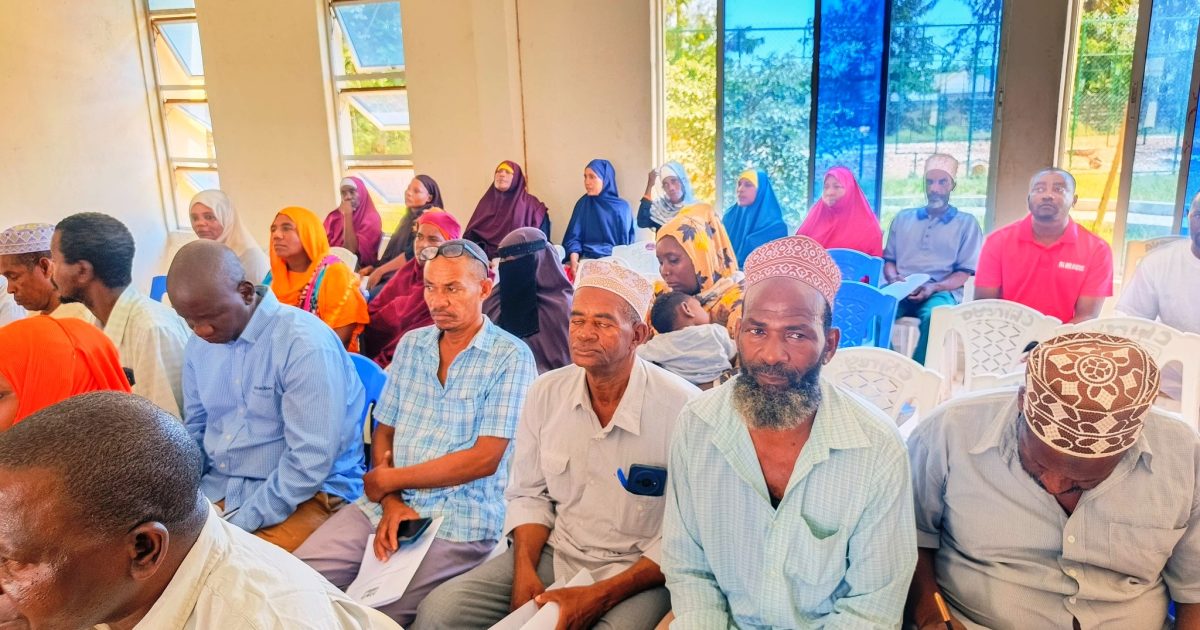
The minority groups were speaking at Mvindeni social hall in Msambweni constituency during a public participation forum on the National Draft Policy on Ethnic Minorities and Marginalised Communities in Kenya.

Speaker after speaker at the forum said they have come together to advocate for greater unity and tolerance among all ethnic groups, recognising that no ethnic group is superior to another.
The countywide forums are spearheaded by the Minorities and Marginalised Affairs Unit (MMAU) under the Executive Office of the President.
The Team was led by George Tarus, an attorney in the Executive Office of The President who received petitions and memoranda from members of the public on the different issues highlighted in the bill and policy.
Tarus said every voice and every story especially from the minority and marginalized communities is shaping Kenya’s promise of inclusion.
The legal expert said the 2010 constitution marked a turning point by affirming the rights of all citizens and explicitly recognising the need to protect and empower minority and marginalized communities.
“This policy therefore responds to the continued exclusion of ethnic minorities and marginalized communities by establishing a comprehensive, rights-based framework to address historical injustices and bridge implementation gaps,” he said.
Tarus said for decades minority ethnic groups across Kenya have been struggling for equality, fairness and full participation in the baking and sharing of the national cake.
“We must collectively remember that it is our diversity that enriches us as a nation and that each ethnic group contributes uniquely to our cultural, political, and social landscape,” said Tarus.
The minority communities want Kenyans to acknowledge that they are equal stakeholders in Kenya and want the county and national government to end alleged ethnic bias in public appointments.
Chairman of the Makonde community Thomas Nguli expressed concern alleging that the minorities in the coastal region are still perceived as aliens unworthy of recognition even after they have transitioned from statelessness to citizenship.
Nguli welcomed efforts by the national government to integrate minorities fully into mainstream society noting for Kenya to grow and thrive it must prioritize inclusivity.
The Mkonde community spokesman underscored the need for minorities to maintain their cultural identity and have control over their communal lands, heritage and resources.
Nguli was instrumental in the fight for citizenship for the Makonde, which was granted in 2017, ending decades of statelessness for the community.
The Makonde came to Kenya from Mozambique as labourers during the British colonial period and later as the descendants of exiled freedom fighters during Mozambique’s civil war.
But, although many Makonde families have been in Kenya since before independence in 1963, they were not recognised as citizens. But in 2016 they were officially recognised as citizens of Kenya and recognised as the country’s 43rd tribe.
Ibrahim Ahmed of Ustawi Imara Africa, a human rights organisation, said minorities should be given room for participation as equal partners in the devolved system of governance.
“The devolved governments in Kwale, Mombasa and Kilifi where the majority of the members of the Pemba, Shirazi and Makonde communities are found have not fully embraced the minorities,” he said.
He went on: ‘we still face discrimination in public appointments despite being equal partners in the devolved system of governance’.
Ahmed called for nomination of ethnic minorities into county and national assemblies through legal and political advocacy, leveraging constitutional provisions that mandate affirmative action and representation for such groups to enhance their political representation.
A human rights activist Mwanajuma Mohamed said minority communities face assimilation pressures including loss of cultural and linguistic identity through discriminatory practices.
She said minorities still grapple with under-representation in decision-making processes at national and county government levels, cultural stigmatisation and discrimination. “We still face exclusion and limited access to services, opportunities and decision-making processes,” she said, adding that minorities also want to contribute to the efforts towards national development.
The chairman of the Pemba community Shaame Hamisi noted that the minorities want to benefit from the devolved system of governance ‘equally and equitably like all other Kenyan communities’.
Hamisi said Kenya is a nation renowned for its rich cultural heritage and vibrant communities noting that ‘our differences should not divide us but rather celebrate the unique identities that contribute to the strength of our country’.
He applauded efforts by the government to resolve the statelessness situation of many minority communities in Kenya like the Pemba, Makonde, Shona and Nubians.
The Pemba community in Kenya is estimated to be a 7,000-strong group of people living in Kwale and Kilifi counties who are primarily fishers and farmers.
They are believed to have entered Kenya from Zanzibar before independence in 1963 and settled on a 10-mile coastal strip where they took up fishing as their main economic activity.
When Kenya became a republic in 1964, the Pembas were neither registered as an indigenous tribe nor recognized as Kenyan citizens struggling with decades of statelessness.
They have long struggled with statelessness, which limited their access to basic services, but in 2023, the Kenyan government officially recognised them as an ethnic community and granted them citizenship.
Hamisi says while this was a major step the community members still face challenges in the registration process and are continuing to fight for official documentation and ancestral land rights.
Stateless people are not recognised as citizens by any country and are denied the right to nationality and often face a range of barriers, such as limited access to quality education, healthcare, employment and the ability to open bank accounts, among others.
By Hussein Abdullahi