Farmers in Narok County are adopting innovative solutions to protect their donkeys as these animals face increasing threats.
For decades, pastoral communities in Narok have depended on donkeys as beasts of burden, yet the welfare of these animals has often been overlooked.
The effects of climate change have exposed donkeys to unprecedented risks, including drought, malnutrition, disease, and even illegal slaughter for the global skin trade.
According to Brooke East Africa, Kenya has over 1.8 million donkeys, 75 percent of which are used for transport and farming. Around one-third of these working animals suffer from malnutrition, disease, and work-related injuries.
Determined to prevent donkey losses, local farmers have embraced innovative strategies to safeguard their animals.
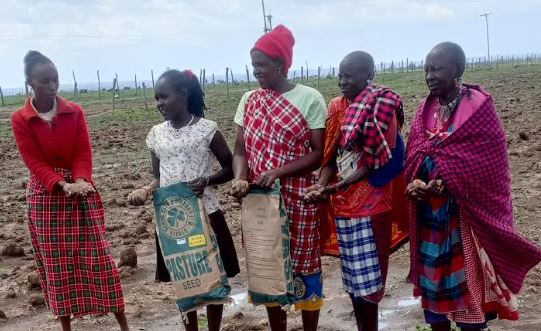
Mwanik Catherine, a farmer in Limanet village, Narok North Sub-County, grows Boma Rhodes grass—a drought-resistant fodder essential for livestock—on a 13-acre farm.
“This farm is just a fraction of what our Enkishon Women Self-Help Group (SHG) manages across the region. In total, we have 10 acres dedicated to fodder production,” Ms. Catherine explains to Kenya News Agency (KNA) as she surveys the soon-to-be harvested fields.
The group started the project three years ago after receiving training on rangeland restoration from Farming Systems Kenya (FSK), supported by Brooke East Africa.
During recent severe droughts, neighbouring villages suffered massive livestock losses, but the 30-member Enkishon SHG was largely unaffected—a testament to their foresight.
“We started with just two acres, leasing land and distributing the harvested grass among ourselves and the community. Over time, our acreage expanded as more farmers joined us,” says Ms. Catherine.
FSK, an advocacy group combating the donkey skin trade, has partnered with the SHG to enhance pasture production and improve animal welfare. This collaboration has been key in countering illegal donkey slaughter and promoting sustainable care practices.
“We grew up watching our parents lose livestock to drought, but we refused to follow the same path. In this community, when donkeys start dying, it’s a sign that people will suffer next,” Ms. Catherine notes.
Traditionally, families relied on tree bark and leaves to supplement livestock feed, but these sources were unreliable. Cultivating Boma Rhodes grass has provided a sustainable, predictable feed source for their animals.
“We’re planning to expand to 50 acres to ensure sustainable feed for our animals and boost production,” says Ms. Catherine.
“Without the donkeys, we would have to carry farm produce and other loads on our backs. They make work easier and allow us to earn extra income,” adds Esther Muyaki, a member of the SHG.
She appreciates the interventions by FSK and Brooke East Africa, which have enabled Limanet farmers to secure drought-tolerant feed for working donkeys, reducing mortality during dry seasons.
“Members of our self-help group have over 100 donkeys collectively. This initiative allows us to feed our animals and sell surplus fodder to neighbours. Growing this pasture has been a game-changer, increasing household incomes,” Ms. Muyaki observes.
FSK, in collaboration with Brooke East Africa, is also working with smallholder farmers in arid and semi-arid lands (ASALs) in Nakuru, Nyandarua, Kajiado, Bomet, and Baringo counties to improve donkey welfare through pasture establishment and management.
The initiative links farmers to markets to sell surplus fodder and certified Boma Rhodes grass seed. Farmers receive training on pasture establishment, storage, and sustainable grazing methods. FSK also partners with owners to build and fence water pans, reducing the distance animals travel for water and grass.
The SHG has expanded into seed production, selling Boma Rhodes seeds to the Kenya Seed Company, which further boosts income.
FSK field officer Samuel Chege emphasizes that as climate shocks intensify, donkeys are increasingly critical to rural survival.
He stresses the need for policy change. “We have successfully advocated for donkeys to be included in vaccination programmes alongside cattle and goats. Narok County has integrated donkeys into livestock health plans, improving overall herd welfare,” he says.
However, Chege warns that donkeys are often overlooked in disaster planning. “Other livestock are usually accounted for, but the equine sector lacks structured disease monitoring. Without proper tracking, we risk missing early warnings of zoonotic disease outbreaks.”
To protect both working animals and communities, he advocates integrating human, animal, and environmental health policies. Donkeys are essential for transporting household supplies, water, firewood, and farm produce, especially during droughts.
Improved pasture management serves as a mitigation strategy against fodder scarcity, protecting donkey populations. Beyond transport, hay production and seed sales offer new economic opportunities for donkey-owning households.
FSK and Brooke East Africa specifically target women, who are often the primary caretakers of working donkeys. Mr. Chege notes that these initiatives have helped protect thousands of donkeys in Kenya by providing better nutrition and reducing the time animals spend searching for feed.
By Emily Kadzo