For years, water in many parts of Igembe North was not just a basic need but a daily struggle that shaped how families lived, how children learned and how women spent most of their time.
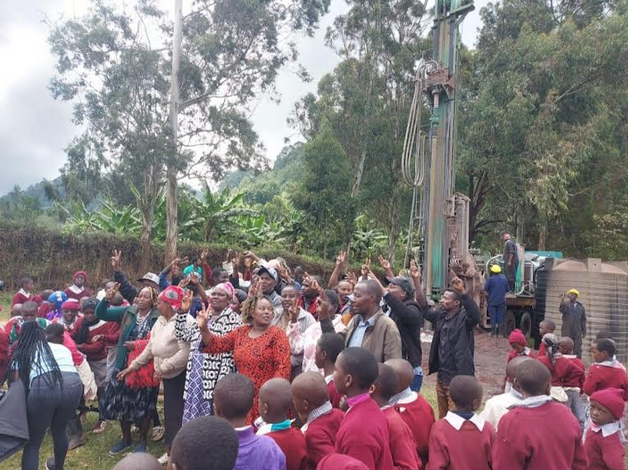
That reality is now beginning to change at Mwerongundu Primary School, where residents are celebrating a successful borehole drilling project launched after World Water Day celebrations were held at the school grounds by Igembe North MP Julius Taitumu.
The event, held under the theme “Water and Gender,” highlighted a long-standing reality in the constituency a region with no permanent river flowing through it, women and children have carried the heaviest burden of water scarcity.
At the centre of this transformation is Mwerongundu Primary School, where the newly accessed water is expected to serve not only learners but also nearby communities including Kaulune village and Lukununu.
Headteacher Kawira Ntarangwi said the borehole will ease a heavy financial burden the school has carried for years.
She explained that the school had been forced to buy water at great cost, sometimes spending Sh3,000 on water that could not even last two days.
The shortage affected everything from cleaning and cooking to providing drinking water for children and water for livestock kept around the institution.
“With a reliable water source now available, the school is now looking beyond survival and into growth,” said the headteacher.
According to the headteacher, the school plans to establish a model farm using the water, an initiative expected to support school feeding by producing crops for a balanced diet while also equipping learners with practical farming skills they can transfer to their homes and communities.
Residents say the water crisis in Igembe North has always been more than an inconvenience because it has deeply affected women and girls.
For many homes, women woke up each day not knowing whether they would find enough water to cook, clean, bathe children or sustain the household.
Teresa Nthama a resident of the area said many families had endured years of hardship and that the intervention had brought visible relief.
She noted that women had often been forced to spend long hours looking for water, leaving them with little time for farming, caregiving or other productive work.
The arrival of water, she said, would now allow families to farm and improve food security at home.
Another resident added that many households had depended on expensive water delivered by lorries, an option that was often unreliable and unaffordable for ordinary families.
In many homes, the absence of water has also strained family roles and daily routines.
Mutuma Mbero, a resident of Lukununu, said women were often forced to leave home for long hours in search of water, leaving men behind to care for children and manage households under difficult circumstances.
He said the situation had deeply affected family life, productivity and the wellbeing of children.
His remarks reflected the wider message of this year’s World Water Day theme, that lack of water is not gender neutral because it steals time, energy, dignity and opportunity, especially from women and girls.
Girls in particular are among the biggest victims of water shortages in rural communities, frequently arriving late to school, missing class or being drawn into household water duties at the expense of education.
Residents now say the new borehole could significantly reduce time wasted on water searches, allowing more time for school, farming, caregiving and income-generating activities.
The successful drilling did not come easy. Residents said water finally came out on Sunday evening after a week of hard work and sleepless nights by the contractor, who had to push through difficult drilling conditions in search of the water source.
Sources at the site said an alternative drilling machine had to be brought in after the initial efforts were slowed by the deep water table, underlining the technical challenge of finding underground water in the dry constituency.
Speaking during the event, Igembe North MP Julius Taitumu said the constituency has for years faced a major challenge with underground water, with many people believing the area was too dry to support reliable water projects.
He said the successful drilling at Mwerongundu had proven that water can indeed be found in Igembe North, provided proper equipment and expertise are used.
The borehole, drilled to a depth of over 320 metres, is expected to serve about 1,500 learners in both the primary and secondary school sections as well as surrounding households.
Taitumu said the success of the project should encourage more investment in water infrastructure across the constituency, adding that each ward should ideally have at least two boreholes to reduce the suffering residents have endured for years.
The law maker said access to water would not only improve life at school and in homes but also increase productivity across the community.
According to local leaders and residents, plans are underway to distribute the water to neighbouring villages, with expectations that it could reach Kaulune and extend as far as Lukununu.
Residents believe that if the county government steps in to support piping and wider distribution, many more families could benefit.
Locals pointed out that while the national government can facilitate such projects, the distribution of water in rural areas largely falls under the mandate of the county government.
That cooperation, they say, will determine whether this borehole becomes a school-based relief point or the beginning of a broader water transformation in the area.
As the project gains praise on the ground, some residents used the occasion to hit back at critics who had doubted whether such a breakthrough was possible.
The successful drilling comes just one week after the Cabinet Secretary for Water and Irrigation Eng. Eric Muriithi Mugaa marked World Water Day at Mwerongundu Primary School, bringing national attention to the constituency’s water crisis.
For residents, the symbolism is hard to believe.Igembe North, where there is no river flowing through the entire constituency, water has long dictated who studies, who farms, who cooks, who waits and who walks.
Now, for the first time in a long time, many residents say they can imagine a different future, one where children stay in school, women spend less time searching for water, families grow food at home and communities reclaim hours once lost to thirst.
By Kamanja Maeria