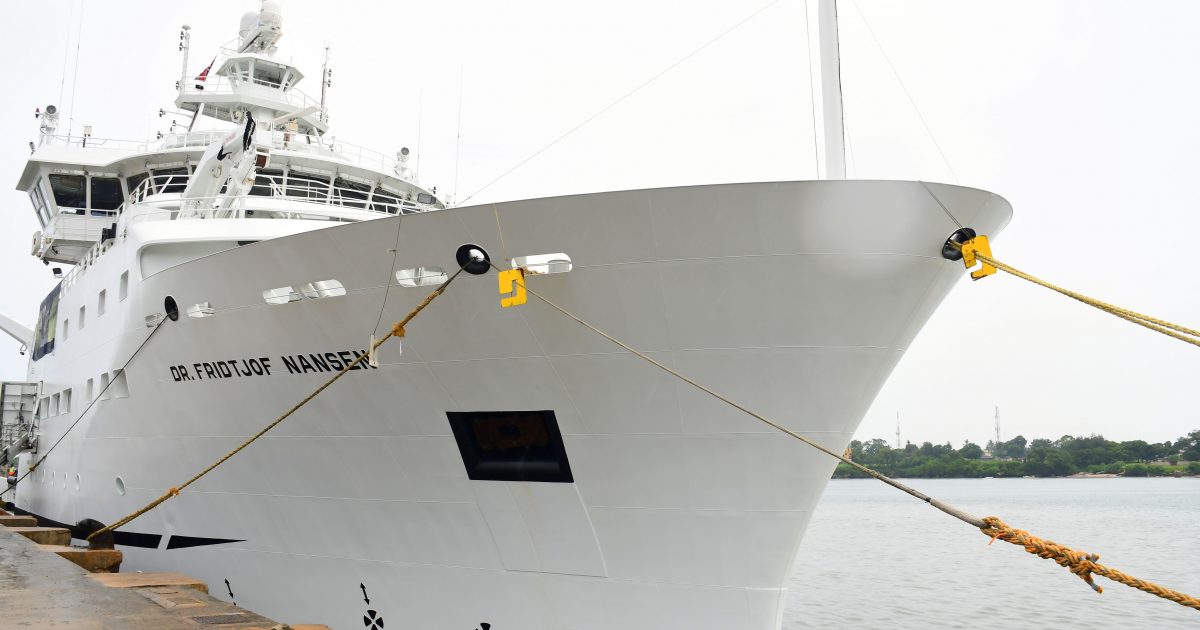
The country’s forays to exploit vast opportunities in the Blue Economy sector received a significant boost with the arrival of a Norwegian research vessel.
The scientific vessel operated by the Norwegian Institute of Marine Research is equipped with seven state-of-the-art laboratories and was built in 2016. It is named after renowned oceanographer and zoology professor Dr. Fridtjof Nansen, who was awarded the Nobel Peace Prize in 1922 for his humanitarian work during World War I.
The vessel recently completed the Kenyan leg of a research expedition from April 24 to May 5, 2025. The mission focused on assessing fish biomass, studying oceanographic conditions, and evaluating the overall health of marine ecosystems within Kenya’s coastal waters and Exclusive Economic Zone (EEZ).
The findings are expected to inform sustainable marine resource and fisheries management strategies.
In his speech, read by the Principal Secretary, State Department for Blue Economy, Betsy Njagi during the Port call of the vessel and celebration of the 50th anniversary of the EAF-Nansen Programme at the Mbaraki Wharf.
Mining, Blue Economy and Maritime Affairs Cabinet Secretary (CS) Hassan Joho says the monumental survey symbolizes Kenya’s commitment to charting new frontiers in pursuit of a science-driven, sustainable Blue Economy.
The CS hailed the partnership between Kenya and Norway that has enabled Kenyan scientists and resource managers to be trained in data-driven and ecosystem-based marine management.
“The programme has fostered cooperation across borders, creating strong networks for shared learning and coordinated action,” CS Joho said, adding that it has also enabled Kenyan scientists to collect data, thus bridging existing knowledge gaps and connecting them with international experts for skills transfer.
He further said that the country is committed to the programme’s future, reiterating that it has provided crucial data for evidence-based fisheries management, built capacity of the Kenya Marine and Fisheries Research Institute (KMFRI) and strengthened ecosystem monitoring and policy formulation.
“The preliminary results of the 2025 survey will help plan for sustainable management strategies and bolster Kenya’s resilience to climate change and marine biodiversity loss,” CS Joho stated, calling for more surveys to capture different seasons to give a clear picture of the ecosystem health and the environmental dynamics involved.
The survey is expected to provide extensive data on the country’s continental shelf and slope, revealing a rich biodiversity among pelagic fish species.
The event was attended by the Food and Agriculture Organisation (FAO) Kenya Representative, Dr. Tipo Tito, Royal Norwegian Ambassador to Kenya, Gunnar Holm, Nansen Programme Coordinator, Ms. Merete Tandstad, among other officials.
FAO Representative to Kenya, Dr. Tipo Tito, stated that over 300,000 Kenyans depend directly on fisheries, yet the resources face serious threats from climate change, overfishing and marine pollution.
She further lauded the programme for introducing tools to help the country monitor progress in sustainable fisheries.
The work of the vessel, she said, aligned with FAO’s Blue Transformation vision, which aims to maximise the role of aquatic foods in providing affordable, nutritious diets while protecting ecosystems and building resilience.
“As we look to the future, the EAF-Nansen Programme offers a model for science-based decision-making. Its contributions support Kenya’s leadership in ocean sustainability, including through President William Ruto’s participation in the High-level Panel for Sustainable Ocean Economy.”
Ambassador Gunner Holm affirmed Norway’s support to promote clean, healthy and productive oceans in the country. The visit by the vessel, he said, is a boost to collaboration between the two countries.
“50 years of the EAF-Nansen Programme testify to the strong common interests between Kenya and Norway in oceans and sustainable Blue Economy,” stated Amb. Holm.
EAF-Nansen Programme Coordinator Ms. Marete Tandstad highlighted that since the inception of the Programme in 1975, it has supported 58 countries in conducting over 400 surveys that generated crucial knowledge on fish stocks, the ocean ecosystem and marine biodiversity.
“This knowledge continues to shape fisheries policies, support sustainable practices and strengthen regional collaborations,” said Ms. Tandstad.
By Sadik Hassan