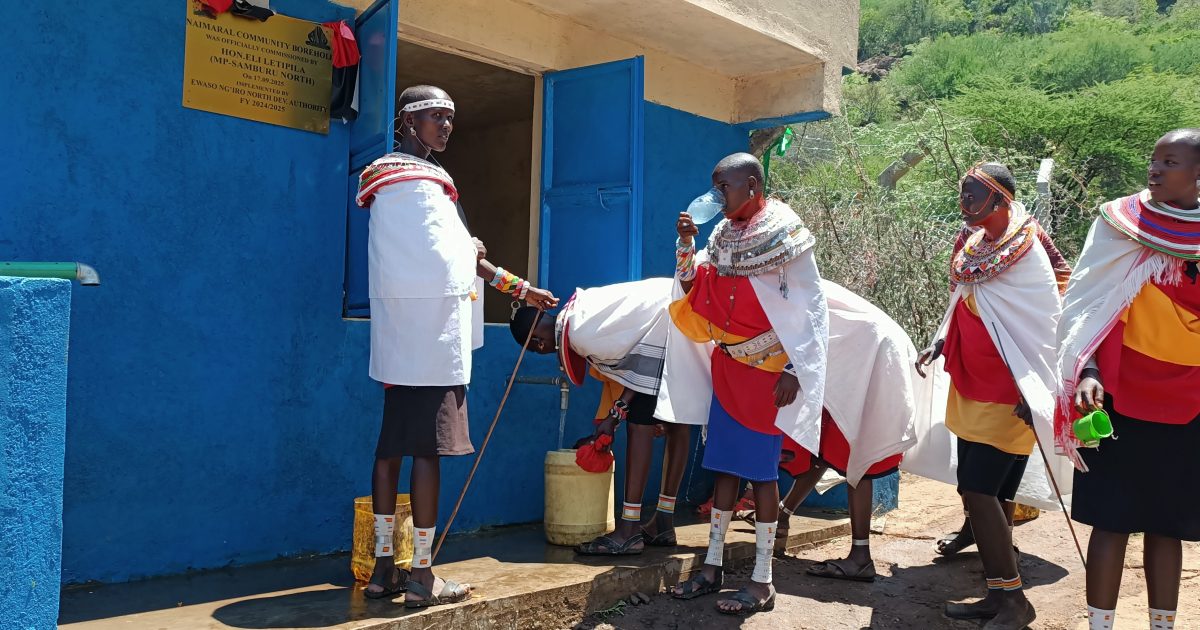
Over 2,000 residents of Naimaralal village in Samburu North sub-county will now have access to clean water after the national government, through the Ewaso Nyiro Northern Basin Development Authority (ENNDA), sunk a Sh14 million borehole.
Speaking during the commissioning of the borehole, ENNDA Director for Infrastructure and Natural Resource Development, Josiah Mulwa, said that over 10,000 livestock and countless wild animals will also benefit from the water project.
He added that the borehole, which has been equipped with a solar pump, will supply water to residents at the rate of 7,200 litres per hour in the water-scarce region.
“This is a water-scarce area, and we drilled 330 metres near Naimaralal Primary School and failed to find water. We changed location and found water at a depth of 251 metres fit for both human and livestock consumption, and we are pleased that the borehole produces 7,200 litres of water per hour,” he said.
Mulwa further added that the project is designed to provide sustainable relief and long-term benefits to children who will have more time for school instead of trekking long distances in search of water.
He noted that beyond Naimaralal, ENNDA has invested significantly in water infrastructure across Samburu East and Samburu West sub-counties in the form of dams and water pans that have provided an additional 2 million cubic metres of additional water storage in the county.
Samburu North MP, Eli Letipila, lauded the national government’s efforts of providing water to area residents through the Regional Development Authorities (RDAs), adding that water is a lifeline to the Arid and Semi-Arid counties of Kenya.
“I urge the government to strengthen the RDAs through increased funding because we see tangible development in the remote areas through them, and this makes them a critical part of governmental agencies,” he noted.
Blessing Lelemusi, a resident of Naimaralal, said that women used to walk for 45 kilometres to fetch 10 litres of water, which they would use for two days.
“We had to endure harsh terrain, long hours and dangerous wildlife encounters in search of water; we would leave home at 6am and return at 6pm with only 10 litres of water. ‘We are very happy that water is now at our doorstep,’ she said.
By Robert Githu