The private sector has secured a major milestone following a directive by H.E. President Dr. William Ruto that the Presidential Roundtable (PRT) with the Kenya Private Sector Alliance (KEPSA) be anchored in law.
The move will institutionalize structured dialogue between the private sector and the Presidency and guarantee its continuity in this and across successive government administrations.
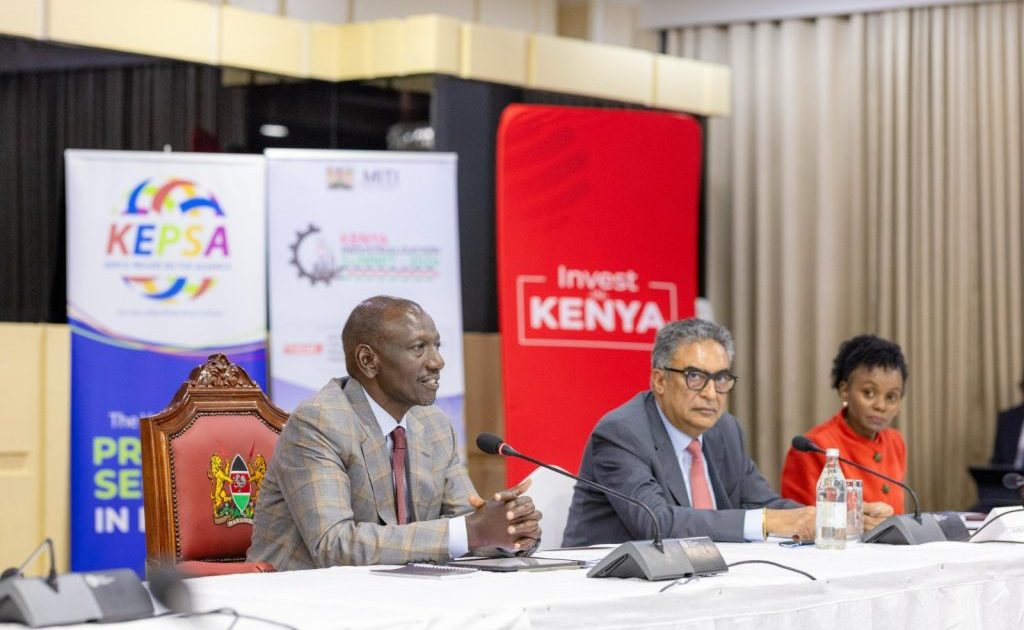
The President issued the directive during the 6th KEPSA Presidential Roundtable meeting recently held in Nairobi which brought together more than 150 participants, including a government delegation led by the President and comprising Cabinet Secretaries and Principal Secretaries, KEPSA member organizations, members of the Diplomatic Corps, and development partners.
The Roundtable was convened in collaboration with the Ministry of Investments, Trade and Industry (MITI) and the Kenya Investment Authority (Invest Kenya) under the theme ‘From Gatekeeping to Open Policy’, which focused on strengthening trade and investment across six thematic areas: energy; finance and banking; trade facilitation and market access; information and communications technology (ICT); social enterprise (health and education); and the regulatory framework.
Notably, the Presidential Roundtable is KEPSA’s flagship strategic engagement with the Head of State on national economic priorities. Over the years, the platform has engaged successive administrations and contributed to significant policy reforms and economic milestones.
Speaking during the event, KEPSA Chief Executive Officer, Ms. Carole Kariuki, described the Roundtable as “a critical platform for identifying what has been done in the economy, where we want to go as a country and the business bottlenecks that need to be resolved together”.
Similarly, KEPSA Board Chair, Dr. Jas Bedi, commended the Government’s efforts to restore macroeconomic stability and rebuild investor confidence.
The Board Chair cited improvements in key economic indicators, including the reduction of the Central Bank Rate (CBR) from 13 percent to 8.75 percent, foreign exchange reserves equivalent to six months of import cover, and projected economic growth of 5.6 percent.
He emphasized, however, that the next priority must be to translate macroeconomic stability into tangible investment, sustainable jobs, and higher household incomes.
“The true measure of investment is not found in policy papers, but in factories established and jobs created within the economy. Investments must create active businesses that earn foreign exchange and provide sustainable employment for our youth,” he reaffirmed.
The Council of Governors (CoG) Chairperson H.E Governor Muthomi Njuki on the other hand committed to harmonizing and standardizing county fees, levies, and charges through the implementation of the County Licensing (Uniform Procedures) Act.
“County governments will work together to create a more predictable and business-friendly environment by eliminating duplication of roles and inconsistencies in the charges imposed on businesses across counties,” he explained.
Meanwhile, the Roundtable yielded significant commitments and policy interventions across the thematic areas, including the following Presidential Directives and commitments: Energy: Implementation of the National Energy Compact where the President directed the full operationalization, before the end of 2026, of the Kenya National Energy Compact Action Plan (2025–2030), which targets 100 percent clean electricity generation, universal electricity access, and universal access to clean cooking. The President also directed the setting up of the Compact Delivery and Monitoring Unit responsible for delivering the Energy Compact by December 2026.
Secondly, was the open access regulations where, following the gazettement of the Open Access Regulations in May 2026, the Energy and Petroleum Regulatory Authority (EPRA) is developing the frameworks for open access, wheeling and net metering, for completion by December 2026.
Thirdly, is the electric vehicle incentives where the Government will, within one month, develop a framework granting duty exemption on the first 100,000 electric vehicles (EVs).
Fourth is the Power Purchase Agreements: where the President directed that all outstanding and stalled Power Purchase Agreements (PPAs) by KPLC be concluded within two weeks.
Another directive is the expansion of electricity generation where the President committed the Government to mobilizing public investment, including through the National Infrastructure Fund (NIF), to develop an additional 10,000 megawatts (MW) of electricity generation capacity.
Additionally, is the net metering operationalization where the President directed the operationalization of the net metering and electricity markets, bulk supply and open access regulations by December 2026.
Finally, was the Auctions Implementation through which the President directed the implementation of the auctions (competitive procurement) framework by December 2026.
Meanwhile, on Trade Facilitation, Market Access and Regulatory Framework for instance; the Port of Mombasa investment opportunities & efficiency, the President invited private investors to take up investment opportunities in Berths 11, 12, 13, 14, 23 and 24 at the Port of Mombasa, paving the way for greater private sector participation in port infrastructure and operations.
He further directed the rationalization of the Agency’s operational presence in the Port to KPA, KRA, KEBS and Port Health.
On Trade relations, the President committed to finalizing the ongoing trade discussions with India and the US, including negotiations on a Preferential Trade Agreement (PTA) with a focus on market access for key Kenyan exports.
On VAT refunds and pending bills, the President urged the private sector to work with the government to identify and eliminate fraudulent claims, ensuring that legitimate businesses receive their dues.
For KRA Funding, Kenya Revenue Authority (Amendment) Act, 2026, guarantees KRA annual funding of at least 2 percent of the revenue the Authority expects to collect, giving it a minimum allocation to support its operations and upgrade its systems.
On Information and Communications Technology (ICT), Access to tech devices & gadgets by young people, the President directed the National Treasury to expedite the removal of import tariffs on tech devices & gadgets by December for young people working in the gig and creative economy.
Specifically, he directed the removal of 25 percent import duty on mobile phones before December 2026.
Likewise, for EU data adequacy, the President announced significant progress in Kenya’s data adequacy negotiations with the European Union (EU), which commenced in May 2024. Once concluded, the arrangement will allow the transfer of EU personal data to Kenya without additional transfer mechanisms, subject to the applicable legal framework.
Kenya would thereby become the first African country to secure EU data adequacy status, enhancing its attractiveness for investment in Business Process Outsourcing (BPO), cloud computing, data centres, fintech, and artificial intelligence (AI).
On completion of technical evaluation, the Cabinet Secretary for Information, Communications and the Digital Economy, Hon. William Kabogo, announced that the technical evaluation of Kenya’s EU data adequacy process has been completed, with approval expected by 16 November 2026.
Separately, the Social Enterprise on Health and Education, in particular the SHA Plus health insurance package, the Government, in partnership with private insurance providers, will launch SHA Plus on Monday, 9 November 2026. The package targets middle-income earners and will expand their access to health insurance cover.
On NHIF legacy Debt, the Government through SHA, released KES 4 billion to settle NHIF legacy debt for providers with debt under KES 10 million in 2026 which helped smaller health providers to stay solvent. The President committed that Sh 15 billion will be allocated to clear NHIF legacy debts owed to providers with claims exceeding Sh 10 million, subject to completion of ongoing verification exercise.
On Reforms at Pharmacy and Poisons Board, the President gave a directive to the Ministry of Health to complete regulatory reforms at the Pharmacy and Poisons Board to promote export of locally manufactured pharmaceutical products and for KEMSA to buy more from local manufacturers. Plans are at an advanced stage and will be concluded by December 2026.
On inbound travel insurance exemption, the President directed that travellers entering Kenya with valid travel insurance cover be exempted from the newly introduced mandatory US$44 inbound travel insurance fee, including any related processing or system charges.
On the support for Pharmaceutical Manufacturing especially to support local pharmaceutical manufacturing, the President directed the National Treasury, the Ministry of Health, and the private sector to review the VAT treatment of pharmaceutical inputs and recommend the most effective approach, whether through zero-rating or VAT exemption, to strengthen local production.
On the equation of qualifications, the President directed the immediate implementation of the Circular MOE.HQS 3/1/21 of 19 November 2025 on the equation of qualifications, to resolve outstanding concerns on the recognition and equivalence of academic and professional qualifications.
Conversely, on Education Bills, the President assured the private sector that the five Education Bills currently before Parliament are undergoing public participation and stakeholder engagement, and that they will be passed before Parliament proceeds to recess.
For student accommodation under the Affordable Housing Programme, the Government is constructing 180,000 student accommodation beds and hostel units across the country to address accommodation shortages in public universities, Kenya Medical Training Colleges (KMTCs) and Technical and Vocational Education and Training (TVET) institutions.
“While meaningful progress has been made in addressing some of the concerns raised, we acknowledge that more remains to be done. We will therefore sustain our engagement and intensify efforts to resolve outstanding bottlenecks and create a predictable, transparent and enabling environment in which business thrives,” the President reaffirmed.
“Our overriding goal is to position Kenya as a leading destination for investment, enterprise and innovation in Africa and beyond,” he added.
In the meantime, President Dr. William Ruto will hold a follow-up meeting with KEPSA before the end of 2026. The meeting will provide an opportunity to review progress, address outstanding issues and track the implementation of the presidential directives and agreed interventions before the end of the year.
KEPSA remains committed to strengthening structured public-private dialogue, advancing an enabling business environment and championing policies that unlock investment, expand trade, create jobs, and enhance Kenya’s global competitiveness.
By Michael Omondi