The government is implementing some 31 water projects in 23 Arid and Semi-Arid (ASAL) counties at a cost of Sh 300 million.
According to the Principal Secretary in the State Department for ASALs and Regional Development, Kello Harsama, the projects were being undertaken in the most drought affected counties including Marsabit, Turkana, Mandera, Wajir, West Pokot, Baringo, Tana River where he noted the food security situation was poor due to inadequate rainfall.
Terming them as strategic projects, the PS said they were being implemented with the aim of strengthening the communities’ drought resilience by improving their access to clean water and boosting food security especially in ASALs in line with the Bottom-up Economic Transformation Agenda.
“These are very strategic projects as some of them are situated in the severely arid and semi-arid counties. Most of these counties have suffered serious drought impacts. For instance, between 2021 and 2022, many of these areas experienced very severe drought,” stated Harsama.
“Our focus is on strengthening drought resilience and food security through sustainable investments in water infrastructure, climate-smart agriculture, and livelihood diversification.”
The PS spoke on Wednesday during the commissioning of the Kabati water project in Kieni Nyeri County. The Sh 21.2 million borehole project was undertaken through a strategic partnership between the Kabati community, National Drought Management Authority (NDMA) and the County Government of Nyeri.
The 220-metre borehole project comprises a solar-powered pump house and a 225,000-litre concrete storage tank. With its 2.9-kilometre distribution pipeline, the borehole water project will supply safe and reliable water to more than 350 households, four primary schools and a health facility situated in the location.
PS Harsama said that infrastructure will significantly reduce the burden of water collection for women in the area who previously used to trek close to five kilometres in search of water. He noted that the project will also support irrigation farming leading to improved nutrition and food security.
“With this project, there will be easy access to water for the 350 households which have been experiencing severe water shortages. Women in Kabati have been trekking for three kilometres to fetch water for domestic use. Because of the completion of this project, sufficient water for domestic use will be available; they will also have the privilege and opportunity to irrigate small parcels of their land and produce food for domestic and commercial use,” stated Harsama.
The positive impact of the water project has already started to be felt by the locals who hailed it as a game changer. About 1.5 kilometres from the main borehole, we meet with Margaret Wakarindi, a dairy farmer who said that the project has not only ensured that she enjoys a reliable supply of clean water but has also reduced the cost of production for dairy farmers like in Kabati.
“Before my household was connected to the water project, I used to spend Sh 1000 daily to buy 2,000 litres of water for my dairy cows and goats. The worst farming season for me was during the dry season where I would be forced to source the commodity five kilometres away in Naru Moru.
However, the commodity is now readily available in my tap, saving me the hassle of looking for water,” said Wakarindi.
Her testimony is similar to that of Samuel Kabui a farmer who specializes in horticultural crops namely capsicum, courgettes and potatoes and one of the beneficiaries of the project. Thanks to the borehole water, Kabui said he has managed to put nearly two acres of his farm under drip irrigation.
When KNA visited him, he had just finished harvesting potatoes cultivated using water from the water project. Kabui said that availability of borehole water will also curb their reliance on rain-fed agriculture and allow farmers like him to shift to irrigation farming.
“I have started to reap the benefits of the water project as I am comfortably using the water to practice drip irrigation on my farm. Through this project we are now guaranteed that we can practice agriculture throughout the year even during the dry season,” he said.
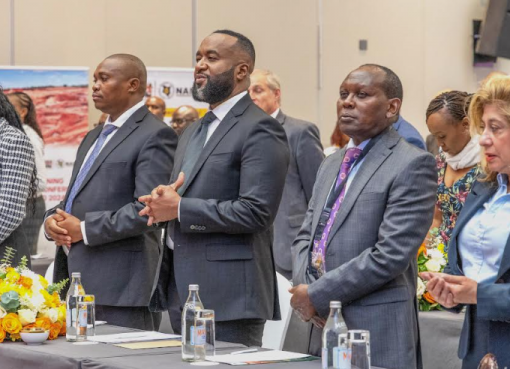
The PS was accompanied by Nyeri Deputy Governor Warui Kinaniri, Kieni Member of Parliament Njoroge Wainaina, NDMA Board Chairman Shallow Yahya and NDMA Chief Executive Officer Lt Col Hared Adan. Nyeri DG said that the county government will continue to partner with the national government to improve lives and build long-term resilience for Kieni residents.
“To complement efforts by the national government, as a county, we are also sinking boreholes in different areas of the drought-prone Kieni constituency and we will continue to work together to improve the livelihoods of the people at the grassroots level,” stated Kinaniri.
By Wangari Mwangi