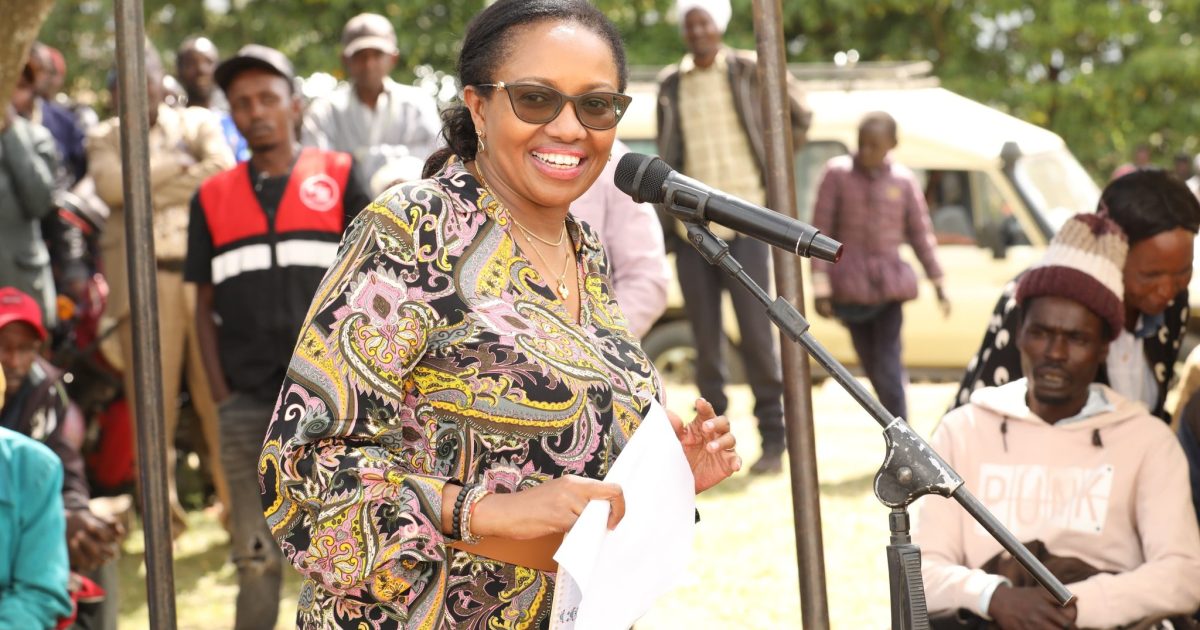
The government has waived over Sh30 million in interest accrued on Settlement Fund Trusts for hundreds of residents in settlement schemes within Gilgil Sub-County in Nakuru County.
According to Nakuru Governor Susan Kihika, the waiver aligns with the government’s ongoing efforts to resolve historical land injustices, enhance agricultural productivity, and unlock land-based economic value.
Ms Kihika said the waiver beneficiaries drawn from Kiambogo, Miti Mingi, Eburru, Oljorai Phase 1 and Oljorai Phase 2 settlement schemes within Elementaita ward, owe the state Sh 30.6 million in interest accrued for decades adding that many settlers had been unable to repay accrued interest due to economic hardship and challenges affecting agricultural productivity.
She said the beneficiaries will be able to obtain title deeds for their land and also regularize land accounts that have been in arrears for decades following intervention by President William Ruto.
She said they will begin receiving their title deeds in the next few weeks noting it would be a major breakthrough in land disputes that have persisted for over five decades.
Ms Kihika noted that many local residents had been unable to collect their title deeds due to the huge debts owed to the Settlement Fund Trust (SFT) adding that the waiver on the interests will enable them to pay up.
The Governor reaffirmed her administration’s commitment to work with the national government in finding permanent solutions to land issues in Gilgil and Naivasha sub-counties which had hindered issuance of land ownership documents.
Ms Kihika pointed out that the County administration was committed to fostering peaceful coexistence among all communities in the devolved unit by addressing historical land disputes through dialogue and Alternative Dispute Resolution (ADR) mechanisms adding that they were encouraging residents to embrace use of ADR to resolve land cases and end disputes.
She observed that Kenya’s land policy encourages the use of alternative dispute resolution (ADR) mechanisms to facilitate expeditious and affordable access to justice.
The Governor indicated that the Constitution encourages communities to settle land disputes through recognized local community initiatives saying that when several parcels of land are locked up in litigation, it means they are not being used productively and consequently the country suffers economically.
The Governor, who was addressing residents at Munanda Police Grounds within Elementaita Ward was flanked by County Secretary Dr Samuel Mwaura, County Executive Committee Members John Kihagi (Lands), Stephen Kuria (Trade), Roselyne Mungai (Health), Deputy County Secretary Newton Mwaura, and Chief Officer Office of the Governor Mr Martin Kagai
She stated that her administration was currently leveraging on ADR mechanisms to address long standing land disputes in all the 11 Sub-Counties, focusing on fostering community cooperation and resolving issues efficiently.
Ms Kihika pledged that the department of Lands and Physical Planning will collaborate closely with local leaders from the region to address land disparities and stated that the initiative will include resource allocation for land surveying and land titling, aimed at improving infrastructure and promoting urban development.
“These efforts will play a crucial role in enhancing the county’s growth unlocking its socio-economic potential for sustainable development,” she pointed out.
Naivasha, Njoro, Rongai, Gilgil, Bahati, Molo, Kuresoi South, Mai Mahiu and parts of Mau Narok have experienced disruptions of peace due to disagreements over land.
A new study has confirmed that residents are inclined to refer every small land matter that pops up to the courts for judicial determination. Subsequently, the county has numerous land cases in court that take long and give mixed results.
Official records indicate that nearly 52 percent of civil and criminal cases before law courts within the devolved unit revolved around land disputes, thus frustrating a joint National and County government titling programme.
Ms Kihika pointed out that it was unfortunate that resultant bitterness over land wrangles at times manifested itself through violence and murder.
She said they were fashioning out alternative options crafted to reduce complainant emotions, reduce process costs and time, which she said help have outcomes that will enjoy better support and ownership by the affected individuals and families, and hence less likely to precipitate acrimony and violence afterwards.
The Judiciary embraced ADR mechanism to clear case backlog in the courts. ADR refers to any means of settling disputes outside of the courtroom and is classified into at least four types: negotiation, conciliation, mediation and arbitration.
The 2010 Constitution provides for the use of alternative forms of dispute resolution mechanisms to enhance delivery of justice to all citizens.
In addition, the Constitution requires courts and tribunals to be guided by, among others, the principle of alternative dispute resolution where this includes reconciliation and traditional dispute resolution mechanism.
By Esther Mwangi