President Donald Trump’s administration will continue supporting critical health programs in Kenya despite a High Court ruling that temporarily suspended a US $2.5 billion health deal over concerns about personal data privacy.
US Embassy Chargé d’Affaires Susan Burns assured that, once the case is resolved, Kenyans would benefit significantly from the agreement, which is expected to address key health challenges, including the provision of drugs for HIV and TB patients. She emphasized that Kenya, as a sovereign state, would respect any judicial ruling regarding the matter.
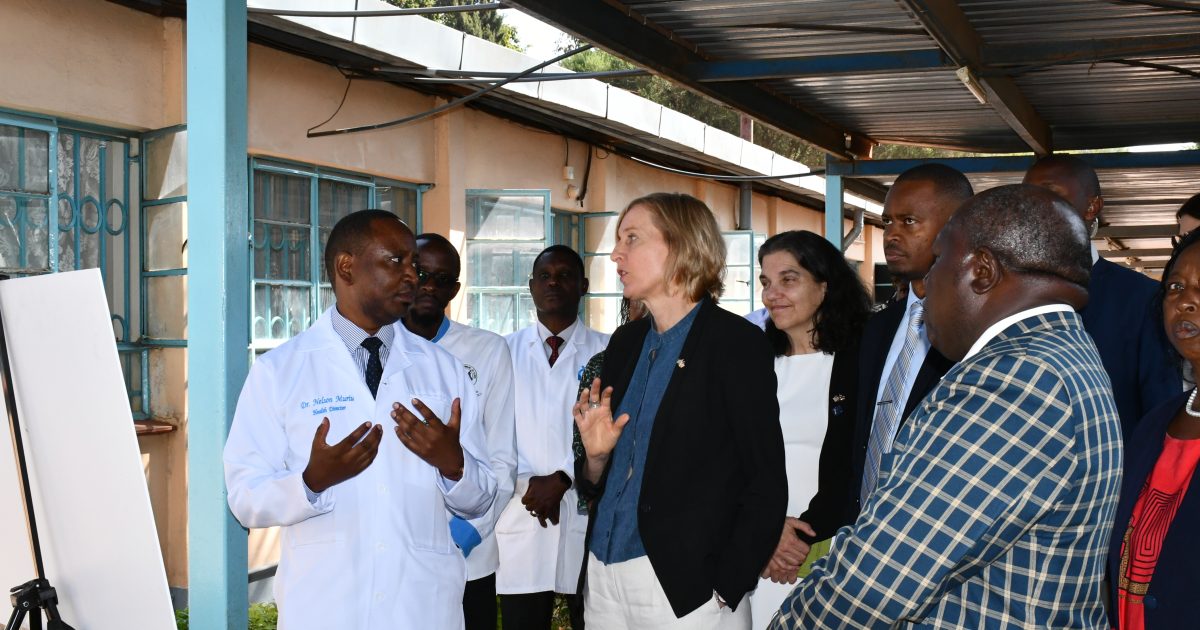
“There was a health agreement signed in December with the US government totaling US $2.5 billion. There is a lot of work to do to figure out how we are going to proceed from both sides, and we are in that process. But this is a Kenyan matter. You have an independent judiciary and a court system, and you have to follow the rules. It’s up to Kenyans to decide whether they want this funding and how they want it to be implemented,” Burns said during a tour of Nyeri County Referral Hospital.
The deal’s suspension followed a petition filed by a consumer rights lobby, including the Consumer Federation of Kenya (Cofek), which raised concerns that the agreement could allow the US government access to personal medical records, including HIV status, TB treatment history and vaccination data. The case is scheduled for hearing on February 12, 2026.
Photos by Wangari Mwangi
Despite the legal uncertainty, Burns assured that other ongoing health services would continue uninterrupted. While Trump’s administration paused major USAID-funded donations, selected programs are now being implemented through bilateral agreements with individual countries.
“I want to stress that ongoing support continues. We have been working on health programs in Kenya for the last 20 years, and there is no interruption. When the court makes its decision on this matter, we will be ready to continue caring for the health of the Kenyan people,” Burns added.
Kenya has been a major beneficiary of US health assistance through USAID, particularly the President’s Emergency Plan for AIDS Relief (PEPFAR). Between 2020 and 2025, USAID committed approximately US$2.5 billion in foreign assistance to Kenya, about US$470 million annually, with 80 percent directed to health initiatives, according to the United Nations Office for the Coordination of Humanitarian Affairs (OCHA).
Trump’s freeze on funding left thousands of Kenyans dependent on the programs at risk, threatening maternal care provision and HIV prevention efforts among young people. Approximately 41,500 health workers employed under PEPFAR programs also faced potential job losses.
Burns explained that the Trump administration would now support affected programs through alternative channels, including the US Centers for Disease Control and Prevention (CDC) and direct embassy initiatives.
She commended Nyeri County for its successful implementation of PEPFAR programs, describing the county and Nyeri County Referral Hospital as models for other counties in delivering health services.
“In Trump’s administration, while some overseas funding was frozen, we are continuing lifesaving support through the US CDC and embassy-managed foreign assistance. Programs targeting HIV, malaria, TB prevention, and other incoming initiatives will continue,” she said.
Burns highlighted Nyeri County Referral Hospital’s success in implementing government-to-government agreements under PEPFAR. “This hospital and county have been working successfully with direct government support. They are a model for how programs like this should be implemented,” she added.
Also present during the tour were CDC Chair Galbraith Jennifer, Nyeri Health CEC Dr. Joseph Kiragu, and County Director of Health Services Dr. Nelson Muriu, among others.
by Samuel Maina and Wangari Mwangi