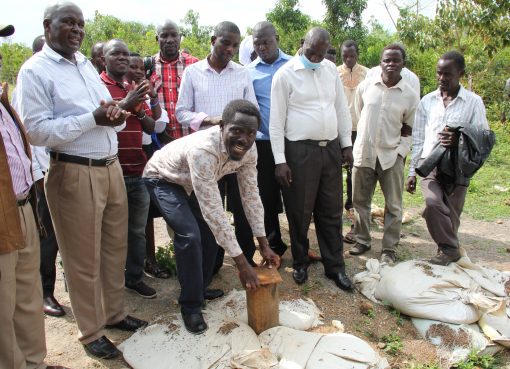
Vihiga County has officially launched an e-voucher livestock vaccination and identification program aimed at preventing livestock diseases, improving productivity and enhancing traceability of animal products in the market.
The initiative was launched at the farm of Leah Iminza in Budaywa Village, Sabatia Sub-County, by Vihiga Governor Dr. Wilber Ottichilo together with Vihiga County Commissioner Peter Maina.
The programme targets vaccination and digital identification of cattle across the county in an effort to control livestock diseases such as Foot and Mouth Disease (FMD), Anthrax and Lumpy Skin Disease.
Speaking during the launch, Vihiga County Director of Veterinary Services Dr. Darlington Kadenge said the county had already vaccinated about 11,000 cattle out of the targeted 80,000 animals.
He noted that although the programme initially experienced technical challenges related to the digital registration system, the issues had since been resolved by the Information Technology (IT) department.
Kadenge commended the County Commissioner and his team for assisting in mobilizing farmers across the county, particularly in Walodeya Ward, where farmers were sensitized on the importance of livestock vaccination.
“I would like to appreciate the County Commissioner and his team for helping us mobilize farmers and educate them about the importance of foot-and-mouth disease vaccination and livestock identification,” said Kadenge.
Vihiga County Executive Committee Member for Agriculture, Livestock and Fisheries Nicholas Kitungulu expressed satisfaction with the progress made so far, noting that the number of vaccinated cattle was steadily increasing.
However, he pointed out that the county had limited time to achieve the vaccination target and urged farmers to register their livestock and participate in the programme before the deadline.
“We are making good progress and are approaching 12,000 vaccinated cattle, but we still have work to do to reach the target of 80,000 animals,” said Kitungulu.
He emphasized that vaccination and identification of livestock are crucial steps toward protecting farmers’ investments and strengthening the county’s livestock sector.

Vihiga Deputy Governor Wilberforce Kitiezo said the programme would help protect livestock from diseases that significantly affect productivity and farmers’ livelihoods.
He noted that controlling livestock diseases would lead to healthier animals, increased milk production and improved quality of meat for consumption.
Kitiezo also acknowledged the efforts of women farmers in Busali Ward who have been actively engaged in agricultural activities.
He urged the youth and men in the county to also embrace agriculture and livestock farming as viable economic activities.
“Our wealth lies in putting more effort into our farms and commercializing agriculture,” said Kitiezo.
County Commissioner Peter Maina confirmed that the national government was working closely with the county government to implement the e-vaccination programme across the country.
He explained that the programme, spearheaded by the national government, aims to ensure that livestock across the country are vaccinated and digitally registered.
Maina said the initiative would help track the origin of meat sold in hotels, butcheries and other markets, thereby improving food safety and consumer confidence.
“In developed countries, livestock are vaccinated and registered so that meat being consumed in hotels or sold in butcheries can be traced to its source,” he said.
He urged farmers in Busali and other parts of the county to register their animals and ensure they are vaccinated within the remaining four weeks of the programme.
Governor Wilber Ottichilo said the county government had embraced the e-vaccination initiative to improve the quality and safety of animal products in local markets.
He noted that the vaccination programme would prevent major livestock diseases including foot-and-mouth disease, Anthrax and lumpy skin disease.
According to the governor, the programme also includes digital identification of cattle, which helps establish ownership and track animals in case of theft.
He explained that cattle identification is done through a digital registration process that records unique characteristics of each animal.
Ottichilo added that the national and county governments will jointly subsidize the cost of the programme.
Under the arrangement, the government will contribute Sh110 toward the vaccination and registration process, while farmers will only pay Sh50 per animal.
The governor urged residents to support local farmers by promoting locally produced livestock products rather than sourcing from other counties.
He also encouraged young people to embrace digital agriculture as a way of improving productivity and addressing food insecurity.
By Yvonne Misango and Maureen Imbayi