The State Department for Technical and Vocational Education and Training (TVET) has entered a mutual enrollment partnership with Western region national government administration officers (NGAO) targeting to recruit more youths to enroll in TVET institutions.
The partnership follows a Presidential directive meant to raise the current enrollment figure which stands at 1.3 million learners to 2 million.
According to State Department for TVET Principal Secretary, Esther Muoria, chiefs and assistant chiefs are best placed to reach out to the youthful population in their respective jurisdictions because they know them by name and where they live.
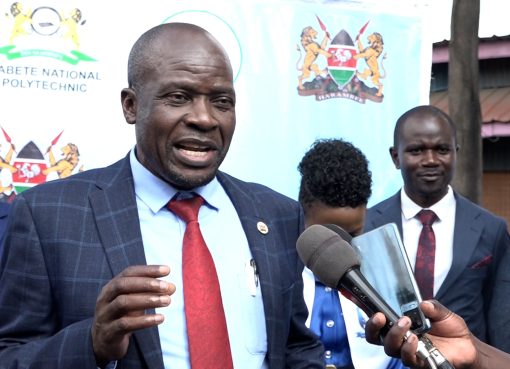
She made the remarks at Shamberere National Polytechnic in Kakamega County during a regional consultative meeting on youth mobilization and sensitization for enrollment into TVET institutions, which brought together her department and the NGAOs from Kakamega, Vihiga Busia and Bungoma.
The PS said the objective of the engagement, which is the sixth across the country, is to ensure a majority of the youthful population joins TVET institutions to acquire skills that will benefit their respective families, communities and the country.
Muoria disclosed that from the over 1 million candidates who sit for the national examinations across the country annually, only a paltry 20 per cent proceed to university because of limited space, saying that does not mean the rest failed.
“Nobody is a failure until you decide to be a failure,” she said, revealing that the Ministry of Education remains committed to 100 per cent transition and that TVET is a critical pathway to earning a living.
The PS told the NGAOs that the TVET curricular has been reviewed with the Curriculum Development, Assessment and Certification Council (CDACC) to focus on practical skills, and modularized so that learners can be certified in three to six months and proceed to work.
She said the government has recruited, and is still recruiting trainers in competency-based education and training and is procuring additional equipment for all the TVET institutions.
Muoria noted that the President is creating job opportunities for the youth through the development programs adding that currently most TVET institutions are being linked to the affordable housing program.
She also disclosed that the government is undertaking reforms on the funding model to enable learners to access the various courses with ease.
“We are focused on both enrollment and retention because. We are looking at the drop-out cases driven by social, security and financial factors and we are striving to address the whole chain to keep the learners in the institutions,” Muoria said.
Western Regional Commissioner Allan Machari reassured the PS of the NGAO support saying increased enrollment is achievable.
He challenged his officers to encourage young people from their jurisdictions who failed to join university to embrace technical and vocational training for skills development and employment under the government’s Bottom-up Economic Transformation Agenda.
Machari said the government agencies and other stakeholders must work together to actualize the presidential directive of increased enrollment directing the NGAOs to play an active role in mobilization.
He noted that the administrators are opinion shapers who work closely with village elders and can identify individual youths by name, origin and residence.
Machari urged the administrators to find ways of addressing barriers to enrollment like inadequate awareness, financial challenges and negative attitude towards technical training, and to report regularly on progress towards enrollment targets.
The administrator advised TVET institutions in the region to align their courses to priority sectors under BETA, including agriculture, manufacturing, housing, healthcare and the digital economy, and that graduates should be linked to financial institutions and empowerment programs such as the Youth Enterprise Fund for credit, equipment and business opportunities.
On security matters he said safety is a shared responsibility and called for a clean, safe and conducive learning environment in and around all institutions.
Machari asked the administrators, security agencies and institution managers to work together to protect young people from criminal networks and social vices.
The administrator said training should be aligned to priority sectors under the agenda, including agriculture, manufacturing, housing, healthcare and the digital economy, and that graduates should be linked to financial institutions and empowerment programs such as the Youth Enterprise Fund for credit, equipment and business opportunities.
Shamberere National Polytechnic Principal Dr. Elisha Nyamu lauded the government for the mobilization initiative saying it will play a critical role in enhancing enrollment in the TVET institutions.
He also said the government is currently working on a sustainable funding model that will ensure the retention rate of the learners remains high.
by Melechezedeck Ejakait