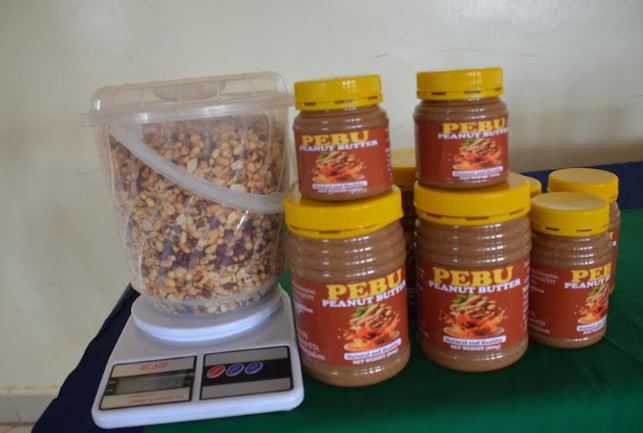
Youths in Migori County have been encouraged to venture into groundnut farming as a viable agribusiness capable of generating meaningful income and improving livelihoods.
Traditionally, groundnut farming has largely been viewed as a subsistence activity, mainly for household consumption, with minimal efforts directed toward commercialization. However, this perception is gradually changing as young entrepreneurs in the county begin to explore the crop’s full economic potential, particularly through value addition.
Despite groundnut products commanding relatively high prices on supermarket shelves, many Kenyan farmers have yet to fully embrace the crop as a commercial enterprise. This gap has created an opportunity for youth in Migori to tap into a market characterized by high demand and limited supply.
Slyvia Ayoo, a 25-year-old groundnut farmer and processor from Suna West Sub County, is among those leading this transformation. She notes that the shortage of groundnut farmers in the region has significantly hindered production, contributing to high market prices.
“In Migori, a two-kilogram tin of groundnuts retails between Sh800 and Sh1,000 depending on the variety. The high cost is mainly due to low supply against a high demand,” she explains.
Ayoo initially ventured into processing groundnuts into products such as peanut butter. However, inconsistent supply of raw materials forced her to rethink her approach.
“I decided to start growing groundnuts myself to sustain my processing business. It became difficult to rely on external suppliers who could not meet demand,” she says.
Currently, Ayoo cultivates three acres of groundnuts while simultaneously running a small-scale peanut butter processing enterprise. Her integrated approach has enabled her to stabilize production and increase her income.
However, she points out that several challenges continue to hinder the expansion of groundnut farming in the county. Chief among them is the limited availability of certified seeds.
“Many farmers are willing to grow groundnuts, but accessing certified seeds that guarantee high yields remains a major challenge,” she says.
Another significant issue is post-harvest handling, particularly the risk of aflatoxin contamination. According to Ayoo, poor storage practices among farmers often lead to the development of aflatoxins, rendering the produce unsafe and resulting in heavy losses.
“Many farmers lack knowledge on proper post-harvest handling. Aflatoxin contamination can destroy an entire harvest, making it unsuitable for consumption or processing,” she adds.
Her experience with contaminated produce is one of the reasons she chose to manage both farming and processing herself.
Ayoo is now urging fellow youth to consider groundnut farming as a profitable venture, noting that the crop offers relatively quick returns compared to other agricultural enterprises.
Josephine Otieno, another farmer and processor from Wasetwa II Ward in Suna West Sub County, echoes similar sentiments. She cultivates five acres of groundnuts and processes them into products such as peanut butter and groundnut oil.
However, she identifies lack of modern processing equipment and irrigation systems as major barriers to scaling up production.
“Groundnut farming in Migori is largely seasonal. We plant in November and harvest in late February. Without irrigation, it is difficult to sustain production throughout the year,” she explains.
Josephine also cites limited access to financial support as a major constraint, particularly in setting up irrigation infrastructure.
Additionally, she highlights the challenge of accessing broader markets due to lack of certification from the Kenya Bureau of Standards (KEBS).
“As a processor, I produce groundnut oil and sell locally at Sh750 per litre. However, without KEBS certification, I cannot access larger and more lucrative markets,” she says.
She has called on the county government to organize more agricultural exhibitions and training programs to enhance farmers’ skills, improve market linkages, and promote value addition.
Migori County Crop Developer Officer Jared Odhiambo says the county government is actively promoting crop diversification as a strategy to enhance food security and increase farmers’ incomes.
“We are encouraging farmers, especially those previously engaged in tobacco farming, to shift to alternative crops such as groundnuts, beans, and sweet potatoes. These crops are not only healthier but also economically viable,” he says.
Odhiambo adds that the county, through the Department of Agriculture, has been organizing training sessions and exhibitions to provide farmers with platforms to showcase their produce and connect with potential buyers.
He further notes that partnerships with organizations such as the Cereal Growers Association (CGA), Market to Farm Alliance, and the Kenya Industrial Research and Development Institute (KIRDI) are helping farmers access certified seeds, improve processing standards, and secure better market opportunities.
“These partnerships are crucial in eliminating middlemen and ensuring farmers get fair returns for their produce,” he says.
Janet Omolo, an agribusiness coordinator with the Cereal Growers Association, says the organization is providing both technical and financial support to smallholder farmers to boost productivity and profitability.
“We are training farmers on best agronomic practices, including proper post-harvest handling to prevent aflatoxin contamination. We are also addressing challenges related to seed access and market linkages,” she explains.
According to Omolo, the association is currently supporting farmers cultivating about 25 acres of groundnuts, promoting improved varieties such as Ndovu, Mwangaza, Dove, and Kanga.
To strengthen the value chain, CGA is also supporting youth through a program dubbed “Vijana na Kilimo Bizz,” which provides equipment for value addition, including groundnut processing machines for peanut butter production.
“One of the major challenges in groundnut farming is shelling, which is labor-intensive and discourages many potential farmers. We are working with partners to acquire shelling machines to ease this burden and improve efficiency,” she says.
By Makokha Khaoya and George Agimba