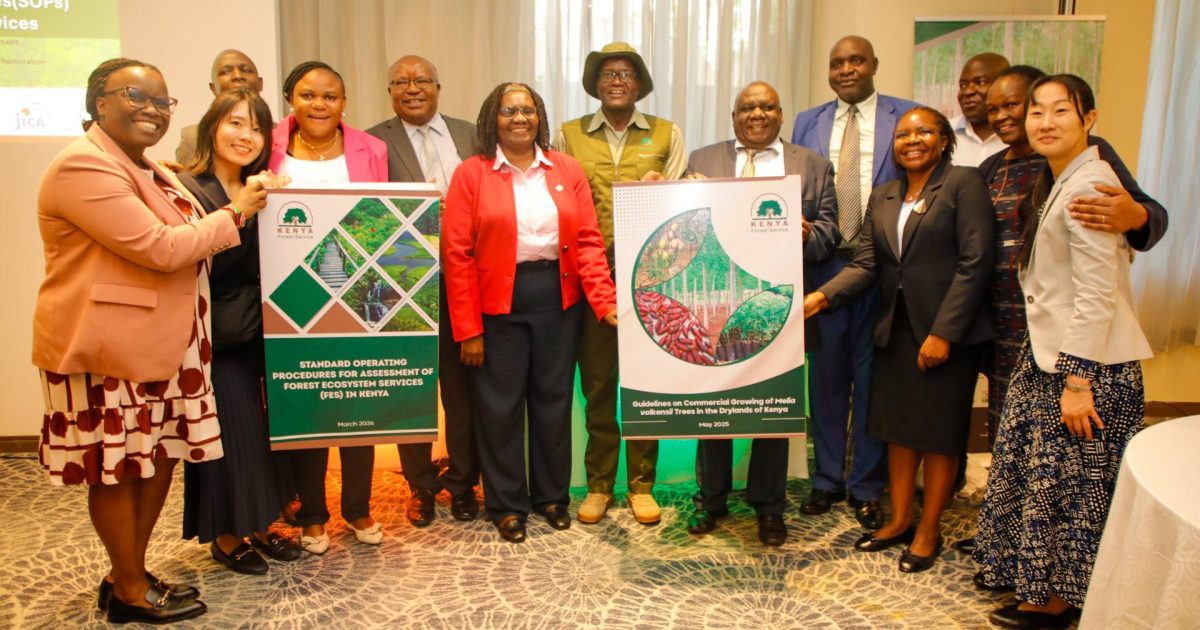
The Kenya Forest Service (KFS) has emphasised the need to scale dryland forestry, positioning the Melia volkensii tree as a drought-tolerant, high-value species capable of diversifying forestry systems.
KFS Principal Senior Deputy Chief Conservator of Forests Dr Clement Ngoriareng said that the Melia volkensii tree is key in strengthening timber security, and enhancing livelihoods in Arid and Semi-Arid Lands (ASALs).
Speaking in Nairobi on Monday during the launch of the Guidelines on Commercial Growing of Melia volkensii Trees in the Drylands of Kenya and the Standard Operating Procedures (SOPs) for Forest Ecosystem Services, Dr Ngoriareng said that the launch of these documents reflects their strong institutional alignment and a shared commitment to translating policy into impact.
He underscored the strategic importance of these tools in advancing Kenya’s 15 billion tree growing initiative and the 30 percent tree cover target.
He further noted that success will hinge on effective implementation, sustained research, strong extension services, and adequate financing.
State Department for Forestry Secretary Administration Patrick Meso emphasised the need to bridge the policy–practice gap.
He noted that the guidelines offer actionable pathways for operationalising national forestry policies and called for coordinated implementation across national and county governments, the private sector, and local communities.
Ms Tae Ose, Project Formulation Advisor at Japan International Cooperation Agency (JICA), highlighted Japan’s long-standing technical cooperation with Kenya’s forestry sector, particularly through the SFS-CORECC project.
She emphasised capacity building, strengthened forest monitoring systems, and the importance of science-based, practical tools.
She situated the initiative within broader global cooperation frameworks such as Tokyo International Conference on African Development, reinforcing commitments to climate resilience, landscape restoration, and community livelihoods.
Ms Beatrice Atemo, Project Manager for SFS-CORECC, provided an overview of the two documents, highlighting their alignment with both national priorities and international commitments, and their contribution to Kenya’s global environmental and climate obligations.
Across all speakers, a consistent message emerged: while these frameworks are transformative, their impact will ultimately depend on effective implementation, strong partnerships, and sustained investment at the landscape level.
By Joseph Ng’ang’a