The Government is in the process of implementing a raft of measures in the tea industry in a bid to double smallholder farmers’ earnings to Sh. 100 per kilo of Greenleaf by the year 2027.
The measures, according to Cabinet Secretary (CS) for Agriculture and Livestock Development Mutahi Kagwe, are part of the comprehensive reform programme also referred to as 10-point plan aimed at improving tea quality, stabilizing prices and ensuring fair returns to farmers.
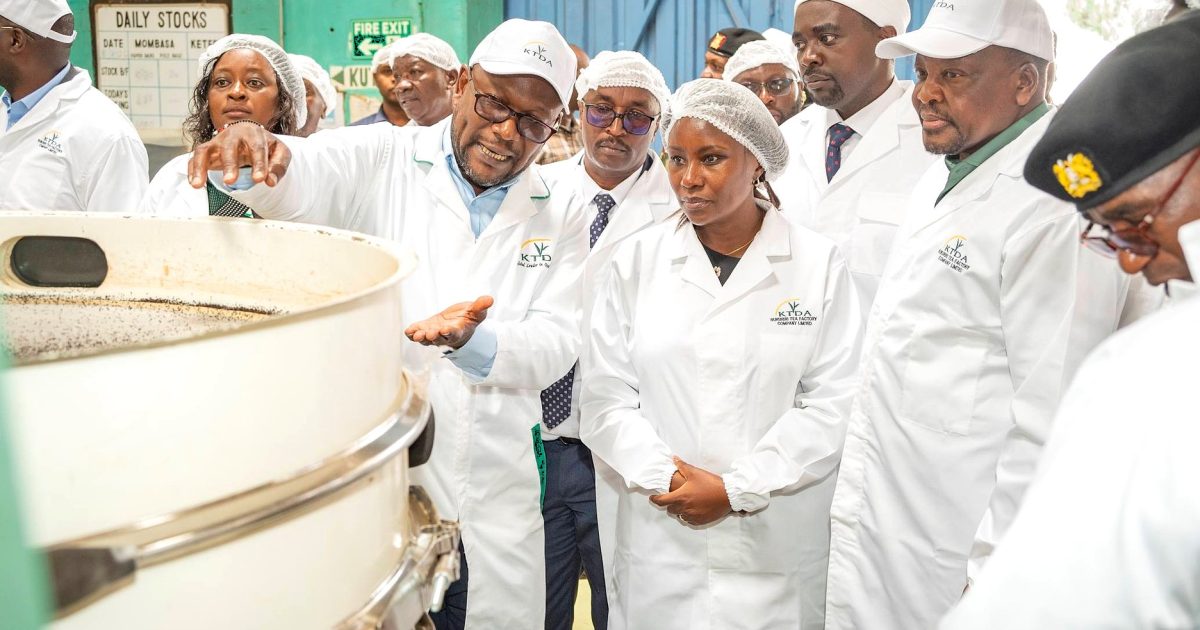
Speaking on Thursday at Rukuriri Tea Factory in Embu while releasing the 2025 Kenya Tea Industry Performance Report, CS Kagwe said the Ministry had finalized Greenleaf quality guidelines and created awareness of the same to all stakeholders and players in the tea value chain in order to enhance the quality of the tea.
This, he said, will aid in bridging the price gaps between the East and West Tea Blocks, where teas from the East of the Rift often fetch better premiums compared to those from the West, which is largely attributable to plucking standards.
He insisted on the maintenance of the “two leaves and bud” standard across the country to eliminate price disparities from the East and West Blocks, where the latter has for long adopted a volume approach over quality, thus hurting their prices.
Further to this, Kagwe said the Tea Board of Kenya had commenced implementation of the Strategic Tea Quality Improvement Programme (STQIP) to upgrade factories that have consistently been producing lower-quality tea.
The program uses an annual tasting competition to rank all factories and then select 15 lowest-ranked ones for capacity building to bring them at par with the rest.
To ensure conformity of Kenyan tea with market requirements, CS Kagwe said they were establishing a state-of-the-art laboratory in Mombasa to enable validation of the quality of made tea through scientific analysis.
He added that the lab will also perform microbial analysis and analysis of heavy metal contaminants, pesticide residues and emerging contaminants to ensure conformity with market demands.
“The facility is designed to ensure that Kenyan tea meets the stringent safety and quality standards of global markets,” he stated. The Lab also represents a shift from the traditional mouth-testing grading system to a scientific one.
Another key intervention he said they were implementing was modernization of factories whereby the State had provided Sh. 3.7 billion loan facility at a concessionary rate of 5 percent interest to help facilities upgrade machinery and also diversify into other high value products such as orthodox tea production.
He said the upgrade will help reduce over-reliance on the volatile CTC (Crush, Tear, Curl) tea production by venturing into products like orthodox tea that command higher prices in the market, especially in Europe.
To mitigate higher costs of production, the CS said factories have signed new management agreements that will see a reduction of management fees from 2.5 to 1.5 percent that will be a direct win for farmers’ pockets.
Other measures include a ban on tea hawking, digital marketing and sustainable funding of the tea industry programmes.
Meanwhile, the CS said the Government had instituted a 100 percent levy on imported teas under the Tea (Levy) Regulations 2025/26 as a protective measure against dumping and unfair competition.

He stated that the levy will be payable at the point of import or export and will eliminate dumping of low-quality and cheap teas that have for long suppressed the prices of Kenyan tea.
He noted that the levy was a consumer cost and does not in any way place any financial burden on Kenyan smallholder farmers.
The CS at the same time reported that tea sales reached Sh. 218.79 billion in 2025 marking an increase of 2 percent from the marketed value of Sh. 215.21 billion in 2024.
He also added that Kenyan tea reached 100 destinations in 2025 compared to 96 in the previous year, with emerging markets being Kazakhstan, Ireland and Japan.
Unlike the previous years where the reports were printed and distributed to farmers, last year’s results were released digitally through QR code scanning to help factories save on printing costs and also give farmers faster access.
By Samuel Waititu