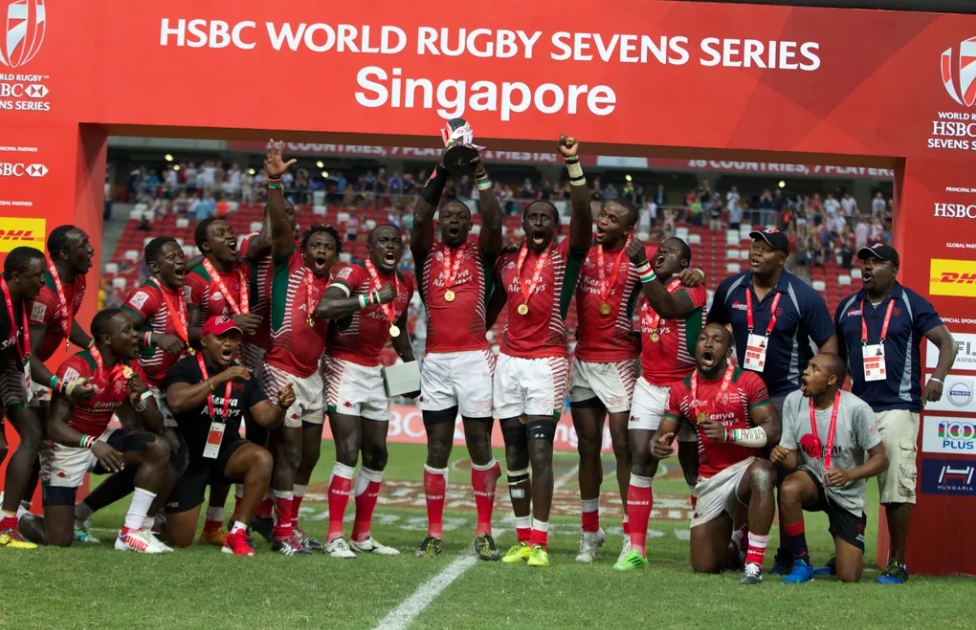
Kenya’s national rugby sevens team, Shujaa, announced themselves on the global stage in the 2003-2004 season by securing promotion to the top tier of the World Rugby Sevens Series. The achievement marked a major milestone for the side, as they joined the South Africa national rugby sevens team as the only African nations competing as full-time core teams at the time.
Kenya’s breakthrough on the global sevens stage had been years in the making, forged through grit and steady progress from the early 2000s.
In 2025, World Rugby introduced a revamped structure for the SVNS, creating a clearer pathway from regional qualification to the elite level. At the base of this system are continental competitions, where teams compete within their regions for a place in the next stage. In Kenya’s case, Shujaa topped the standings in the Africa Men’s Sevens to secure qualification for the Challenger level.
Shujaa progressed to the World Rugby Sevens Challenger Series, where leading teams from across the globe compete over three legs, each staged across two days. Kenya produced consistent performances throughout the series, finishing third at the Nairobi leg SVNS Challenger (14th-15th February 2026) and again placing third at the Montevideo leg SVNS Challenger (21st– 22nd March 2026).
Kenya closed out the campaign strongly with runners-up finish at the São Paulo leg SVNS Challenger (28th-29th March 2026), securing third place in the overall standings. That result saw Kenya qualify among the top four Challenger teams, earning a place in the next phase alongside the elite SVNS sides, where they would compete for core status.
The elite level of the SVNS is made up of eight core teams, who compete across the season for overall standings and core status. Kenya national rugby sevens team dropped out of this group after the 2024-2025 campaign, finishing ninth overall and suffering relegation.
The SVNS season is divided into two phases. The first is the regular season, where the eight core teams compete across six events to determine rankings. This phase also sets the stage for the final showdown, as the top teams are later joined by four qualifiers from the World Rugby Sevens Challenger Series for the jaw dropping World Championship phase.
The 2025- 2026 regular season began at the Dubai Sevens (29th-30th November 2025), before moving to the Cape Town Sevens (6th – 7th December 2025). The circuit then shifted gears to the Singapore Sevens (31st January -1st February 2026), followed by the Perth Sevens (7th– 8thFebruary 2026).
The final stretch of the regular season took place at the Canada Sevens (7th– 8th March 2026) and the USA Sevens (14th– 15th March 2026), completing the six-event schedule before the transition to the World Championship phase.
Phase two of the SVNS season begins with the World Championship stage, where the eight core teams are joined by four qualifiers from the World Rugby Sevens Challenger Series. This creates a 12-team field competing across three decisive events to determine the overall champion and next season’s core teams.
The opening leg takes place at the Hong Kong Sevens from 17th-19th April 2026. The tournament features three pools of four teams, with Kenya national rugby sevens team drawn in Pool C alongside Australia, New Zealand and the United States. Pool A consists of South Africa, Argentina, Spain and Uruguay, while Pool B features Fiji, France, Great Britain and Germany.
The series then moves to Valladolid Sevens (29th-31st May 2026) before concluding at the Bordeaux Sevens (5th-7th June 2026). These final events will determine both the overall SVNS champion and the eight teams that will retain core status for the following season.
“I want to congratulate the boys for the hard work and discipline they have shown this season. It has not been easy, but they have played with heart and belief to achieve this milestone.” Shujaa’s head coach Kevin Wambua said in an interview after the São Paulo leg.
“We are optimistic going into the World Championship Series. The players have shown they can compete against strong sides, and now it’s about staying focused and taking our chances.” Wambua added.
Under the guidance of coach Bill Githinji and the leadership of captain Benjamin Ayimba, Kenya began to make a lasting impression in 2001 after earning invitation status to the World Rugby Sevens Series. One of their early highlights included a narrow 12-7 victory over France, signaling their potential against established rugby nations. Despite this big win Kenya lost to Chile 35-12 in the Bowl semi-finals and finished 19th overall.
At the 2002 Commonwealth Games in Manchester, Kenya stunned one of the sport’s traditional powerhouses, Samoa, with a 28-20 victory. They followed this with an emphatic 19-0 win over Wales during the South Africa leg of the 2003 IRB Sevens Circuit.
Momentum continued to build as Kenya secured a notable 15-12 victory against Australia at the Hong Kong Sevens, one of the sport’s most prestigious tournaments.
By the 2003-2004 season, Kenya’s consistent performances earned them core team status on the series, cementing their place among the elite in international rugby sevens.
Following their establishment as a regular presence on the World Rugby Sevens Series, Kenya transitioned from a side built on veteran leadership into one entering its most successful era.
At the 2006 Commonwealth Games in Melbourne, Kenya claimed the Bowl title, underlining their growing competitiveness, even if still outside the Cup elite.
Their true global breakthrough came at the 2009 Rugby World Cup Sevens in Dubai. Under coach Benjamin Ayimba, Kenya shed their long-standing whipping boy tag, with a stunning 26-7 quarter-final victory over defending champions Fiji.
They fell 12-0 to Argentina in the semi-finals, ending a historic run that saw Kenya finish joint third. Argentina progressed to the final, where they were defeated by Wales.
That same year, Kenya reached their first-ever Cup final in the series at the Adelaide Sevens, finishing runners-up after a 26-7 loss to South Africa.
This period was defined by a core group of influential players. Collins Injera finished as the 2008-2009 World Series top try scorer with 42 tries, while tactical playmaker Lavin Asego who played a central role in shaping Kenya’s attacking identity, becoming the first Kenyan to breach the 1000-point barrier in the world series. Humphrey Kayange, Injera’s brother earned a nomination for IRB Sevens Player of the Year. In fact, New Zealand coach, Gordon Tietjens voted Kayange as one of the best Sevens players in the world when he was asked to name his ideal 7.
These victories not only secured Kenya a place among the series’ core teams but also signaled the arrival of a new force in international sevens rugby, one built on years of persistence, exposure, and gradual progress rather than overnight success.
Kenya national rugby sevens team continued to establish themselves on the World Rugby Sevens Series circuit with a run of steady performances during the early 2010s.
At the 2013 Rugby World Cup Sevens in Moscow, Kenya, under coach Mike Friday nicknamed Otoyo by Kenyans, topped Pool C with victories over Samoa and advanced to the semi-finals after defeating France 24-19 sudden death extra time in the quarter-finals. Their campaign ended with a loss to England in the last four 12-4, before falling to Fiji 29-5, in the third-place playoff to finish fourth overall.
They carried that momentum into the 2013-2014 IRB Sevens World Series season, finishing seventh overall with 84 points. A standout performance came at the Sydney Sevens 2014, where they secured an impressive fifth-place finish.
However, inconsistency remained a concern under head coach Felix Ochieng. This was evident in a disappointing 13th-place finish at the London Sevens. Off the field, internal challenges, including administrative disputes and player unrest over unpaid salaries, further disrupted the team’s progress. Kenya ultimately finished 13th overall, narrowly avoiding relegation, with a Plate semi-final appearance losing 21-5 to Australia at the Wellington Sevens among their few bright spots.
The 2015-2016 season saw Kenya’s national rugby sevens team engrave their name into the history books, emerging as African underdogs to win a leg in the World Rugby Sevens Series. Under head coach Benjamin Ayimba and captain Andrew Amonde, Kenya stunned the rugby world at the Singapore Sevens 2016. Facing Fiji national rugby sevens team in the final, Shujaa produced a commanding display to secure a 30-7 victory, their first-ever World Series title.
At the heart of Kenya’s success was Collins Injera, one of the country’s finest players, who proved instrumental throughout the campaign. Earlier, at the Hong Kong Sevens, he reached a remarkable milestone, scoring his 200th career try, further cementing his legacy as one of the greatest try-scorers in rugby sevens history.
Following their historic 2016 triumph, the Kenya national rugby sevens team remained competitive on the global stage, returning to prominence in 2018 with runners-up finish at the Hong Kong Sevens 2018.
Kenya reached the final after a commanding 21-12 victory over New Zealand national rugby sevens team in the semi-finals, a match that also saw Willy Ambaka score his 100th career try.
They ultimately fell 24-12 to the Fiji national rugby sevens team in the final, but the performance underlined Kenya’s ability to compete with the world’s elite.
In the seasons that followed, however, consistency proved elusive. Kenya slipped back into a pattern of mid-table finishes, struggling to maintain the momentum of previous years. A brief resurgence came in 2021, when Shujaa delivered strong performance at the Canada Sevens, on September 26th 2021, after defeating the hosts Canada 33-14 securing third-place finish at the events and hinting at a return to form.
The team’s identity also evolved during this period. The nickname “Shujaa,” officially adopted by the Kenya Rugby Union (KRU) in 2021, became a defining symbol of the side. However, performances on the field failed to match that renewed identity. A prolonged dip in results eventually saw Kenya lose their core-team status in the SVNS.
The decline of the Kenya national rugby sevens team began to take shape after the Los Angeles Sevens 2022, where they finished sixth. Their campaign ended in the quarter-finals with a heavy 40-14 defeat to eventual champions Australia national rugby sevens team.
In the fifth-place playoff, Kenya suffered another setback, falling 29-7 to Argentina national rugby sevens team, as they went through Shujaa’s defense like hot knife through butter.
Rather than a sudden collapse, the relegation was the result of a steady decline over several seasons. By 2023, with Damian McGrath in charge, the team reached its lowest point, dropping out of the elite tier and marking the end of their 19years of long-standing presence among the core teams.
Damian McGrath took charge of Kenya national rugby sevens team in 2019, overseeing a difficult transition period marked by inconsistency and gradual decline. Captain Nelson Oyoo led the side through a challenging rebuild, but results continued to fade. The downturn ultimately culminated in relegation from the SVNS in 2023 where they failed to win a match.
The relegation was met with frustrations expressed through different social media platforms from different players, rugby groups and supporters of the sport.
“We didn’t envision this outcome 19 years ago when we elevated Kenya to core status.” Dennis Mwanja, a member of 2004-2007 squid posted on twitter.
“Someone tell me I am dreaming; I sympathize with the boys. Life-changing result at the London Sevens.” Lamented Dennis Ombachi retired Kenya 7s star.
“Kenya Rugby Union (KRU) needs to overhaul the structure of its leagues and competitions starting with the next 7s circuit and the 15s competition if we’re ever to return to play in the HSBC. Merge the lower tier clubs to form stronger teams and more competitive leagues. Invest in a Kenya 7s academy and put them on contract.” Kenya Rugby Players Association posted on their Facebook page after the relegation.
The slide ultimately forced a reset for the Kenya national rugby sevens team, highlighted by a 40-7 victory over Japan in April that offered a glimpse of their potential during a difficult period.
Head coach Damian McGrath departed soon after, paving the way for his assistant Kevin Wambua to take charge on 4 August 2023. A former rugby union player, Wambua nicknamed Bling, moved quickly to stabilize the squad, working alongside co-captains Samuel Asati and George Ooro to rebuild both structure and identity.
A defining moment of that resurgence came in Harare, where Kenya edged South Africa national rugby sevens team 17-12 to win the 2023 tournament and secure qualification for the Olympic Games.
That reset sparked an immediate response. Competing in the World Rugby Sevens Challenger Series, Shujaa strung together strong performances to secure a place in the promotion playoffs. They capitalized on that opportunity, earning their return to the top-tier SVNS in 2024 and completing a swift turnaround.
However, the comeback proved short-lived. Back in the 2024-2025 SVNS season, Kenya struggled for consistency against elite opposition and finished ninth overall, narrowly missing out on the top eight required to retain core status, and were relegated once again to the Challenger pathway.
By Victor Ngugi