Murang’a County has partnered with various stakeholders to introduce organically grown food into its school feeding programme, in a bid to promote healthy eating from an early age while creating reliable markets for farmers using regenerative agriculture practices.
Five implementing partners have launched their coordinated agroecology projects supported by The Rockefeller Foundation. They are Kenya Organic Agriculture Network (KOAN), Digital Green, Participatory Ecological Land Use Management (PELUM) Kenya, Institute for Culture and Ecology (ICE), and Practical Action.
Speaking at a Murang’a hotel during a joint inception meeting, Rockefeller Foundation Director Betty Kibaara, responsible for leading the implementation of the Regenerative School Meal Initiative in Africa, said that Murang’a county was selected because it already has an agroecology policy, a clear strategy, and an existing school feeding programme.
“We want to promote school meals where food is produced in ways that heal the soil and support efficient water use,” she said.
“We are creating a strong linkage between school feeding programmes and regenerative agriculture.” She added.
Kibaara emphasised that access to nutritious, organically grown food is critical for children’s growth and development and helps improve concentration and learning outcomes in school.
She added that the foundation will work with multiple partners to ensure the programme’s success, noting that it will cost over USD 26 million to transition 20 percent of farmers in the county to regenerative agriculture.
“We hope that after the initial transition that will be done by the partners the county will take up the initiative and adapt it fully as part of the school feeding programme,” She noted.
Murang’a County Executive Committee Member for Devolution and External Linkages, Kiringai Kamau, said the programme is centered on improving the health and well-being of residents, starting with children.
“We are focused on sustainability and empowering communities through schools so that children grow up with the knowledge of producing and consuming healthy food.” He said.
He added that the programme, launched in partnership with agroecology stakeholders and funded by the Rockefeller Foundation, will integrate agroecology into schools, giving children a strong foundation in nutrition and sustainable food systems.
“We will begin with 15 wards and later scale up to the remaining 20 wards across the county,” he said, adding that the county government will also ensure that farmers supply food that meets school standards and is produced using agroecological practices.
Kamau observed that the initiative will promote indigenous crops such as arrowroots, sweet potatoes, and millet in school meals, enhancing dietary diversity and nutrition.
He added that Murang’a is also advancing a “food as medicine” approach under its Food Pharmacy initiative, which encourages healthy eating to reduce the risk of lifestyle diseases.
We are establishing demonstration gardens in schools to teach children how to grow food organically and understand the nutritional value of different foods,” Kamau said.
PELUM Kenya Head of Programmes Manei Naanyu explained that the organisation is setting up agroecological kitchen gardens in public primary schools, turning them into practical learning centers where 4K clubs, teachers, and nearby communities can gain hands-on skills in agroecological farming and nutrition.
She said that the programme aims to reach 1,500 pupils and 2,700 smallholder farmers across six sub-counties, helping to strengthen a local food system that can sustain school feeding programmes.
Practical Action, working alongside KOAN and the Research Institute of Organic Agriculture (FiBL), is grounding this initiative in a participatory Market Systems Development approach. Their emphasis on raising consumer awareness and influencing behaviour is essential, since sustainable food systems rely on consumers who recognise and demand the value of products grown through regenerative practices.
Practical Action Kenya Country Director Susan Maina said they will link farmers to markets, which will include schools prioritising the production of safer food through agroecology while ensuring farmers have access to stable markets.
“Together with our partners, we encourage farmers to take care of the soil by avoiding harmful chemicals that have been linked to many illnesses.” She said.
Maina noted that both local and international markets are increasingly demanding organic food, presenting farmers with growing opportunities while ensuring consumers access safer, healthier products.
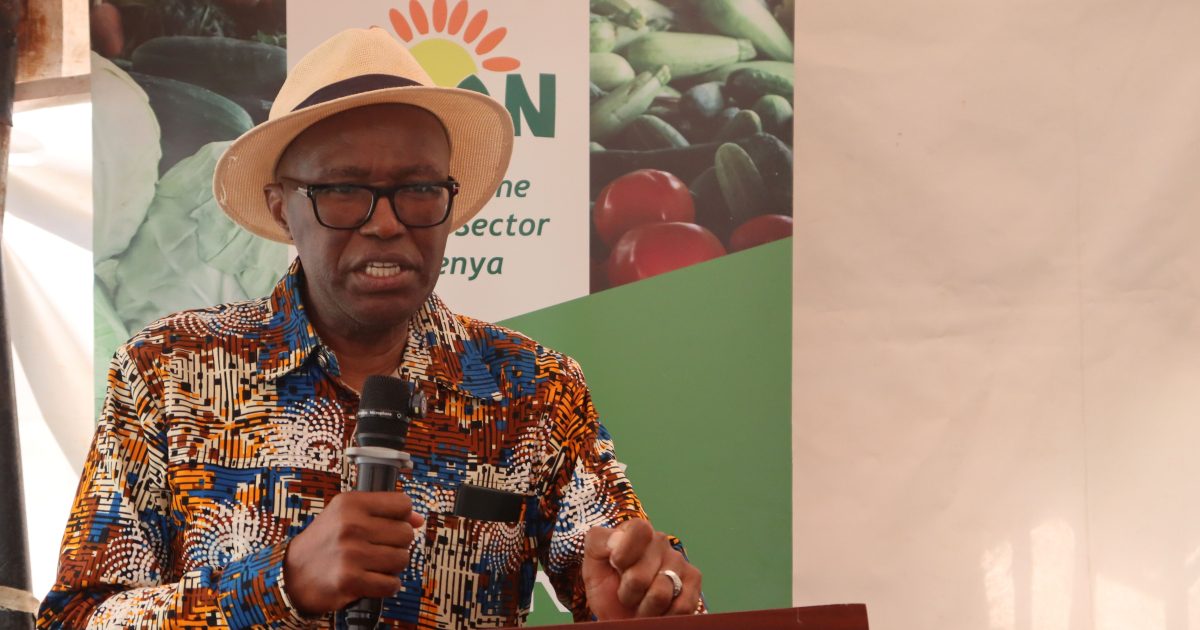
KOAN CEO Eustace Kiarii Said KOAN’s Kilimohai mark through a Participatory Guarantee System (PGS) is designed to certify agroecological produce in a way that is accessible to smallholder farmers
He said that the organisation aims to organise at least 800 farmers into 40 groups, connecting them to schools, local markets, and other off-takers.
Digital Green Country Coordinator Jacqueline Wang’ombe, said that their FarmerChat mobile application, an AI-powered advisory tool, will provide farmers with real-time guidance on best farming practices, helping ensure food safety and quality.
She said the platform will also link producers to school meal buyers, closing the loop between advisory and procurement.
ICE executive director Martin Muriuki said ICE will enhance the governance of the Agroecology Multi-Stakeholder Platform by strengthening its capacity to mobilise resources and by putting into action an effective monitoring, evaluation, and learning system.
by Purity Mugo and Anita Omwenga