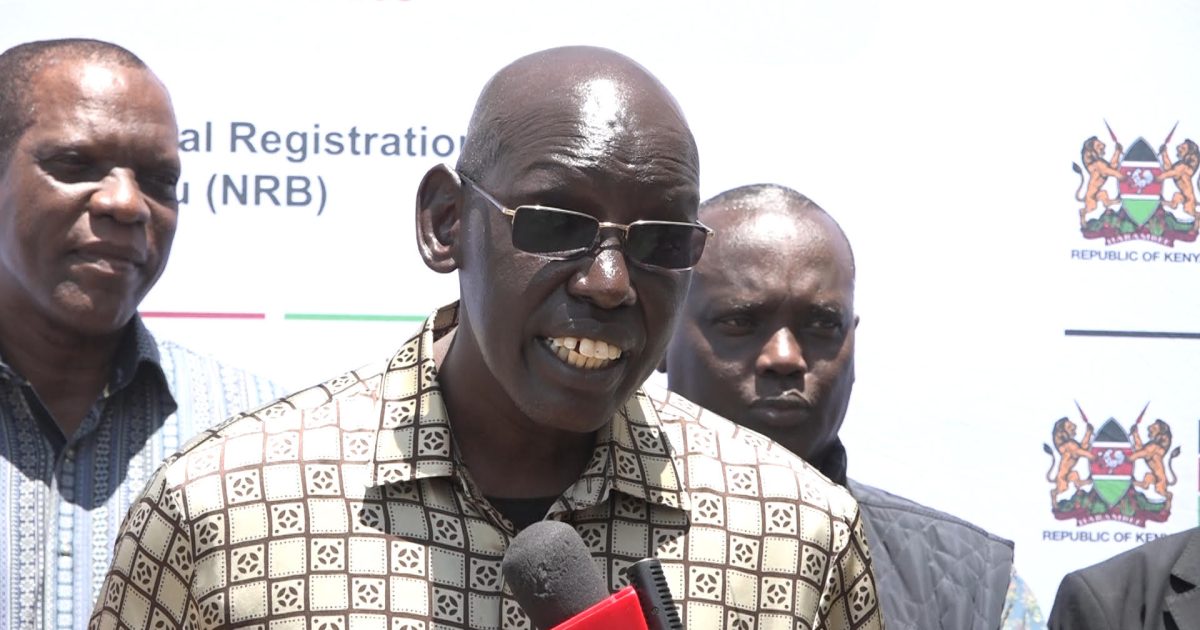
The government has urged Kenyans who applied for and have not collected their more than 400,000 new identity cards from national registration bureaus across the country to go and pick up the documents.
According to Immigration and Citizen Services Principal Secretary Dr Belio Kipsang, the documents are piling up in registration bureaus amid a nationwide voter registration conducted by the Independent Boundaries and Electoral Boundaries Commission.
While indicating that Nakuru County has 34,000 uncollected Identity Cards, Dr Kipsang pointed out that the government was concerned with the rising number of Kenyans who were not collecting their IDs after issuance.
At the same time, Dr Kipsang revealed that the government is revamping the national identity card system, introducing faster processing times that allow new applicants to obtain their ID cards in just one day.
This reform is designed to enhance public service efficiency, minimize bureaucratic delays and provide citizens with quicker access to essential identification documents.
He said the changes follow heavy investment in modern technology, which has streamlined the application and production process across the country.
“Our cards are now delivered between three and seven days, and if you are in Nairobi, you can even get them the same day. The level of technology we have invested has made the process very fast and efficient,” Dr Kipsang said.
For those outside the capital, the processing timeline has also been significantly reduced, with applicants expected to receive their IDs within three to seven days.
Dr Kipsang also asserted that the government has scrapped all fees related to ID applications and replacements, following a directive by the President to waive the previous charges of Sh300 for new applications and Sh1,000 for replacements.
Speaking at the Rift Valley National Polytechnic within Rongai Sub-County during a sensitization forum for chiefs and assistant chiefs dubbed “Integrated Population Registration Services”, the Principal Secretary directed that the uncollected identity cards be moved from national registration bureaus to chiefs’ offices where the local administrators will trace holders of the documents to their villages and homes.
Dr Kipsang said following the abolition of vetting for ID applicants by President William Ruto, an alternative way had to be put in place to help identify Kenyans who deserve to benefit from national IDs and other government documents.
“Chiefs and their assistants are the only ones who are not transferable, and they have a better understanding of people living within their jurisdictions,” said Dr Kipsang.
Dr Kipsang asked all Kenyans who applied for the IDs to collect them and use them to get government services and also register as voters.
The Principal Secretary said the sensitization was going on along with mobile registration of persons, which had so far been done in Narok, West Pokot, Baringo, Turkana and Elgeyo Marakwet, and was now heading to Kajiado, then Isiolo, Samburu and Marsabit.
He said the counties being covered first were those initially affected by vetting. “These are counties which have inaccessible terrain with residents who cannot easily reach the registration centres,” noted Dr Kipsang.
He said the government had so far acquired 56 vehicles for the mobile registration exercise and also ordered 600 live capture equipment, out of which 200 had been delivered.
“We are now leveraging technology to improve service delivery and currently, there are no queues even at Nyayo House,” said Dr Kipsang.
“We are ensuring that even if it’s through manual application, the IDs have to be ready within 7 days,” said Dr Kipsang.
The Principal Secretary said the IDs were important in helping Kenyans register for SHA, among other government programmes, including online services that benefit mostly youth.
Dr Kipsang said quick services and easy access to national documents will speed up expansion in all sectors of the economy.
“When Kenyans easily access crucial documents, they are able to engage in various activities that end up spurring economic growth,” he said.
He clarified that foreigners residing in Kenya, including refugees and asylum seekers, are issued alien cards through a separate legal process, which does not grant them voting rights.
“For foreigners, there is a clear process they must follow. Refugees are issued with alien cards, not national IDs, and without a Kenyan ID, one cannot vote,” he explained.
Dr Kipsang further raised concerns over the low number of new ID applications, especially in arid and semi-arid regions, despite the removal of vetting committees in border communities, a move aimed at making the registration process easier.
He also highlighted that elderly citizens remain underrepresented in ID applications, urging them to take advantage of the presidential directive allowing free application and collection of identification cards.
“We have made it as easy as possible. We urge every eligible citizen to acquire their ID and register as a voter,” he emphasized.
The government has assured the public that all necessary measures are in place to ensure the ongoing voter registration exercise runs smoothly and efficiently, ahead of the upcoming electoral processes.
By Jane Ngugi and Dennis Rasto