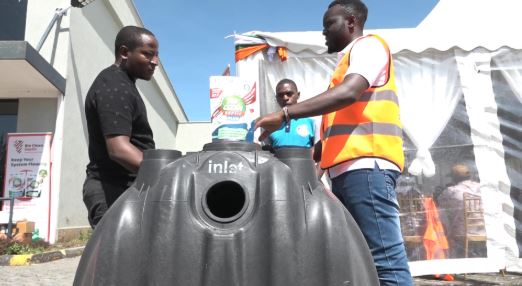
With land becoming scarce in urban areas, people are turning to biodigesters to save space and clean up waste.
According to Edward Kirugo, the founder of Bio Tank Biodigester System that specializes in installation of biodigesters, a biodigester is simply a tank that digests organic matter.
Mr. Kirugo indicates that if not properly managed human and animal waste contributes significantly to greenhouse gas emissions.
Bio Tank Biodigester System has devised a way of not only dealing with household waste and thus cutting greenhouse emissions, but also producing energy and manure for household use.
Through the system, organic waste such as food leftovers, animal or human manure and other household waste are converted into renewable clean energy and fertilizer.
“Bio Tank Biodigester manages organic waste daily and generates free cooking gas daily,” explains Mr. Kirungu. The system, he says, replaces the need to cook with polluting fuels like coal and wood.
The company, the founder indicates, has completed over 3,000 biodiversity sanitation system installations in seven years.
“The beauty of our product is simplicity,” explains Kirugo, “Your existing plumbing contractor can plug and play our solution. No separate contractor needed,” he says, describing how his bio-systems can handle everything from a single-family unit to 40-user apartment complexes.
Worldwide, waste generated per person per day averages 0.74 kilogram and global waste is expected to grow to 3.40 billion tonnes by 2050. Sub-Saharan Africa is one of the fastest growing waste generating regions, where more than half of waste is currently openly dumped.
“In Kenya, the massive rural urban-urban migration means that waste generation continues to rocket, yet a robust waste management system doesn’t exist,” says Mr Kirugo.
According to Mr. Kirugo, the waste management industry in the country has continued to evolve, while facing myriad challenges.
“One of the biggest issues is that 80 per cent of waste recycling is conducted by the informal sector. Unlike developed countries where municipalities are enablers, in Kenya, most funding comes from the private sector and it’s often not sustainable. This lack of funding, he says, affects the quality of equipment used in the industry.
Lack of land for waste management, Mr Kirugo says, is another major hurdle for the industry, which has seen such enterprises encroach road reserves and riparian land.
He indicates that one of the most important aspects of Bio Tank Biodigester is that the systems are compact and everything is done on site.
“Our customers are varied: some are suburbanites, off-gridders and tiny houses that want to use renewable energy while recycling all of their organic waste”, explains the founder.
“Our goal was to impact the world on many levels and today, we are impacting important, pressing issues around the world such as climate change, waste management and renewable energy,” says Mr Kirugo.
He adds “While flush toilets use an average of nine litres of water per flush, the Bio Tank Biodigester only requires 1.2 litres, meaning that you can save up to 40,000 litres of water a year.”
Mr Kirugo observes that Kenya is leading in Africa when it comes to policies on biogas as well as biogas investment on the continent.
He affirms that the firm has far-reaching effects on cutting down carbon dioxide emissions in Kenya and by extension the whole of Africa.
“This groundbreaking achievement aligns with the company’s ambitious goal of reducing 1 percent of global greenhouse gas (GHG) emissions by 2030.”
He further observes that the company serves as a global benchmark for innovative technology and efficient business operations, creating a profound impact worldwide.
Mr Kirugo regrets that the uptake of biogas technology is still low in the country despite its potential to provide clean energy.
“Currently, we have about 22,000 biogas digesters in Kenya and about 30,000 in Ethiopia. The potential in sub-Saharan Africa is 32 million biodigesters,” he says.
He points out that the cost of installing the biodigesters remain one of the hurdles. Other hurdles include insufficient government support, the general lack of demand and of awareness of the existence and benefits of biodigesters.
Biodigesters help to cut methane emissions while producing renewable energy.
It can help reduce methane and black carbon emissions while producing cleaner fuel for cooking, lighting, and electricity.
He states that one biogas system has the potential to save four and a half tonnes of carbon dioxide equivalent from methane emission and avoided deforestation.
“A lot of households rely on firewood collection but if you have a biodigester, you do not have to go to the forest to collect firewood,” he says.
Mr Kirugo notes that a biodigester also helps to improve the air quality as it does not emit smoke.
He says air pollution kills more people than HIV and malaria combined.
The World Health Organization says approximately 19,000 people die each year in Kenya due to air pollution.
The 2022 Kenya Demographic and Health Survey indicates that 58 per cent of Kenyan households have electricity, including 90 per cent in urban households and 36 per cent in rural households.
KDHS says 24 per cent of the household population in Kenya has access to clean fuels and technologies for cooking, including stoves/cookers using electricity, LPG/natural gas/biogas, solar, and alcohol/ethanol.
Use of clean fuels and technology for cooking is substantially higher in urban areas than in rural areas at 59 per cent versus six per cent.
Economic Survey Report, 2022 indicates increasing cases of diseases of the respiratory system largely associated with air pollution.
The survey shows that cases handled in 2020 were 16,562,227 while in 2021, reported cases were 20,613,455 indicating an increase by 21.9 per cent.
Nakuru County Executive Committee Member (CECM) for Water, Environment, Energy, Climate Change, and Natural Resources Dr Nelson Maara said the technology reduces costs of fuel in households almost by a half.
The biodigester technology, he added, is also expected to ensure there is food and nutrition security which will boost incomes for more than 5,000 households by 2022.
Dr Maara noted that it is critical to ensure that the biodigester technologies provided to Kenyans are functional and well-suited for their energy and bio-fertilizer requirements.
He pointed out that local climate actions are tied to the country’s global mitigation commitment.
Currently, Kenya’s National Determined Contribution (NDC) targets to cut emissions by 32 per cent by 2030, compared to a business-as-usual scenario of 143 metric tonnes of carbon dioxide (CO2) emission.
“It is our belief that the Kenyan cooking sector will offer a significant prospect for climate action and sustainable development. A bio-digester intervention is considered as one strategy for reducing greenhouse gas emissions,” he said.
According to the Kenya Biogas Programme, the average ton of deforestation prevented by construction of one bio-digester is 1.08 tonnes per year.
In addition, construction of one bio-digester reduces an equivalent of 13.1 tonnes of carbon dioxide (CO2) per year.
“Climate change continues to be a key issue in the global development and sustainability goals. You and I must ensure that we consume less energy, reduce wastage and use renewable energy. These efforts can go a long way in reducing greenhouse gas emissions. Interventions like the one we are witnessing today can make a significant contribution to the nation’s contribution to climate carbon emission reduction,” Dr Maara said.
by Jane Ngugi and Dennis Rasto