For decades, pig rearing in many rural Kenyan communities was viewed with scepticism, often relegated to the margins of livestock farming. Today, however, it is emerging as one of the most viable and transformative agribusiness ventures for smallholder farmers.
One such person who has dared into this venture is a 42-year-old David Kiprono, a resident of Meteitei village in Tinderet Sub-county, whose journey into pig farming has not only reshaped his household income but also inspired a growing number of farmers in the region to rethink traditional agricultural practices.
“I started with just two pigs in 2019,” Kiprono recalls, leaning against the wooden rails of his now expanded pig unit. “At the time, maize farming was no longer reliable due to erratic rainfall. I needed something that could guarantee returns within a short time.”
His decision reflects a broader shift among farmers in the area, where changing weather patterns and declining returns from traditional crops such as maize have pushed households to diversify into more resilient and profitable ventures. While fodder farming has gained traction in the area, livestock, particularly pigs, has become a preferred alternative due to its fast turnover and high demand.
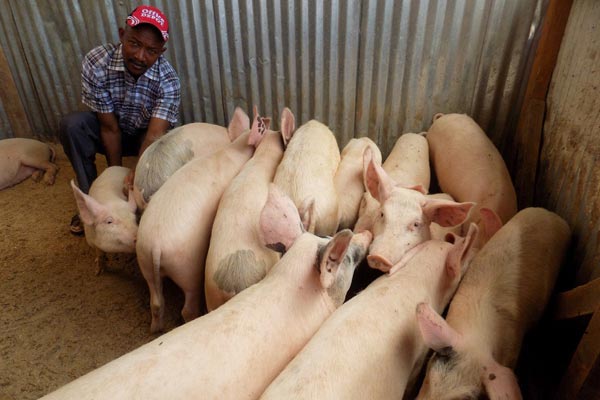
Kiprono’s pig enterprise has grown steadily over the past five years. From the initial two pigs, he now keeps 18 pigs, including four sows and one boar, operating on a semi-intensive system. On average, each sow produces 8 to 12 piglets per litter, with two litters annually, translating to nearly 64 to 96 piglets per year across his herd.
He sells his pigs at an average weight of 50 to 60 kilograms, fetching between Sh 20,000 and Sh 24,000 per pig, depending on market conditions. In 2025 alone, he sold 52 pigs, generating approximately Sh1.4 million in gross revenue.
“After deducting feed and veterinary costs, I made a net profit of about Sh 420,000,” he says. “That is far better than what I used to earn from maize on the same piece of land.”
Indeed, pig farming’s profitability lies in its efficiency. Pigs convert feed into body weight much faster than most livestock, significantly reducing production costs while maximising returns.
The rising profitability of pig farming is closely tied to increasing demand for pork across Kenya. Urban consumption has grown steadily over the years, driven by a growing middle class and changing dietary preferences.
Hotels, restaurants, and butcheries in nearby towns such as Kapsabet, Eldoret, and even Nairobi provide a ready market for farmers like Kiprono. Some farmers have also begun forming cooperatives to supply pork in bulk, enhancing their bargaining power and reducing reliance on middlemen.
“Nowadays, traders come directly to the farm,” Kiprono explains. “Sometimes I don’t even need to transport the pigs. They are bought on-site.”
This growing market has encouraged more farmers in Tinderet to venture into pig rearing. According to local agricultural extension officers, the number of households keeping pigs in the Ward has increased by nearly 40 per cent over the last five years, with most farmers starting with small units of between two to five pigs.
Beyond individual success stories, pig farming is having a ripple effect across the community. For Kiprono, the income from pigs has enabled him to educate his three children, improve his home, and invest in other ventures.
“I have built a permanent house and installed a water tank using proceeds from pigs,” he says. “I am also planning to expand into dairy farming.”
His wife, Mary, manages the day-to-day operations of the pig unit, highlighting another critical impact of the venture, women’s economic empowerment.
“Feeding and cleaning the pigs is my responsibility,” she says. “I also keep records of sales and expenses. This has given me financial independence.”
Pig farming’s relatively low space requirements and manageable labor demands make it particularly suitable for women and youth, who are increasingly taking up the enterprise as a source of income.
Despite its promise, pig farming is not without challenges. The high cost of feed remains the biggest hurdle, accounting for a significant portion of production costs.
“To raise one pig to market weight, you need a substantial amount of feed,” Kiprono explains. “If feed prices go up, your profits shrink.”
Diseases such as African Swine Fever also poses a significant threat, often wiping out entire herds if not properly managed. Limited access to veterinary services and high-quality breeding stock adds to the challenges faced by smallholder farmers.
“We have learnt the hard way,” Kiprono admits. “In 2021, I lost six pigs to disease. Since then, I have improved hygiene and vaccination.”
Additionally, lack of structured markets and price fluctuations can affect farmers’ earnings. While demand is high, the absence of formal contracts leaves farmers vulnerable to exploitation by brokers.
Perhaps the most profound change brought about by pig farming in Tinderet is the shift in perception. What was once considered a low-status activity is now recognised as a viable and lucrative business.
“People used to laugh at me,” Kiprono says with a smile. “Now they come asking for advice.”
Local leaders and agricultural officers are now encouraging farmers to adopt modern pig farming practices, including improved housing, feeding, and breeding techniques, to maximise productivity and profitability.
Training programmes and farmer groups are also being established to share knowledge and resources, further accelerating the growth of the sector.
As climate change continues to disrupt traditional farming systems, pig rearing offers a resilient alternative for farmers in Tinderet. Its short production cycle ensures quicker returns compared to many other agricultural enterprises.
“I want to increase my herd to 50 pigs in the next two years,” he says. “Pig farming has changed my life, and I believe it can change many others.”
By Sammy Mwibanda