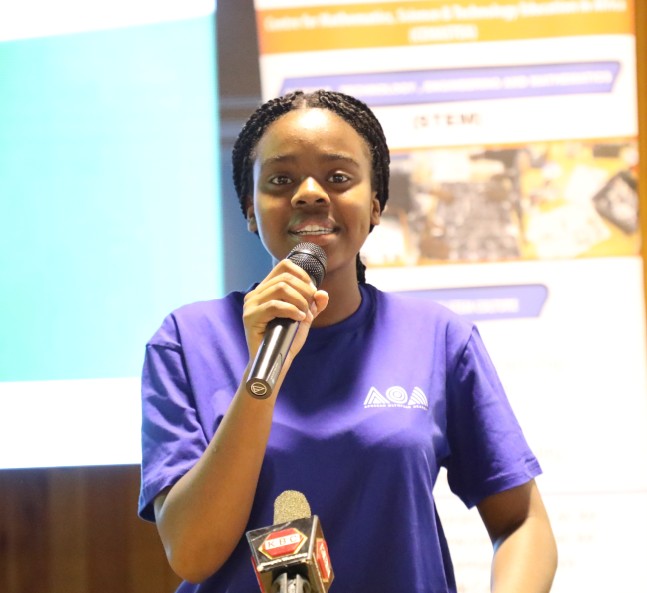
Kenya High School student Mitchelle Ombuna, 15, has challenged learners to develop a positive mindset and approach mathematics with confidence.
Speaking during the closing ceremony of the 2026 African Olympiad Academy (AOA) Rising Stars Training Camp at the Centre for Mathematics, Science and Technology Education in Africa (CEMASTEA), Karen Campus, Ombuna said many students end up failing the subject due to negative perceptions about mathematics.
She added that many students struggle with mathematics not because of lack of ability but due to attitude, stressing that consistent practice and problem-solving are key to mastery and success.
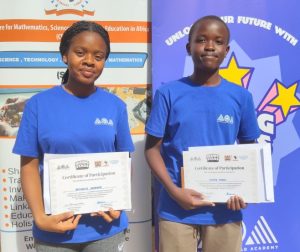
Ombuna was selected to join the African Olympiad Academy (AOA) in Rwanda on a 3-year full scholarship, alongside Caleb Tanui (15) from Alliance High School and Juni Pearl Mumo (15) from Alliance Girls High School, after emerging as the top-performing students.
The five-day residential camp, which started on April 8th to 12th, 2026, brought together 32 of the brightest young learners, selected from a pool of over 15,000 students through the Kenya Mathematics Olympiad selection process.
The African Olympiad Academy (AOA) programme is designed to identify and nurture students to compete on the global stage as they gain skills that will help them become innovative and contribute meaningfully to society.
During the camp, students went through intensive training, tackling very challenging problems and sitting rigorous tests.
Ombuna encouraged students to join CEMASTEA to get exposure to Science, Technology, Engineering, and Mathematics (STEM).
She said many learners continue to struggle with mathematics mainly due to attitude rather than ability, emphasising that confidence and consistent problem-solving practice are key to success.
“Math is not a hard subject; it is about your mentality. If you approach it positively and take time to think through problems, it becomes much simpler,” she said.
She described the experience at African Olympiad Academy (AOA) Rising Stars Training Camp as both challenging and enriching.
“Honestly, the experience has been interesting. The parts where it was quite challenging and the parts where it was fun made it a wonderful experience,” she said.
She said she is preparing for a more demanding academic environment, where she expects to face tougher challenges and size up against more advanced peers.
“I think after this I will go back, sit down, and work harder at a higher level compared to what I was doing. At AOA, I will meet smarter people and more difficult problem-solving tasks,” she said.
Ombuna explained that Olympiad mathematics is significantly different from classroom learning, noting that it emphasizes on critical thinking and independent problem-solving rather than direct application of formulas.
“In class, you are taught to apply formulas, but here you are given problems that require critical thinking. Sometimes you are not even given a formula; you have to figure it out yourself,” she said.
She added that while Olympiad mathematics is more demanding, it is also more effective in developing analytical and creative thinking skills.
“Even though it is more challenging, it is better because it engages your mind more and develops problem-solving skills. Classroom mathematics is simpler but limits creativity,” she noted.
Ombuna emphasised that success in mathematics largely depends on mindset and persistence.
“If someone asks me how to do math, I would say just look at a problem and try different ways to solve it. Your mentality is everything,” she said.
She further suggested that integrating Olympiad-style learning into the national curriculum could strengthen learners’ problem-solving abilities and improve overall educational outcomes.
“It is not a bad idea to add what we learn here into the curriculum. It would make students better at problem-solving, which would benefit the country,” she said.
She also highlighted the importance of collaboration in learning, noting that interaction with peers and mentors played a key role in improving her understanding of complex concepts.
“At first, I used to try solving problems alone, but I realised that you need help from others. Discussions with teachers and fellow students really helps,” she said.
Ombuna credited her teachers and mentors for guiding her journey and supporting her selection into international-level training opportunities.
Another participant, Caleb Tanui, also 15, echoed similar sentiments, noting that Olympiad training is more challenging but more impactful because it builds deeper understanding and real-world problem-solving skills.
He observed that while Kenya’s education system is largely exam-oriented, Olympiad training focuses on practical problem-solving, suggesting that such approaches could strengthen the national curriculum.
Caleb also reflected on his 2025 AOA experience, describing it as highly competitive, where learners are constantly pushed to excel.
He thanked teachers and the parents for their support, saying the programmes will significantly contribute to his academic and personal growth.
The Co-founder and Executive Director of the African Olympiad Academy, Arun Shanmuganathan, said AOA aims to nurture world-class problem solvers capable of addressing complex challenges beyond academics, including in technology, research, and innovation.
He encouraged students to embrace Mathematics, “We encourage students to deeply understand concepts rather than rush to solutions.” “Mathematics is not just about memorising formulas or passing exams. It is about problem-solving and critical thinking,” he said.
The selected students will now proceed to the African Olympiad Academy in Rwanda, where they will undertake a rigorous Olympiad-focused curriculum alongside Cambridge A-Level studies, preparing them for continental and global competitions, including the International Mathematical Olympiad (IMO) and the Pan African Mathematics Olympiad (PAMO).
By Ian Chepkuto