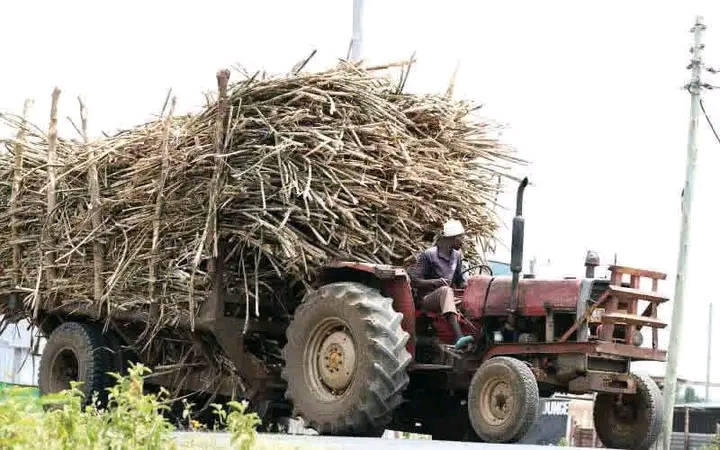
Sugar cane farming has steadily evolved into a defining pillar of economic growth in Nandi County, with Tinderet Sub County emerging as one of the region’s most vibrant production zones.
What was once a landscape dominated by subsistence crops is now characterized by vast stretches of cane fields, reflecting a shift that is transforming livelihoods, creating employment, and strengthening the rural economy.
In Tinderet, the transition to sugarcane has been driven by farmers seeking stability in an increasingly unpredictable agricultural environment. Maize farming, once the mainstay, has become less attractive due to fluctuating prices and rising input costs.
In contrast, sugarcane offers a more predictable income cycle, making it a preferred choice for many households.
Tinderet Sub County agronomist Josephine Chepkemoi says the shift is a clear indication of the region’s gradual move toward commercial agriculture.
“We are seeing farmers move away from subsistence crops to more reliable cash crops. Sugarcane gives them a structured income and allows better financial planning,” she explains.
For farmers on the ground, the impact is evident. Daniel Kiprotich, a farmer from Songhor-Soba ward, says sugarcane has brought financial stability to his household.
“Maize farming was unpredictable. With sugarcane, I know what to expect at the end of the cycle, and that has helped me even access loans,” he says.
Across the sub county, the economic benefits of sugarcane farming extend beyond individual households. Trading centres have grown busier, transport services have expanded, and casual employment opportunities have increased significantly.
The crop’s value chain has created jobs for a wide range of people, including farm laborers, transporters, loaders, and input suppliers.
Mary Jelagat, a farmer in Meteitei, notes that sugarcane has improved living standards in her community. “We are now able to educate our children, improve our homes, and even invest in small businesses. Cane farming has really changed our lives,” she says.
However, she points out that delays in harvesting and payments sometimes affect farmers’ earnings. “At times you harvest but have to wait before the cane is collected. That delay can be costly,” she adds.
The growth of sugarcane farming in Tinderet has also attracted investor interest, particularly in the establishment of processing facilities. These developments are expected to reduce the distance between farms and factories, lowering transport costs and minimizing post-harvest losses while creating more employment opportunities.
Economist Peter Langat says sugarcane’s potential goes beyond raw production. “If properly managed, sugarcane can support industries such as ethanol production, electricity generation, and manufacturing of by-products like molasses. This can significantly boost the county’s economy,” he explains.
Recent reforms in the sugar sector have played a crucial role in boosting the standing of sugarcane farming in Nandi County.
Government-led initiatives aimed at revitalizing the industry have begun to address long-standing challenges that previously discouraged farmers. Improved pricing frameworks, streamlined payment systems, and increased investment in extension services have restored confidence among growers.
Chepkemoi notes that the introduction of early-maturing cane varieties has significantly enhanced productivity. “Farmers are now harvesting earlier than before, which improves cash flow and overall returns. At the same time, we are strengthening extension services to ensure they adopt best practices,” she says.
The reforms have also improved coordination within the value chain, reducing inefficiencies that once plagued the sector. Farmers are increasingly experiencing more reliable market access and better engagement with millers, translating into improved earnings.
The pricing has also improved from about Sh.4, 500 to Sh. 5,200 per tonne.
Infrastructure development has further complemented these reforms. Efforts to improve road networks in rural areas are gradually easing the transportation of harvested cane.
While challenges remain, these improvements are helping reduce losses and ensure timely delivery to processing points.
Transporter Collins Tanui, who operates within Tinderet, says the growth of the sector has created new opportunities. “We now have more work transporting cane from farms to collection centres. The business has grown, and it is supporting many families,” he says.
Despite these gains, concerns about food security continue to emerge as more land is allocated to sugarcane cultivation.
The reduction in acreage under food crops has raised questions about long-term sustainability, particularly in ensuring household food sufficiency.
Langat emphasizes the importance of diversification. “Farmers should not rely entirely on sugarcane. Integrating food crops and livestock is important for resilience and food security,” he advises.
Farmers themselves are increasingly aware of the need for balance. Kiprotich says that while sugarcane has become his main source of income, he still reserves part of his land for food crops.
“You cannot depend on one crop entirely. I still grow maize for my family even as I focus on cane,” he says.
The crop has not only improved household incomes but has also stimulated growth in related sectors, creating a ripple effect throughout the local economy.
With ongoing reforms strengthening the sector and increasing investor interest, sugarcane farming is poised to play an even greater role in Nandi County’s development.
By Sammy Mwibanda