Agriculture Cabinet Secretary Mutahi Kagwe has warned farmer co-operative societies, with the habit of taking up loans without a clear repayment plan, that the government will not continue to write off debts that do little to benefit farmers.
Kagwe says that the government has put in place stricter accountability measures that will be enforced across all agriculture value chains, with the hope of bringing an end to the era of repeated bailouts by the government.
However, the CS said the government was in the process of writing off debts in the coffee, tea and sugarcane subsectors.
But then again, he emphasised that the intervention is not tenable and cannot continue indefinitely.
“I think it is important for us to appreciate that the government does not have infinite money for write-offs when we do not even know or you cannot audit what that money was spent on,” he said.
“The problem is that the state is not able to plan for debts because they are endless and as a government, you are not planning for losses. So you cannot be able to say that in two years this is the amount of money you need for a debt write-off. That is why I am saying the only way to deal with this is to eliminate the concept of debt write-off,” he said.
The CS cited examples in the coffee subsector, where he noted many factory directors had borrowed loans beyond their capacity to repay and without knowledge of the farmers.
Kagwe lamented that the trend was so bad that the directors also lacked a business plan and accountability mechanisms, a situation he said had left the factories financially crippled.
While reassuring coffee farmers that the government would settle their Sh 6.8 billion debt, Kagwe also said that the enactment of the Coffee Act 2026 will address some of the fiscal management challenges that have long crippled the sector.
He told the farmers that the new law has proposed the formation of a Coffee Board, whose responsibility will include auditing the purpose of the loan, establishing who the beneficiaries are and how the cooperative will repay the loan before granting approval for a loan to be taken up on behalf of the farmers.
“We will also not allow people to commit innocent farmers to repay loans taken up in their name. We must know the purpose of the loan, and once the project for which the loan was taken up is complete, the beneficiaries who are the farmers must be invited to approve the project. Therefore, let us agree the government will not allow you to take a loan without a repayment plan,” said Kagwe.
The CS also raised concerns over the weak governance in cooperatives, noting that poor leadership is to blame for the endless woes that have bedeviled the sector.
To reverse the bad reputation, Kagwe urged farmers to demand for better management and transparency from their officials.
“It is critical and I am appealing to Kenyans who are members of cooperatives to first raise the quality of leadership they have within the cooperatives. Co-operative governance issues must be addressed so that the factories, which are business organisations, do not render themselves into debt,” he said.
“A lot of cooperatives that have borrowed the money, are for all intent and purposes broke because of those debts and that is why the government is stepping in to save the farmers. But we are not even saving the farmers from money they benefited from. Essentially what we are doing is giving the money to a few people, who run the factories down and that is not acceptable and it’s not even affordable as we move forward,” added Kagwe.
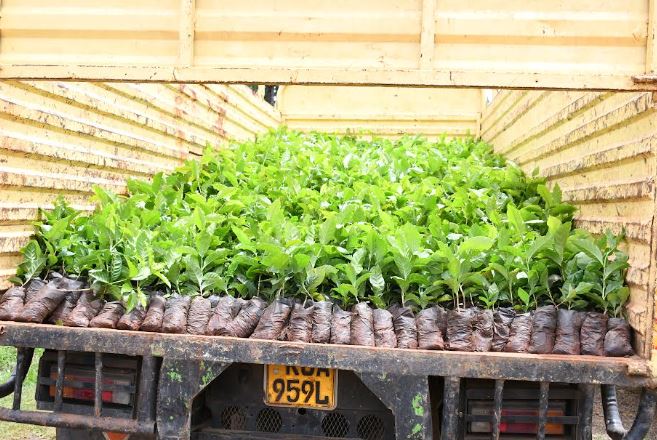
The CS spoke during a visit to the Gachatha coffee society in Tetu, where he also flagged off the distribution of some 200,000 coffee seedlings, which will be shared out to factories within Nyeri county under the National Coffee Revitalization Programme.
He said that through the revival programme, which will be undertaken in the 34 coffee growing counties, the government will distribute more than 10 million coffee seedlings to farmers for free through their cooperative societies.
He noted that the seedlings will help farmers increase the area under coffee plantation, as well as yields per bush from the current 2.5 kilograms per bush to at least 6 kilograms.
“This is another direct subsidy to farmers who are supposed to be buying these seedlings but we are saying, to support them and to support the rejuvenation of the coffee sector, let us try and provide seedlings to these people so that instead of buying a seedling they will be able to instead spend that money in other farm inputs that will improve the production,” said Kagwe.
Further, he hailed the fertilizer subsidy as a key enabler of the revitalization programme.
He said that in addition to increasing earnings for the smallholder farmers, a key priority for the government will be to triple the country’s coffee production from the current 50,000 metric tonnes to 150,000 metric tonnes per year.
By Wangari Mwangi