

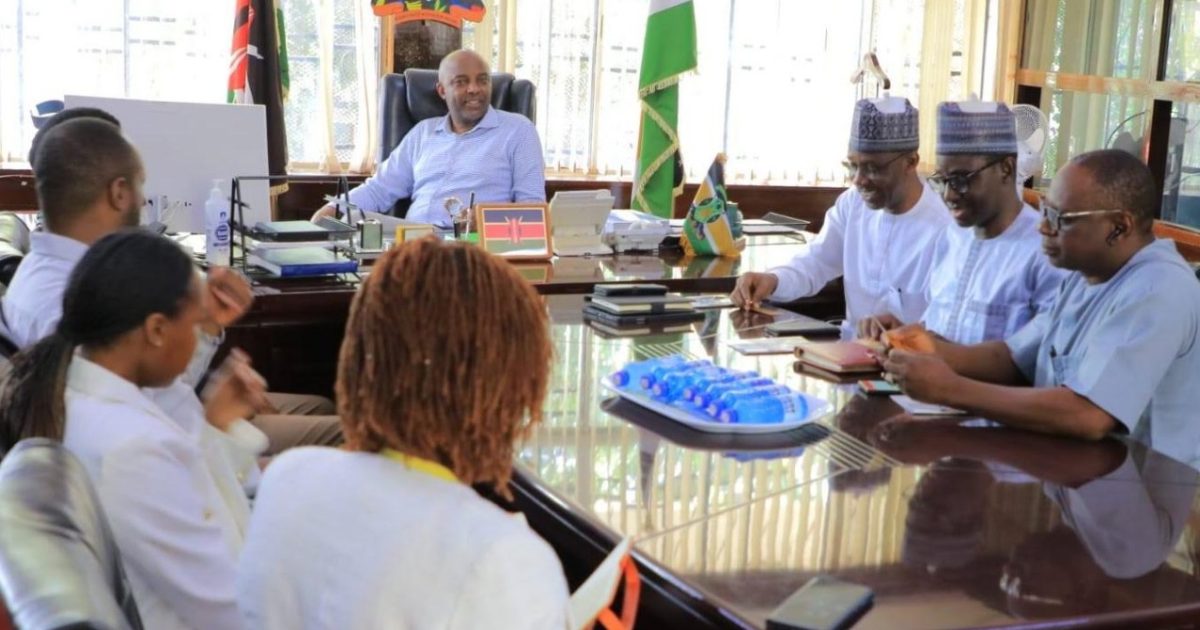
Digitisation of the health sector by the Murang’a administration has attracted continental recognition when a high-level delegation from Niger State in Nigeria arrived to study how the county is using innovation to tackle healthcare challenges.
Murang’a County is steadily emerging as a model for how technology can reshape healthcare delivery, drawing attention far beyond Kenya’s borders.
This growing reputation was evident on Friday when a senior delegation from Niger State in Nigeria toured the county to learn how innovation is being used to improve access to medical services.
The visiting team, led by the Permanent Secretary in Niger State’s Ministry of Health, Dr Usman Abdullahi Imam, included key officials such as Dr Junaidu Inuwa, Executive Director of the Niger State Primary Health Care Development Agency.
Their mission was simple but significant to understand what is working in Murang’a and explore how similar approaches could be adapted back home.
Rather than a routine courtesy call, the visit turned into a deep dive into Muranga’s evolving healthcare system, which has increasingly leaned on digital solutions and community-focused programmes.
Governor Irungu Kang’ata walked the delegation through several initiatives that are quietly transforming the patient experience.
At the centre of these efforts is the county’s telemedicine programme. In a region where access to specialists can be limited, this system has made it possible for patients to consult doctors remotely, reducing the need for long and costly journeys.
The delegation also showed keen interest in Kang’ataCare, Murang’a’s universal health coverage programme.
Designed to ease the financial burden of medical care, the initiative has enabled thousands of households to access treatment without the constant worry of out-of-pocket expenses.
Officials from Niger State engaged county staff in detailed discussions on how the programme is funded and managed, signalling a strong interest in replicating aspects of it.
Equally notable was Muranga’s use of teleradiology, a system that allows medical images such as X-rays and scans to be reviewed by specialists remotely.
This has significantly cut down waiting times for diagnosis and improved the accuracy of treatment decisions.
For the visiting team, it highlighted how relatively simple technological investments can have a far-reaching impact.
Automation within health facilities was another area that sparked discussion. Murang’a has digitised many of its services, helping to streamline patient records, reduce paperwork and improve overall efficiency.
Governor Kang’ata, while welcoming the delegation, emphasized that the county’s progress has been driven by a commitment to practical solutions that directly benefit residents.
He noted that partnerships and the smart use of technology have played a key role in making healthcare more accessible and affordable.
“Murang’a County is keen on leveraging technology and strategic partnerships to ensure our residents have access to affordable, quality and efficient healthcare services.
“We are pleased to share our experiences and learn from our counterparts as we work towards strengthening health systems across our regions,” said Kang’ata.
For Niger State officials, the experience offered a closer look at how innovation can be implemented in real-world settings, even with limited resources.
The visit underscored the growing importance of collaboration between regions, as governments look beyond their borders for ideas that can help improve lives.
By Bernard Munyao