The Independent Electoral and Boundaries Commission (IEBC) has registered over 2.6 million new voters following the conclusion of the Enhanced Continuous Voter Registration (ECVR) Phase I exercise conducted between March 30 and April 28, 2026.
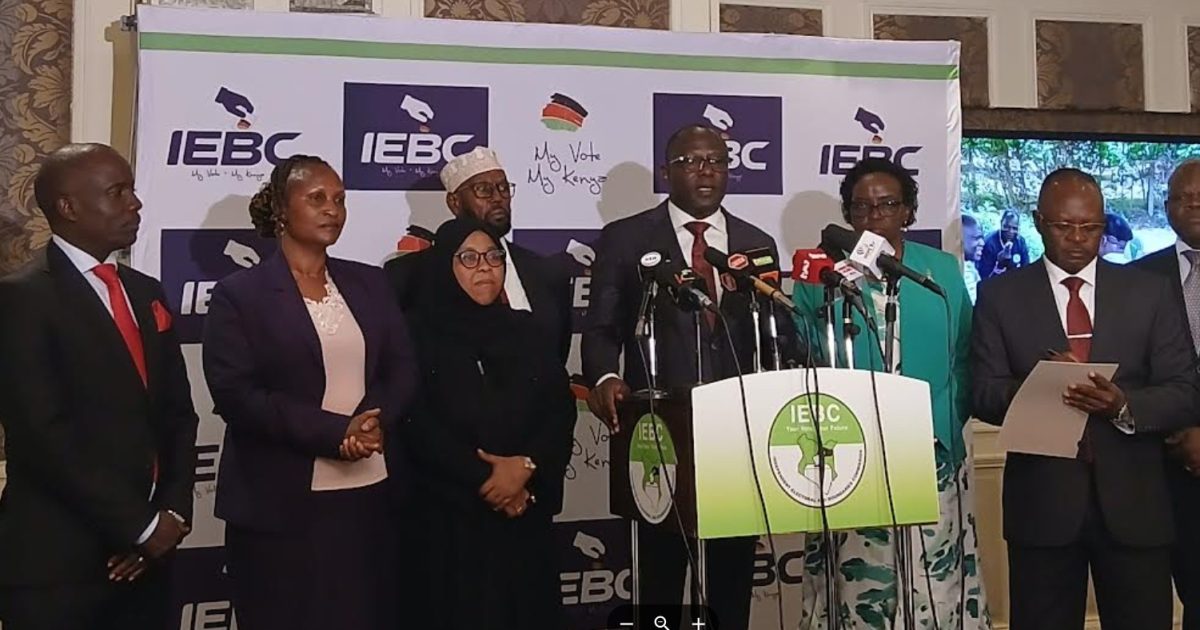
Speaking during the release of the final status report, IEBC Chairperson Erastus Edung Ethekon said the Commission enlisted a total of 2,612,725 new voters since the resumption of continuous registration in September 2025.
Of these, 2,345,476 were registered during the 30-day mass registration exercise, while 267,249 were captured earlier through routine registration at constituency offices.
“This is a major milestone in our preparations for the 2027 General Election,” said Ethekon.
“Within just 30 days, we surpassed our target of 2.5 million voters, demonstrating improved efficiency and public participation compared to previous cycles.”
The exercise was conducted across all 290 constituencies and over 1,400 county assembly wards, supported by 30,615 registration centres and 12,520 personnel.
The Commission also deployed 5,390 Kenya Integrated Election Management System (KIEMS) kits to facilitate biometric voter registration.
Ethekon attributed the improved performance to several strategic interventions, including the adoption of the “open kit” system, which allowed eligible voters to register at any centre regardless of their place of origin.
“This eliminated geographical barriers and enabled citizens working or studying away from home to register conveniently,” he said.
The Commission also expanded registration points to include universities, colleges, Huduma Centres and its Customer Experience Centre in Nairobi, increasing accessibility particularly among youth and first-time voters.
Additionally, the IEBC adopted data-driven planning and real-time monitoring, with weekly public updates on registration figures enhancing transparency and encouraging mobilisation in low-performing regions.
“Unlike previous exercises that relied on static census projections, we utilised dynamic ID-based data to guide deployment and resource allocation,” Ethekon noted.
He further credited the success to multisectoral partnerships involving national and county governments, civil society organisations, media, and youth groups, which helped mobilise citizens across the country.
Despite the achievements, the Commission acknowledged several challenges, including regional disparities in voter registration, logistical constraints in remote areas, and security concerns in some locations.
“Vast distances, limited infrastructure and harsh terrain in arid and semi-arid regions affected registration outcomes,” Ethekon said, adding that isolated incidents of threats to registration staff required enhanced security coordination.
The Commission also flagged the growing threat of misinformation during the exercise, emphasizing the need for continuous public communication and verification of official data.
Ethekon lauded Kenyans for turning out in large numbers, particularly young people, whom he described as “the energy that powered this exercise”.
“You proved that you are not just leaders of tomorrow, but active stakeholders today,” he said.
He also commended elderly citizens, pastoralist communities, women, and persons with disabilities for participating in the process despite various challenges.
As part of the next phase, the IEBC has begun the process of compiling and verifying the register of voters through a multi-stage system involving biometric data validation, de-duplication, and public inspection.
“Each voter’s details will undergo rigorous verification to ensure the final register is accurate, credible and free of duplication,” Ethekon explained.
He noted that once data cleaning and validation are complete, the register will be subjected to an independent audit before being gazetted as the official voters’ roll for the 2027 elections.
The Commission has encouraged registered voters to verify their details once the verification window opens and report any discrepancies through the established claims and objections process.
Continuous voter registration will proceed at Huduma Centres, IEBC constituency offices, and the Nairobi headquarters to ensure more eligible Kenyans are captured ahead of the August 10, 2027 General Election.
“The gains realised during this exercise provide a strong foundation for a credible and inclusive electoral process,” Ethekon said. “A reliable register of voters remains the cornerstone of free, fair and transparent elections.”
By Anita Kariuki and Celestine Lomolijah