Supreme Court Judge Isaac Lenaola has called on journalists to exercise responsible reporting while upholding truth and national cohesion, warning that media narratives will play a decisive role in shaping Kenya’s peace ahead of future elections.
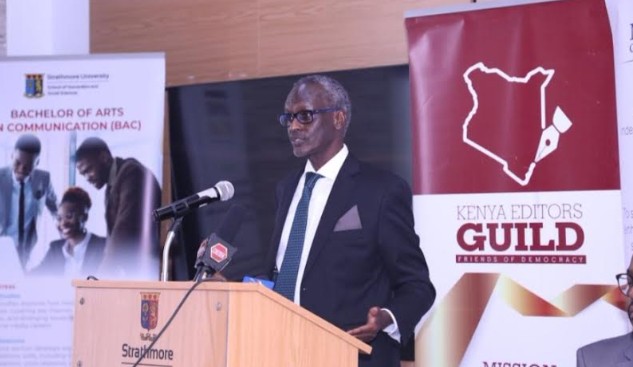
Speaking during the commemoration of World Press Freedom Day 2026 at Strathmore University in Nairobi, Justice Lenaola underscored the immense influence of the media in a rapidly evolving information landscape dominated by social media and emerging technologies.
“You are the heartbeat of the nation. Every headline, every breaking news alert shapes public perception,” Lenaola observed, urging journalists to remain accurate and measured in their reporting.
He cautioned that the widespread use of digital platforms has intensified the spread of misinformation, noting that a majority of citizens now rely on social media for news consumption.
“Misinformation spreads just as fast as information, sometimes even faster. The responsibility lies with you to ensure accuracy without inflaming tensions,” he remarked.
Drawing from Kenya’s past electoral experiences, the judge emphasised the need for peace-sensitive journalism, particularly as the country approaches another electoral cycle.
“The national moment must remain one of truth, not fear,” he stated, adding that journalists must present facts in a way that informs the public while safeguarding unity.
Justice Lenaola further challenged the media to adapt responsibly to technological advancements such as artificial intelligence, calling for ethical frameworks to guide their use.
“We must embrace innovation cautiously, ensuring that technology serves truth rather than distorts it,” he added.
Media Council of Kenya (MCK) Chairman Maina Muiruri echoed the call for a free and accountable press, describing media freedom as a cornerstone of democracy.
“A free press is the lifeblood of any democratic society. It equips citizens with the information they need to make meaningful decisions,” Muiruri noted.
He revealed that the Council had documented numerous cases of threats and violations against journalists in the past year, warning that such trends could escalate as the country moves closer to elections.
“This is unacceptable and must be condemned in the strongest terms,” he asserted, while pointing to the growing use of coordinated intimidation tactics targeting media practitioners.
Muiruri also highlighted the vulnerability of women and young journalists, who face disproportionate risks, including online harassment and workplace insecurity.
“Protecting journalists is not optional; it is fundamental to safeguarding democracy itself,” he maintained.
He added that the council continues to strengthen regulatory frameworks, including the enforcement of the Code of Conduct for Media Practice, to ensure professionalism and accountability within the industry.
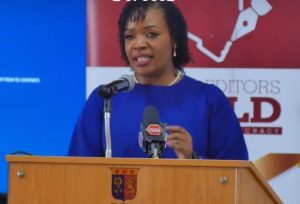
Kenya Editors’ Guild (KEG) President Zubeida Kananu called for an end to intimidation and legal harassment directed at journalists, stressing that press freedom is essential for a peaceful society.
“Peace is not merely the absence of conflict; it is the presence of justice and the safety of those who speak truth to power,” Kananu emphasised.
She likened journalism to a mirror reflecting society, cautioning against attempts to silence the media when uncomfortable truths emerge.
“When you don’t like the reflection, you don’t break the mirror; you fix what is wrong,” she stated.
Kananu revealed that more than 75 per cent of journalists expected to cover upcoming elections would be doing so for the first time, many in environments where safety remains a major concern.
“We cannot build a peaceful future when reporting the truth comes with fear,” she observed, calling for stronger protections, improved working conditions and mental health support for journalists.
She urged stakeholders to utilise formal mechanisms such as the Media Complaints Commission to address grievances instead of resorting to threats and intimidation.
“We must move toward a culture where the messenger is protected and the message is clear,” she added.
The event, organised by the Media Council of Kenya in partnership with Strathmore University and the Kenya Media Sector Working Group, was held under the theme “Shaping a Future at Peace”. It also featured the launch of the State of the Media 2025 Report, which assesses media performance and public perception in Kenya.
Stakeholders from government, media, academia, civil society and the technology sector attended the forum, focusing on the role of journalism in promoting accountability, countering misinformation and fostering social cohesion.
Participants agreed that strengthening media independence, enhancing journalist safety and embracing ethical innovation are critical to building resilient information systems.
As the country prepares for future elections amid a complex digital environment, speakers stressed that the role of the media will be pivotal in safeguarding democracy and national unity.
The commemoration concluded with a unified call for collaboration across sectors, with leaders affirming that a peaceful future depends on a free, responsible and fearless press committed to truth and public interest.
By Nicholas Ochieng and Nyawira Githinji