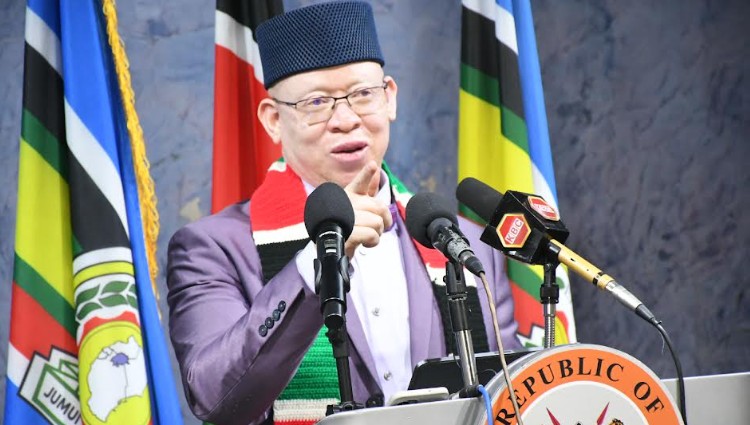
Government Spokesperson Isaac Mwaura has reaffirmed the government’s commitment to strengthening the education sector, announcing key reforms aimed at improving access, quality, equity and affordability across all levels of learning.
Speaking during a press briefing at Harambee House Annex in Nairobi on Monday, Mwaura said the Government had already disbursed Sh23.4 billion in capitation funds to public schools ahead of the reopening of the current term.
“The funds were released in advance to ensure smooth operations in schools and to ease the financial burden on parents,” he said.
He explained that primary schools receive Sh1,400 per learner annually, with funds distributed in a 50:30:20 ratio across the three school terms by the National Treasury through the Ministry of Education.
According to the spokesperson, the capitation is divided into two key accounts. Account One caters for learning materials such as textbooks, exercise books and teaching guides, while Account Two supports operational costs including wages, maintenance, utilities, examinations and co-curricular activities.
Mwaura dismissed claims that delays in capitation have forced schools to introduce additional levies, terming such assertions misleading and politically motivated.
“Disbursement is done before learners report to school. Any claims that schools cannot operate without charging extra fees are not valid,” he said.
He warned school administrators against imposing unauthorised charges on parents, emphasising that principals, as accounting officers, will be held accountable.
“We have seen attempts to introduce hidden costs. This is unacceptable, and action will be taken against those who exploit parents,” he cautioned.
Mwaura noted that the National Education Management Information System (NEMIS) continues to play a critical role in ensuring accountability by verifying student enrolment and preventing misuse of funds.
On teacher recruitment, he said the government has so far hired 100,000 teachers out of the planned 116,000 and constructed over 23,000 classrooms nationwide. Plans are also underway to build 1,600 laboratories and strengthen technical training institutions to support the competency-based curriculum.
In higher education, Mwaura highlighted reforms in the funding model aimed at making university education more affordable. He said the government has increased higher education loans by 69.7 per cent to Sh53.1 billion in the 2025/2026 financial year to ensure that no student is left behind.
He added that construction of 178,000 student accommodation units is ongoing under partnerships linked to the Affordable Housing Programme to address hostel shortages.
On healthcare, the spokesperson reported significant progress under the Social Health Authority (SHA), noting that coverage has expanded from less than 8 million to about 30.8 million Kenyans, representing approximately 65 per cent of the population.
“This marks a major improvement from the previous 16 per cent coverage under the defunct NHIF,” he said.
Mwaura further announced a landmark agreement between the government, teachers’ unions and the Ministry of Health to improve medical coverage for nearly 350,000 teachers. The deal eliminates co-payments and expands access to specialised treatment locally and abroad, including in India and Turkey.
He said the SHA has disbursed Sh284.3 billion and is working to streamline services through tariff standardisation and improved monitoring at the county level.
On housing, Mwaura said the Affordable Housing Programme continues to drive economic growth, with over 273,000 housing units under construction and more than 9,000 already completed.
He noted that the programme has created over 640,000 jobs, particularly benefiting youth, women and persons with disabilities.
“Construction remains one of the leading sectors in job creation, and we aim to generate up to one million jobs through this initiative,” he said.
Mwaura added that the Recognition of Prior Learning programme has so far certified over 2,000 artisans, enabling them to access formal employment and better wages.
On the economy, he said Kenya’s Gross Domestic Product (GDP) has grown to over Sh17 trillion, with a growth rate of 4.6 per cent, while inflation has declined to 5.6 per cent.
He attributed the stability to sound macroeconomic policies, noting that foreign exchange reserves currently stand at Sh1.7 trillion, equivalent to about six months of import cover.
In agriculture, the Government has registered over 7.2 million farmers on a digital platform to enhance transparency and eliminate middlemen, thereby improving access to subsidised inputs such as fertiliser.
Mwaura also highlighted progress in the micro, small and medium enterprises sector, stating that more than 121,000 youth have benefited from entrepreneurship programmes, while about 800,000 Kenyans have improved their credit access through the Hustler Fund.
On overseas employment, he said the Government has facilitated over 580,000 Kenyans to secure jobs abroad through structured labour mobility programmes, while cautioning against fraudulent job offers.
“There are no government-sanctioned jobs involving military deployment abroad. Kenyans should verify opportunities through official channels,” he warned.
Additionally, he noted that diaspora engagement has been strengthened through bilateral agreements, including partnerships with countries such as Canada.
Mwaura also provided updates on development projects in Kajiado County, citing improvements in healthcare, infrastructure, housing, water supply and industrial development.
He said key hospital upgrades, road construction projects and market developments are underway, alongside major investments in water and irrigation to support livelihoods.
“The government remains committed to delivering inclusive development and improving the quality of life for all Kenyans,” he said.
The spokesperson reiterated the importance of accountability, transparency and service delivery, urging all stakeholders to work together to achieve national development goals.
By Anita Kariuki and Catherine Odoyo