Global leaders have resolved to address the longstanding consequences of excessive imbalances affecting developing economies, particularly in Africa.
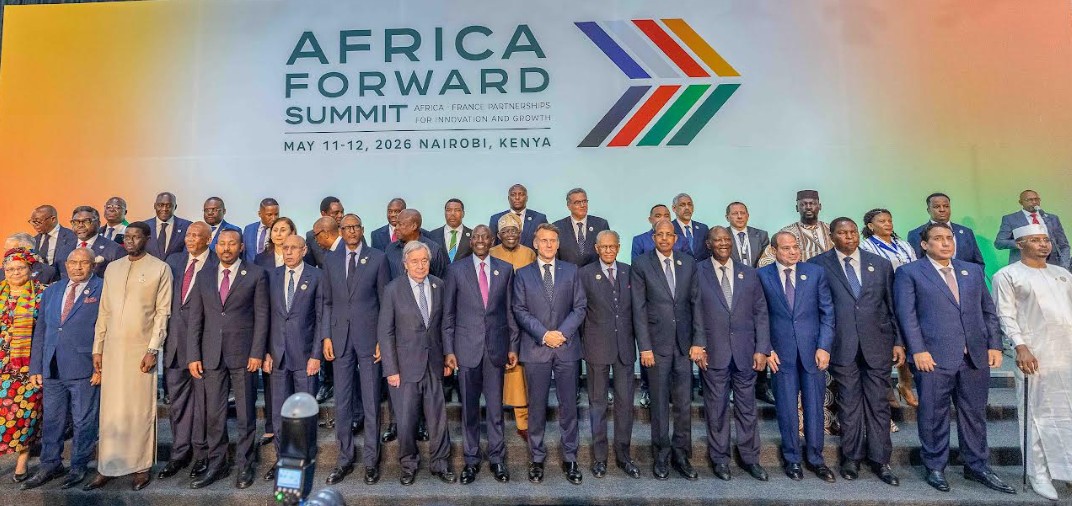
Heads of State from African countries convened a high-level meeting with counterparts from France, alongside representatives of the International Monetary Fund (IMF), World Bank Group, African Development Bank Group (AfDB), European Bank for Reconstruction and Development (EBRD), European Investment Bank (EIB), Green Climate Fund (GCF), West African Development Bank (BOAD), and other development partners, including the Agence Française de Développement Group (AFD) and the Pact for Prosperity, People and the Planet (4P).
Through a joint communiqué issued at the Kenyatta International Convention Centre, Nairobi during the historic 2026 Africa Forward Summit, delegates said they held fruitful exchanges on the current global economic situation and its implications for Africa.
“We met against the backdrop of rising geopolitical tensions and conflicts such as the ongoing conflict in the Middle East, geo-economic competition and instability, deepening inequalities, increasing global economic uncertainty, fragmentation, and global macroeconomic imbalances, which disproportionately affect developing economies, particularly in Africa,” the statement reads.
Leaders noted that these developments are compounding existing vulnerabilities in global supply chains, energy markets, and food security, with serious consequences for African economies.
In their joint statement, they reaffirmed that Africa is both a continent of opportunity and challenge, stressing the need to turn its demographic transition into a demographic dividend by creating labour markets capable of absorbing more than 10 million young people annually.
They emphasized the importance of managing rapid urbanization through expanded infrastructure, accelerating industrialisation and value addition for local benefit, enabling a just energy transition, and strengthening adaptation to climate change while fully participating in global technological advancement.
The leaders underscored that Africa’s human capital, dynamism, innovation, and vast natural resource endowment, including critical minerals, are key assets for future growth. They stressed that these should drive local value addition, beneficiation, and job creation across the continent.
“We acknowledge that the challenges of the continent are exacerbated by the consequences of global macroeconomic imbalances. The persistent reliance on raw material exports in international trade (hydrocarbons, cocoa, vanilla, coffee and minerals); increasing sovereign debt; the growing development financing gap; and the limited diversification of African economies constitute a source of vulnerability,” the Heads of State said.
They warned that if left unaddressed, excessive global imbalances across major economies would further deepen these vulnerabilities.
The leaders observed that structural overcapacities, combined with distorting non-market policies and practices, are hindering Africa’s industrialisation and export development.
They further noted that the proliferation of unilateral and uncoordinated trade measures is weakening Africa’s integration into the global economy. According to the statement, such overcapacities artificially depress global commodity prices, undermine the competitiveness of emerging African industries, discourage foreign direct investment in productive sectors, and ultimately slow structural transformation and job creation.
They added that these dynamics contribute to higher borrowing costs, limited fiscal space, exchange rate volatility, and reduced access to affordable long-term development finance for African economies.
“We reaffirm that a rules-based, non-discriminatory, fair, open, inclusive, equitable, sustainable and transparent multilateral trading system is indispensable. Addressing overcapacities, curbing distortive subsidies and ensuring fair market access are essential to enabling Africa’s industrialisation,” the statement read.
The leaders underscored the need to strengthen African regional value chains capable of generating decent jobs, promoting technology transfer, and enhancing industrial resilience.
“Strong, inclusive and sustainable economic growth is the cornerstone of prosperity. We call on the world’s major economies to work together to achieve a balanced and growth-oriented macroeconomic policy mix that supports global economic stability, maintains well-regulated financial markets, and ensures that all citizens benefit from growth,” they stated.
They further urged major economies to recognise their shared responsibility in reducing excessive imbalances and to adopt coordinated domestic policy measures aimed at rebalancing global growth models in support of sustainable development.
“We call on these economies, as well as international financial institutions, in particular the IMF, to strengthen surveillance of global imbalances and ensure effective multilateral monitoring of these commitments,” they added.
The leaders also encouraged international financial institutions to better account for the specific vulnerabilities of African countries affected by conflict, climate shocks, and structural development constraints.
They further called on France, together with Kenya, which is associated with the G7, to convey this important concern of the African continent to the Summit in Evian in June 2026.
By Ian Chepkuto