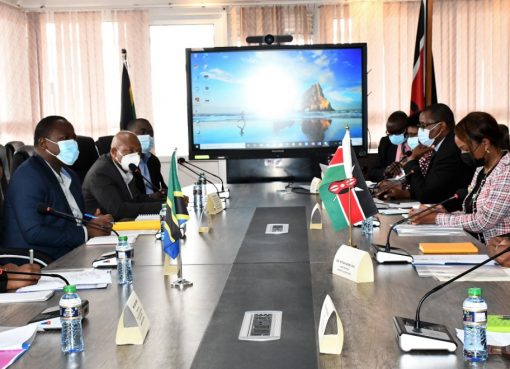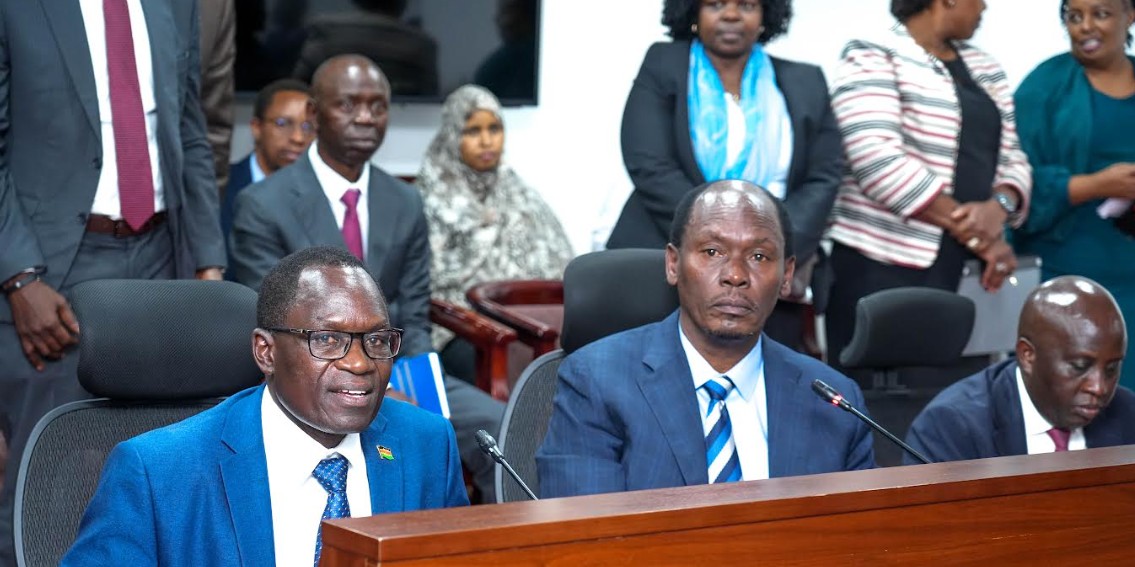
The National Assembly Departmental Committee on Communication, Information, and Innovation, Chaired by John Kiarie, met with the Ministry of Information, Communications and The Digital Economy and its various Departments and Agencies (MDAs) to consider the Budget Estimates for the 2026/2027 Financial Year.
During the session, the Cabinet Secretary (CS), Ministry of Information, Communications and the Digital Economy, William Kabogo Gitau, appeared before the Committee to present the Ministry’s 2026/2027 Budget Estimates, outlining key priorities for the upcoming Financial Year and highlighted the Ministry’s achievements and financial performance.
While reaffirming the Ministry’s commitment to advancing the Government’s Bottom-Up Economic Transformation Agenda (BETA), particularly under the Digital Superhighway and Creative Economy pillars, the session focused on addressing fiscal adjustments to safeguard Kenya’s digital transformation agenda.
Lawmakers and Ministry officials discussed how proposed reductions in funding could be managed to prevent the slowing down of critical infrastructure projects and ensure the continued integrity of government communication systems.
The Committee emphasized the importance of maintaining robust allocations for strategic programmes within the BETA framework.
“We are talking about programmes that are central to the country’s future, yet they are being reduced mechanically because of budgeting processes,” remarked the parliamentary committee Chairperson John Kiarie.
The Cabinet Secretary noted the resource constraints, stating, “We can only implement programmes within the limits of the resources provided. I cannot sit here and promise delivery of programmes for which funding has effectively been reduced to near zero,” adding that “development programmes are not stalled because Government lacks ideas; they are stalled because financing is insufficient.”
The Ministry outlined measures to keep initiatives operationally viable through the State Department for Broadcasting and Telecommunications and the State Department for ICT and the Digital Economy, working closely with its Semi-Autonomous Government Agencies (SAGAs)—including the Communications Authority of Kenya (CA), the ICT Authority (ICTA), Konza Technopolis, the Kenya Broadcasting Corporation (KBC), the Media Council of Kenya and the Postal Corporation of Kenya.
The Ministry discussed the impact of reduced external financing. This fiscal adjustment affects flagship programmes such as the Last Mile County Connectivity Project and the Kenya Digital Economy Acceleration Project, alongside constituency Digital Innovation Hubs, the National Data Centre, and the expansion of nationwide signal coverage.
To mitigate these connectivity gaps, Kabogo explained, “Where terrestrial connectivity remains difficult, we are now deploying satellite connectivity to ensure those areas are not left behind.”
PS Tanui of the State Department for ICT and the Digital Economy clarified the underlying financial dynamics, noting, “The reductions affecting our externally funded projects are not because funding is unavailable. The challenge has largely been absorption.”
While noting that implementation bottlenecks are being systematically resolved to accelerate projects, he added that “underfunding will significantly affect implementation of planned programmes and service delivery” and invited parliamentary collaboration:
“We request the Committee’s intervention to restore reduced allocations for strategic digital transformation programmes,” said PS Tanui.
Beyond infrastructure, the deliberations centred on enhancing the coordination of government communication to ensure the delivery of clear, unified messages to the public.
Both the Chairperson and CS Kabogo agreed on the importance of streamlining public information systems.
“Right now, the government is speaking from too many corners,” said Kiarie.
“What we need to tell the Committee is that we have done serious deliberation on the issue of government communication. We have written a policy, and in the next couple of weeks we should be able to take it to Cabinet,” said the CS.
Highlighting the national importance of effective communication frameworks, Chairperson Kiarie added, “Lack of proper communication and information to the people can lead to national tragedies and disasters,” while recalling that “the Finance Bill experience showed us what happens when misinformation moves faster than official communication.”
PS Isaboke of the State Department for Broadcasting and Telecommunications highlighted existing state infrastructure equipped to manage these responsibilities, explaining, “The National Communication Center was established as a center to support coordinated government communication, especially during emergencies and national incidents.”
The strategic roles of KBC and the Kenya News Agency (KNA) were highly prioritised by lawmakers as essential instruments for national cohesion and civic education. “KBC and KNA keep coming up as the carriers of government communication and national values,” Chairperson Kiarie noted, emphasizing that “Public Communication must go beyond announcements and actively promote national unity and shared values.”
Joyce Otieno Bensouda added her support for the public broadcaster’s ongoing modernisation, stating, “KBC should become a broadcaster that Kenyans feel proud to watch again,” while requesting standard administrative oversight.
“We need a clear report on the status of KBC property and land assets.” Added Bensouda.
Addressing the institutional structure of the broadcaster, CS Kabogo agreed that its public service mandate must remain protected.
“Public broadcasting cannot be treated purely as a commercial enterprise. KBC was always intended to separate commercial operations from public service broadcasting,” said CS Kabogo.
CS Kabogo suggested a practical compromise to balance commercial stability with public service, noting, “If the entities cannot entirely remain under the current structure, then perhaps the commercial functions may remain under the GOE framework while public communication functions return to the Ministry.”
The Budget review also examined a proposed allocation for advanced AI-powered media monitoring systems designed to track digital trends, analyse public sentiment, and counter misinformation across major platforms such as X, Facebook, and TikTok.
“The communication environment has changed fundamentally in the AI era,” said PS Isaboke. AI-enabled systems can now monitor sentiment across X, Facebook, TikTok and other digital platforms, which allows teams to “determine whether a narrative is political, social, health-related or security-related”, added PS Isaboke.
He maintained that the AI era requires a completely different approach to communication monitoring, noting that communication now extends beyond newspapers, television and radio. He added that the system is designed to support whole-of-government communication monitoring.
Lawmakers, however, emphasized the need for clear legislative understanding and governance frameworks before deploying such technologies.
Engineer Mark Nyamita requested further clarity on institutional integration, asking, “What exactly does this AI monitoring tool do for the country?” and “are these monitoring systems duplicating each other, and where exactly will they sit?” Nyamita further called for transparency across the regulator’s processes.
Chairperson Kiarie reasserted Parliament’s role in thorough budget oversight. “Parliament must fully understand these AI systems before approving major allocations. What is good for another country may not necessarily be good for Kenya or Africa,” said Kiarie.
This position was supported by Joseph Tanui, who stated, “Africa must not become merely a testing ground for foreign AI systems,” and Eratus Kivasu, who stressed, “We must develop AI tools that reflect our local realities and interests.”
The session further addressed completion timelines for constituency Digital Innovation Hubs, with legislators working with the Ministry to ensure value for public funds.
Alfah Miruka shared the expectations of local constituencies, stating, “We put our money into these Digital Innovation Hubs. What do we tell our constituents now that projects have stalled?”
PS Tanui explained that the completion of these hubs is directly linked to technical human resource deployment. The recruitment of ICT officers is directly linked to the operation of Digital Innovation Hubs and support for national digital systems. Digital Innovation Hubs are critical constituency projects and require staffing support once operational,” Said PS Tanui.
Bensouda highlighted the broader socioeconomic potential of similar grassroots creative infrastructure, noting that “Studio Mashinani can significantly contribute to youth empowerment and employment”.
In tandem with grassroots innovation, the committee discussed structured training programmes to professionalise the digital workspace for bloggers and content creators. Hon. Joyce Otieno Bensouda advocated for constructive engagement in the digital space.
“We cannot have bloggers whose work is simply abusing people online. How do we train bloggers and use them productively for development communication?” Stated Bensouda.
PS Isaboke outlined the Ministry’s collaborative approach to supporting responsible digital citizenship.
“Social media can either be used constructively for development or destructively. The responsibility is how we guide people to use these platforms. We are already working with platform operators and the Media Council to improve responsible use of digital platforms. The Media Council’s role is different; theirs is media-content oversight while ours focuses on broader government digital communication,” He explained.
The budget review concluded with institutional updates from across the Ministry’s dockets. PS Tanui reported steady progress at the tech city, noting that “Konza infrastructure is largely complete but now requires operational and maintenance support”, while adding that “the Office of the Data Protection Commissioner continues to expand, but funding remains constrained and the cybersecurity remains a very critical area requiring urgent support.”
PS Isaboke also defended the preservation of national records, noting that the “Kenya Yearbook remains critical in documenting government achievements and preserving institutional memory.”
In his closing remarks, Hon. Engineer Mark Nyamita reminded the committee that “the country is moving into a new digital era, and budgeting must reflect that reality.”
“This Committee is not only scrutinising budgets; we are shaping the future of the digital economy,” Chairperson Kiarie noted.
To support the strategic path forward, PS Isaboke closed the session with an earnest appeal to the committee to favourably consider funding for key foundational pillars, specifically highlighting the necessity of supporting advanced AI software deployment, the urgent modernisation of the Kenya News Agency (KNA), the operational sustainability of the National Communication Centre, and the continued establishment of the Studio Mashinani project across the country.
The committee urged the Ministry to maintain high project absorption rates to optimise these strategic allocations as the 2026/2027 budget estimates move toward final parliamentary approval.
By Violet Otindo