A group of over 50 youth in Changamwe sub-county have turned the stringent moisture-content rejection criteria imposed by local grain millers into a thriving, self-sustaining informal employment venture.
The youth, operating under the leadership of a local coordinator, Johannes Ogai, specialize in sun-drying multi-ton consignments of maize rejected by major milling plants due to excessive moisture levels, restoring the grain to commercial standards before it is resubmitted for processing.
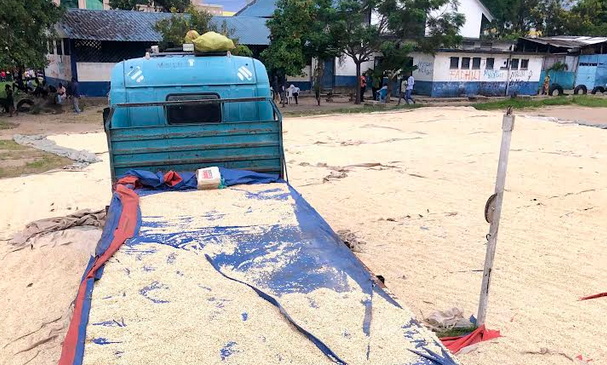
The group utilizes open yard spaces within Changamwe’s industrial zones to manually spread out and air tons of damp maize arriving from cross-border and local production hubs.
This emergency intervention salvages hundreds of thousands of shillings in potential losses for grain traders while creating essential daily wage opportunities for vulnerable youth in the coastal city.
“This business is not mine as such; it is a service we provide to grain merchants after their commodities are turned away at the mill gates because of high moisture content,” explained Ogai during an interview at the drying site.
He noted that the maize consignments originate from major production regions including Tanzania, Busia, and Eldoret.
“When the trucks arrive at the millers and the tests reveal the grain has high humidity, the traders seek us out to dry it so it can pass inspection on the next attempt,” Ogai added.
The labor-intensive enterprise provides an economic lifeline for dozens of young people, who would otherwise remain unemployed.
According to Ogai, the workforce scales up to 60 individuals on peak days, drawing in local youth, casual laborers, and commercial motorcycle (bodaboda) operators seeking alternative streams of income when transport business slumps.
The operational scale of the venture involves managing massive heavy-commercial transport trucks, locally referred to as ‘pullings,’ which haul immense weights.
“A single pulling trailer carries an average of 38 tons of maize. When you convert that into standard 90-kilogram bags, it amounts to roughly 420 bags per truck,” Ogai stated.
He added that due to the spatial limitations of their current operating ground, they are restricted to processing only one truckload per day, forcing other arriving vehicles to queue up and wait.
Despite the steady demand, the informal venture faces severe vulnerabilities, primarily driven by unpredictable coastal weather patterns and infrastructure deficits.
The open-air nature of sun-drying leaves the spread-out grain exposed to sudden rainfall, which can instantly ruin hours of manual labor and worsen the traders’ losses.
“Our biggest challenge is the Mombasa weather. We can spread out the grain nicely, and suddenly it rains heavily. We try our best to rush and cover the canvas tarps, but a natural calamity is beyond our control, and when it happens, the trader incurs losses and we have to repeat the entire process the following day,” Ogai lamented.
Furthermore, the seasonal nature of the maize harvest means the youth experience prolonged periods of financial dry spells when the crop cycles end.
The group is currently appealing for strategic partnerships and the acquisition of larger, dedicated open spaces to expand their capacity and safely accommodate multiple trucks simultaneously.
The informal venture plays a critical role in social stabilization by keeping local youth constructively engaged during periods of economic and political tension.
During recent public transport and cost-of-living protests that caused widespread disruptions across Mombasa, the Changamwe drying yard remained fully operational, shielding dozens of young men from participating in potentially volatile street demonstrations.
“We had two trucks to clear during the protests, keeping nearly 60 youth completely occupied from morning until evening. Had that work not been available, many might have found themselves caught up in the chaos on the streets where they could have been injured,” Ogai remarked.
The continuous influx of high-moisture grain highlights systemic gaps in post-harvest management and drying infrastructure at the farm level, particularly in regions like Taveta, Olili, and Voi where drivers report collecting the crop.
As local millers maintain strict standards to prevent aflatoxin contamination in flour brands like Taifa, Kitui Millers, and Ajab, the youth of Changamwe continue to fill a critical gap in the agricultural supply chain, transforming an institutional rejection into a sustainable urban livelihood.
By Otieno Kevin