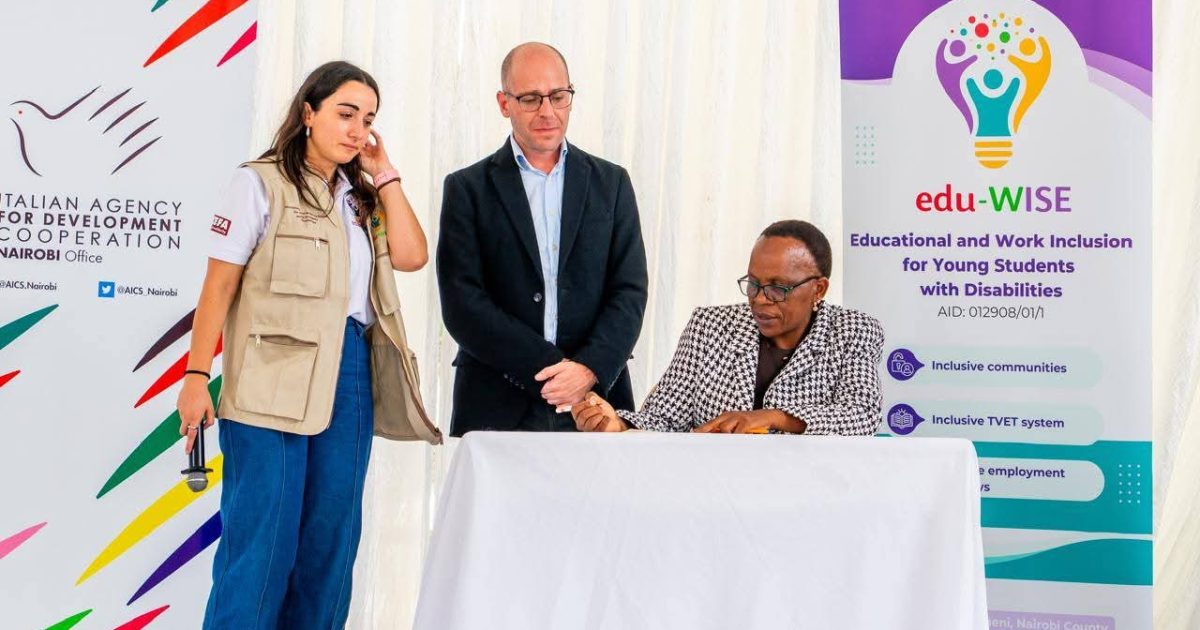
For many years, young people living with disabilities have faced exclusion, stigma and limited access to education and employment opportunities due to inaccessible learning environments and inadequate support systems.
However, hope is gradually being restored in Murang’a, Nairobi and Makueni counties through the Edu-WISE project, an initiative aimed at enhancing skills training and employment opportunities for persons with disabilities.
The programme seeks to strengthen vocational training institutions in the three counties to ensure they provide quality, inclusive and accessible training for all learners regardless of their physical condition.
Speaking during the launch of the initiative, Eric Ochieng from the Federation of Kenya Employers said stakeholders are working to bridge the gap between skills acquisition and employment opportunities, especially for young persons with disabilities who are often left out of the labour market.
“We are committed to ensuring that young people with disabilities not only access technical skills training but also secure employment opportunities that enable them to become self-reliant,” he said.
Having such an initiative to advance employment opportunities for young persons living with disabilities is noble and ensures they have a dignified life.
He observed that the federation’s focus is to bridge the gap between skills development and employment for young people living with disability.
Ochieng called on employers to play a critical role in creating pathways for transition from training into meaningful and dignified work
“Support workplace adaptations, and give every individual a fair chance to contribute, grow and thrive in the workplace by addressing barriers, whether physical, social or systemic that limit persons living with disabilities from thriving,” he added.
Murang’a County Director of Education Faith Wairimu said the county government is committed to partnering with stakeholders to improve technical and vocational education.
“This project will help expand employment opportunities for young people and empower them with skills that can enable them to become independent,” she said.
She reaffirmed the county government’s commitment towards empowering youth and promoting equal opportunities for all through inclusive technical and vocational training programmes.
The head of the Italian Development Cooperation Agency in Nairobi, Fabio Minniti, noted that the programme is working with nine technical training institutions across the country.
“Our goal is to ensure these institutions are accessible to persons with disabilities and are equipped to provide relevant skills that can enhance employability,” he said.
Stakeholders who attended the launch observed that vocational training institutions continue to play a critical role in equipping learners with practical skills that are highly needed in the job market.
Kandara ACC Collins Oyango commended the initiative while also urging the stakeholders to consider even the most vulnerable in the interior parts of the country.
“We have very vulnerable people who are not seen, not receiving education and not getting even a meal in our slums and once the slums are eradicated, these people will relocate to the villages.”
Joseph Njoroge Wanjiku, who is visually impaired and a beneficiary, noted that the initiative would help address most of the challenges people living with disabilities face.
“I am totally blind and throughout my school life I have had challenges, buildings are not friendly, there are no books and also stigma associated with disability.
The initiative, he notes, has enabled him to pursue a shoemaking course, and he is able to make shoes and earn a living from it.
“I want to encourage other young people living with disabilities but cannot come out as they do not have the courage; be strong, knock on doors that you can, learn a skill so you will not be forever dependent on your parents or caregivers.”
By Florence Kinyua