The Public Service Commission (PSC) has entered into a five-year Memorandum of Understanding (MOU) with the National Council for Persons with Disabilities (NCPWD), CBM Christian Blind Mission Kenya and Light for the World Kenya (LFTW) to enhance disability mainstreaming in the public service.
The agreement, which takes effect from 22nd May 2026 and is renewable upon mutual consent, establishes a coordinated framework for advancing inclusivity, accessibility, and compliance with disability rights obligations within Kenya’s public sector.
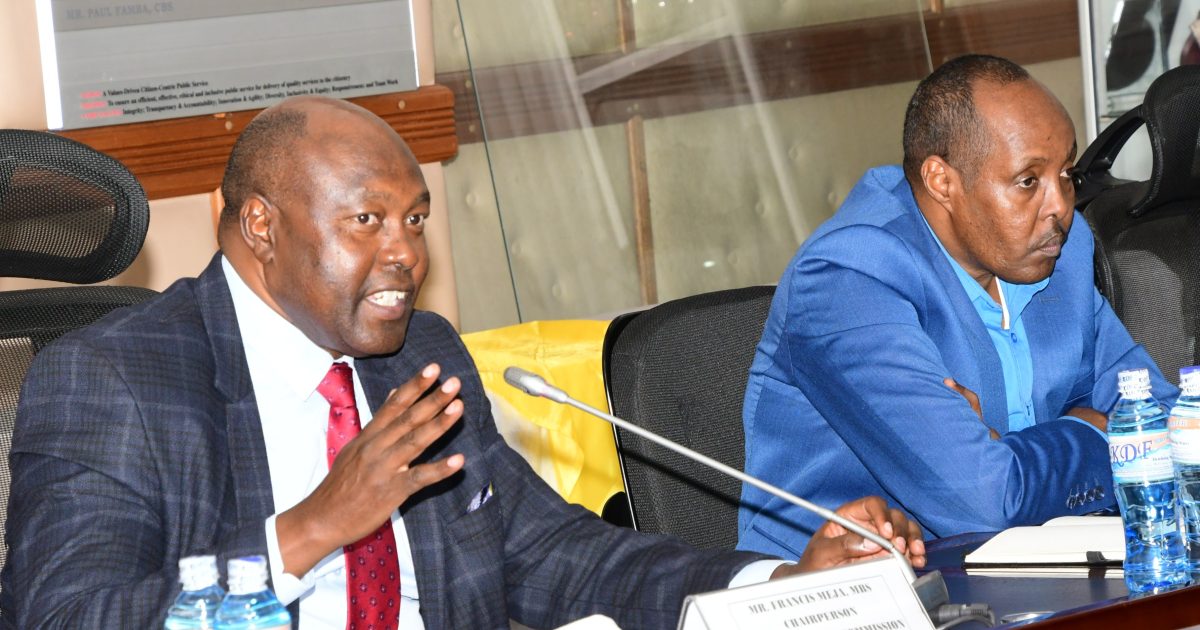
Speaking during the agreement signing at PSC Headquarters, Francis Meja, the Chairperson, Public Service Commission, expressed appreciation to partners and stakeholders for their support in advancing disability inclusion within the public service, noting that the Commission is committed to strengthening inclusivity across all its operations.
Through the MoU, the partners will collaborate to strengthen institutional capacity within the PSC and other public service institutions, support inclusive human resource management systems, and enhance compliance with the Persons with Disabilities Act, 2025.
“The enactment of the Persons with Disabilities Act, 2025, places statutory obligations on State organs, including PSC, to mainstream disability inclusion, ensure reasonable accommodation, promote accessibility, and achieve at least five percent (5%) representation of Persons with Disabilities across the public service,” read part of the document.
The Chair noted that the Commission will lead by example by taking the necessary steps before other institutions follow suit.
“And to assure you, once more, we are indeed very committed to ensuring that we actualise the implementation of this particular project,” said Meja.
The partnership will focus on enhancing the institutional capacity of the Public Service Commission (PSC), including strengthening Disability Mainstreaming Committees and Units, providing technical support on policy development, and promoting internal awareness and capacity building on disability inclusion.
The MoU also seeks to improve the capability of public service organisations by supporting PSC oversight of Disability Mainstreaming Units in Ministries, Departments, and State Agencies. It further provides for the review of organisational structures to ensure compliance with the Persons with Disabilities Act, 2025, and the enhancement of accessibility to public services.
He noted that the Commission is strategically positioned under the Constitution to drive inclusivity reforms nationwide and assured partners that it will deliver measurable improvements, including better representation and participation of persons with disabilities in the public service.
He underscored the importance of the ongoing partnership, stating that it will help position PSC as a model institution for inclusive workplace practices and a benchmark for other public sector organisations.
“At PSC, we have resolved that even as we carry out the constitutional mandate of evaluating inclusion and equality, we must first ensure that we comply so that others can benchmark with us,” said Mr. Meja.
The collaboration will target human resource management systems by supporting reforms in recruitment, selection, deployment, promotion, training, and reasonable accommodation policies to ensure inclusivity. It will also promote awareness of disability rights across the public service.
The agreement further focuses on the promotion of public service values and principles through mainstreaming disability inclusion in audits, surveys, compliance frameworks, and communication materials.
It also supports the full operationalisation of the Persons with Disabilities Act, 2025, including the development of guidelines, tools, and monitoring mechanisms for measuring inclusion.
The document will integrate disability mainstreaming into performance and productivity measurement systems to strengthen accountability and improve service delivery across the public sector.
Commissioner Harun M. Hassan, from Public Service, said the partnership will advance disability inclusion in Kenya, noting that partners have made significant contributions in financing, advocacy, and policy development within the sector.
He said the commission has demonstrated strong commitment to disability inclusion, with all commissioners actively championing the agenda during recruitment, shortlisting, and other human resource processes.
According to Hassan, disability inclusion has become a shared responsibility within the Commission.
He added that the MoU marks a shift from policy discussions to practical implementation, aimed at accelerating disability mainstreaming and strengthening inclusive practices across the public service.
Under the Memorandum of Understanding, the Public Service Commission (PSC) will specifically provide overall leadership, coordination, and oversight of disability mainstreaming initiatives within the Commission and the wider public service.
The Commission will also implement recommendations arising from joint activities, integrate agreed programmes into its strategic and performance frameworks, and facilitate access to relevant data, policies, and institutional platforms to support implementation.
Partners, including the National Council for Persons with Disabilities (NCPWD), CBM, and Light for the World, will provide technical expertise on disability inclusion, accessibility, and reasonable accommodation to support implementation of the programme.
The partners will also contribute to the development and review of inclusive policies, guidelines, and tools while supporting capacity building, sensitisation, and awareness creation for the Public Service Commission and Ministries, Departments, and Agencies (MDAs).
They will also support accessibility audits, research, monitoring and evaluation, knowledge-sharing initiatives, and mobilisation of resources for agreed activities in collaboration with the PSC and other stakeholders.
The collaboration follows recommendations from the Disability Mainstreaming Committee capacity-building workshop held in January 2026, which identified the need for partnerships to support implementation of disability inclusion policies.
“The Disability Mainstreaming Committee (DMC) capacity-building workshop held from 26th to 30th January 2026 identified priority areas for collaboration with development partners, including CBM, NCPWD and LFTW, to strengthen institutional capacity, policy implementation, monitoring, accessibility, and compliance,” read part of the document.
The partners emphasized that the MoU does not create legally binding obligations but provides a structured framework for cooperation, knowledge sharing, and joint implementation of disability inclusion initiatives over the five-year period.
By Ian Chepkuto and Cynthia Oyuke