The government has unveiled a raft of measures aimed at cushioning Kenyans from soaring fuel prices triggered by the conflict in the Middle East and disruptions in the global oil supply chain.
The global oil supply shock has been exacerbated by disruptions at the Strait of Hormuz, a key oil transit route that accounts for nearly one-fifth of the world’s oil supply, resulting in a sharp increase in fuel prices globally.
The rise in fuel prices has sparked anxiety among Kenyans, triggered protests by transport sector stakeholders, and intensified pressure on the cost of living.
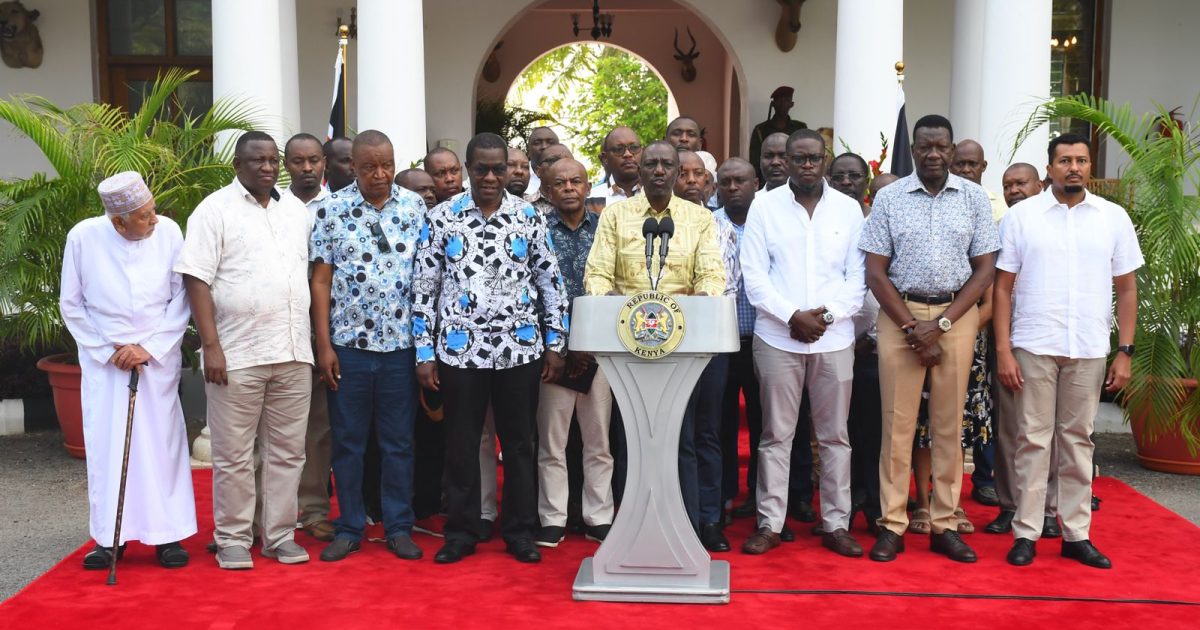
On Friday, the Head of State met transport sector stakeholders at State House in Mombasa, where they agreed to call off their planned strike in the national interest.
The Head of State reaffirmed the government’s commitment to ensuring the country continues to receive stable fuel supplies while cushioning Kenyans from the full impact of the global crisis.
Transport sector stakeholders have welcomed the raft of short-term and long-term measures aimed at streamlining the sector and protecting the country from external disruptions in oil supply.
The government has directed that the cost of diesel in the June–July pricing cycle be reduced by Sh10 to further stabilise pump prices.
To safeguard the country against external oil shocks and conflicts, the government, in partnership with other East African Community member states, is committed to establishing a regional oil refinery.
The government is also fast-tracking investments in renewable energy, electric mobility, modern public transport, and energy security infrastructure to ensure future generations are less exposed to global fuel instability.
To support the transition to electric mobility, the government, through the Ministry of Interior and National Administration, has already ordered 3,000 electric vehicles for use by security agencies and National Government Administration Officers.
To encourage the importation of electric vehicles, the government has announced that the first 100,000 electric vehicles imported into the country will be duty-free.
The government, through the Petroleum Development Fund, has also built strategic financial reserves to help stabilise the market during times of crisis without disrupting the broader economy, as had happened in the past.
The government has further utilised the Petroleum Development Fund to stabilise pump prices. In the April–May and May–June 2026 pricing cycles, the government spent Sh13.74 billion to cushion consumers. During the April–May 2026 pricing cycle alone, the government utilised Sh6.04 billion in fuel stabilisation measures.
In total, the government has committed Sh28.19 billion in the April–May and May–June 2026 pricing cycles through direct fuel stabilisation measures and tax relief interventions. The National Assembly has also reduced Value Added Tax on petroleum products from 16 per cent to 8 per cent.
Matatu Owners Association National Chairman Albert Karakacha welcomed the proposals, affirming the association’s support for the government’s measures.
“We want to thank the government and the President. We know he has addressed most of the issues that have been pending for a long time,” said Karakacha.
He added: “We are going to work with the government. All of us are Kenyans and we want peace and unity so that we can move forward. When the President talks about Singapore, I see it as a reality. Let us put politics aside and build our country. Politics will come in 2027.”
Federation of Public Transport Chairman Edwin Mukabana urged matatu owners, drivers, and conductors to resume operations immediately after the strike was called off.
“We are hopeful that this takes effect immediately. Everybody should return vehicles to the road and allow the country to continue running because there is an economy to save,” said Mukabana.
By Sadik Hassan