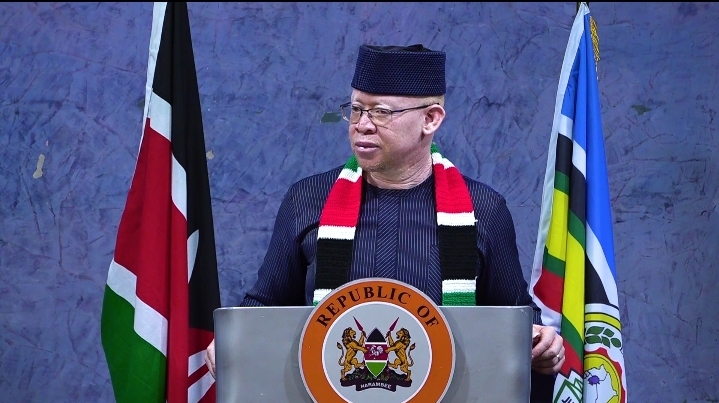
Government Spokesperson Isaac Mwaura has disclosed that President William Ruto’s recent State visits to Azerbaijan and Kazakhstan have opened new opportunities for trade, investment, energy cooperation and education partnerships aimed at strengthening Kenya’s economy and global influence.
Speaking during a press briefing at Harambee Annex in Nairobi on Friday, Mwaura said the high-level engagements had positioned Kenya as an attractive investment destination and expanded diplomatic and economic ties beyond its traditional Western partners.
He said Kenya signed several bilateral agreements with Kazakhstan that will help diversify export markets for tea, coffee, horticultural produce and manufactured goods.
According to Mwaura, expanding into new markets beyond Europe and North America will help boost foreign exchange earnings, strengthen the Kenyan shilling and support farmers, manufacturers and small and medium enterprises.
“In agriculture, President Ruto witnessed the signing of several bilateral agreements with Kazakhstan which will enable Kenya to diversify its export markets beyond traditional destinations such as Europe and North America,” said Mwaura.
On energy cooperation, the spokesperson said the discussions opened opportunities for collaboration in petroleum infrastructure, refining, fuel distribution and energy pricing.
He noted that the partnerships are expected to improve Kenya’s energy security and protect the country from global fuel price shocks while supporting the government’s transition to clean energy and electric mobility.
Mwaura further said the State visits had boosted investor confidence in Kenya, attracting interest from multinational companies seeking to establish regional headquarters and distribution hubs in Nairobi.
He said sectors expected to benefit from foreign direct investment include infrastructure, renewable energy, information communication and technology, agriculture, manufacturing, transport, logistics and affordable housing.
“Such investments will create employment opportunities for Kenyan youth, drive technology transfer, stimulate industrial growth and increase tax revenues vital for national development,” he said.
The spokesperson added that Kenya remains the largest economy in Eastern and Central Africa, currently valued at 147 billion US dollars according to International Monetary Fund data, making the country an attractive gateway to the African Continental Free Trade Area.
Mwaura also revealed plans to strengthen aviation and transport partnerships between Kenya and Central Asia, including proposals for direct flights between Nairobi and Astana.
He said the move is expected to improve trade, tourism, cargo transport and people-to-people exchanges between Africa and Asia.
On education and technology, Mwaura said the agreements signed during the visits will promote scholarships, university partnerships, artificial intelligence, digital innovation, technical training and research collaboration aimed at equipping Kenyan youth with globally competitive skills.
He further announced plans to establish an Office of the Consul General in Astana to strengthen diplomatic and economic relations between Kenya and Kazakhstan.
Meanwhile, the Government has announced tougher measures to protect children from harmful online content amid growing concerns over excessive digital exposure among young people.
Mwaura warned that increased use of digital platforms is exposing children to cyberbullying, explicit sexual material, graphic violence, substance abuse promotion and dangerous online trends.
He said the Government has strengthened guidelines through the Kenya Film Classification Board to regulate audiovisual content across television, cinemas, online streaming platforms and social media.
“These new regulations aim at safeguarding child development amid increased digital media consumption,” said Mwaura.
The new framework introduces mandatory age classification and content labelling while requiring parents and guardians to actively monitor children’s media use.
The regulations will also apply to online streaming services and user-generated content platforms in an effort to minimise children’s exposure to harmful and unregulated material.
Mwaura said the measures seek to address child exploitation, cyberbullying, self-harm content, substance abuse promotion and exposure to dangerous online behaviour while preserving Kenya’s cultural and moral values.
He called on parents, schools, digital platforms and other stakeholders to support government efforts aimed at promoting responsible media consumption and protecting children in the digital age.
By Anita Kariuki