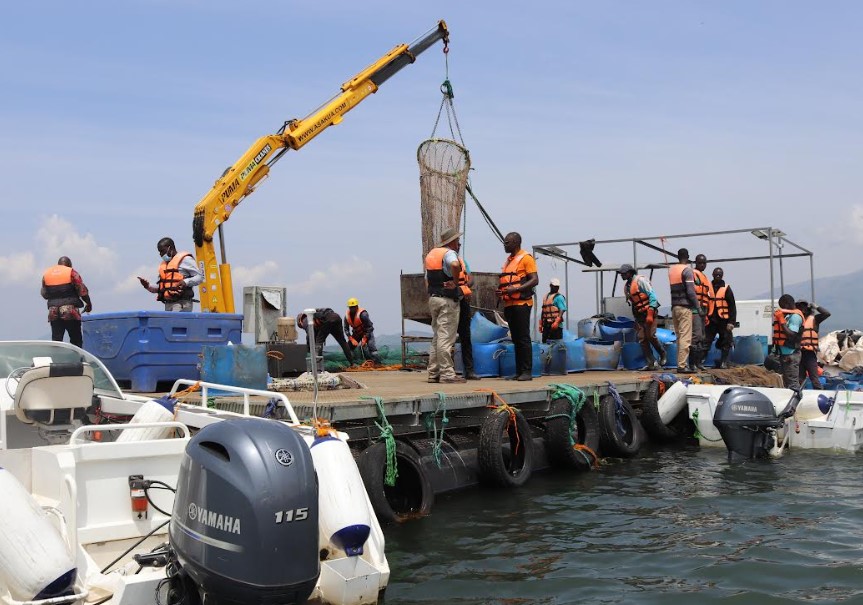
Standing on the tranquil shores of Lake Victoria in Suba South, what started as a modest aquaculture venture with less than ten ponds and a handful of floating cages has grown into one of Africa’s most ambitious food production enterprise.
Today, Victory Farms is not only the largest producer of tilapia in sub-Saharan Africa but a company pursuing a far bigger vision, to feed more than two billion Africans with affordable, locally produced fish over the next decade.
This ambition formed the backdrop as the company celebrated its 11th Founders Day at its flagship farm in Roo beach, a milestone that leaders say is defined less by the tonnes of fish harvested than by the lives transformed, the jobs created and the growing confidence that Africa can produce enough nutritious food for its rapidly expanding population.
Victory Farm’s Chief Development Officer, Caesar Asiyo says the enterprise’s long-term vision extends beyond East Africa and is anchored on increasing access to affordable fish while creating jobs and improving livelihoods.
“We are looking beyond East Africa with a goal to feed more than two billion Africans over the next decade. Our greatest achievement will not simply be the fish we harvest, but the jobs we create, the families we support and the communities that continue to grow alongside us,” he says.
Presently, Victory Farms employs more than 1,000 people, making it one of the largest private employers in Homa Bay. Thousands more earn incomes through activities
linked to the business, including fish trading, transport, feed manufacturing, input supply and
retail distribution.
Chief Executive Officer and co-founder Joe Rehmann, said the company has exceeded the targets it set when operations began in 2015 with fewer than 10 ponds and a handful of floating cages.
“Roo, where we are today, is our first farm and still our largest. When we started 11 years ago, our goal was to produce 10,000 tonnes of fish and employ 500 people. We achieved that years ago. Today we have over 1,000 employees, and that is probably our biggest milestone on the human capital side,” he says.
According to Rehmann, the company’s rapid growth has been driven by deliberate investment in people, technology and strong partnerships with the local community.
“The growth we have achieved has only been possible by investing in people and technology. We’ve also had tremendous support from our community and all the different stakeholders because none of this is possible alone,” he says.
That growth is visible in the company’s production figures. Victory Farms recently recorded monthly sales of about 1,400 tonnes of tilapia and is targeting even higher yields as it scales operations across Kenya and Rwanda.
The company plans to expand into Tanzania once regulatory approvals are secured and is
also preparing to enter the Ugandan market as part of its regional growth strategy.
Despite the rapid expansion, demand for fish continues to exceed supply across East
Africa. Fish remains one of the healthiest and most affordable sources of protein, yet production across much of Africa has failed to keep pace with population growth.
Per capita fish consumption in Kenya remains under pressure as population growth accelerates faster than production. This imbalance, according to Rehmann, has direct implications for nutrition and food affordability.
“The remarkable thing is that imported tilapia from China has declined by 80 per cent since we started, which means our mission of producing fish for local consumption is working. But because our population is growing, fish consumption per person is actually declining. Fish is still too expensive for many families, and we have to continue investing so we can bring prices down,” he said.
To bridge that gap, Victory Farms is working to quadruple its annual production from the current 25,000 tonnes production to 100,000 tonnes by 2030.
Across its Kenyan and Rwandan operations, the company has already recorded its first 2,000-tonne monthly sales milestone.
However, to achieve the 100,000 target in a span of four years will require major investments in technology, infrastructure and human capital.
Among the latest investments by the fish company is a modern feed-handling system capable of processing one-tonne bags, replacing the previous 25-kilogram handling system and improving efficiency as production scales up.
Feed remains the largest cost in aquaculture, accounting for more than 70 per cent of production expenses. To reduce costs, Victory Farms has shifted from importing feed to manufacturing about 90 per cent of its fish feed locally.
According to the company, this shift has reduced feed costs significantly while strengthening local supply chains.
“When we started, all our feed was imported. Today we are producing it locally at about 30 per cent lower cost. That reduction is transformational because it allows us to lower the price of fish,” Rehmann explains.
Over the past decade, the average retail price of tilapia has fallen from about Sh.800 per kilogram to less than Sh.500, making fish increasingly affordable to Kenyan consumers.
Asiyo attributed the savings to the company’s vertically integrated business model, where every stage of production is managed internally.
“Fish feed contributes more than 70 per cent of the cost of fish production. Because Victory Farms owns every part of the value chain, from hatcheries and feed production to processing, transport and retail, we have eliminated unnecessary costs and passed those savings to consumers,” Asiyo noted.
He added that the company continues to explore alternative feed ingredients that are more
economical without compromising quality.
In its 11-year journey, the fish company now operates more than 85 branches across Kenya, enabling freshly harvested fish from Lake Victoria to reach consumers within 36 hours.
Asiyo describes Founders Day as a reminder of both the company’s progress and its future ambitions.
“It is a celebration of where we have come from and also a reminder of the long journey ahead. We now employ over 1,000 people, and each employee supports between five and seven dependants. That is an impact we do not take lightly,” he adds.
Asiyo further lauds the Homa Bay County Government for creating an enabling environment that has allowed the company to thrive.
Beyond commercial production, the farm has expanded into community-based aquaculture through the Homa Bay Extensive Aquaponics Programme (HEAP).
The enterprise partners with local landowners, who provide idle land for broodstock ponds developed and managed by the company.
Participating households earn income from fish egg production while also benefiting from integrated irrigation systems that use nutrient-rich water to grow crops. The approach blends aquaculture and agriculture into a single circular system that improves both food production and household earnings.
For many families in Suba South, HEAP has turned unused land into a reliable source of income while strengthening local food security.
In one of its most transformative innovations, Victory Farms introduced drone-based logistics to its aquaculture operations.
What began as a pilot project in 2025 has now become a core part of its supply chain. Today, unmanned aerial vehicles transport roughly 80 percent of all fertilised fish eggs collected from smallholder partners to the company’s central Recirculating Aquaculture System (RAS) hatchery.
The shift replaces much of the traditional road transport that previously slowed delivery times and increased handling risks.
By moving logistics into the air, the company reports dramatic improvements in efficiency.
Drone transport is up to ten times faster than road-based systems, while also significantly lowering operational costs and reducing environmental impact.
For Victory Farms, the drone programme is also closely tied to youth employment.Many local technicians and licensed drone operators are young people from surrounding communities who are trained and deployed to manage the system, positioning technology as both an efficiency tool and a job creator.
Rehmann says investing in young people is central to the company’s long-term strategy.
“We are seeing extraordinary talent among Kenyan youth and our responsibility is to give them the tools, training and opportunities to compete globally, he says.
From its origins in Homa Bay, Victory Farms is preparing for further growth across and beyond East Africa. Its ambition is to become the leading supplier of affordable protein across the continent.
By Sitna Omar