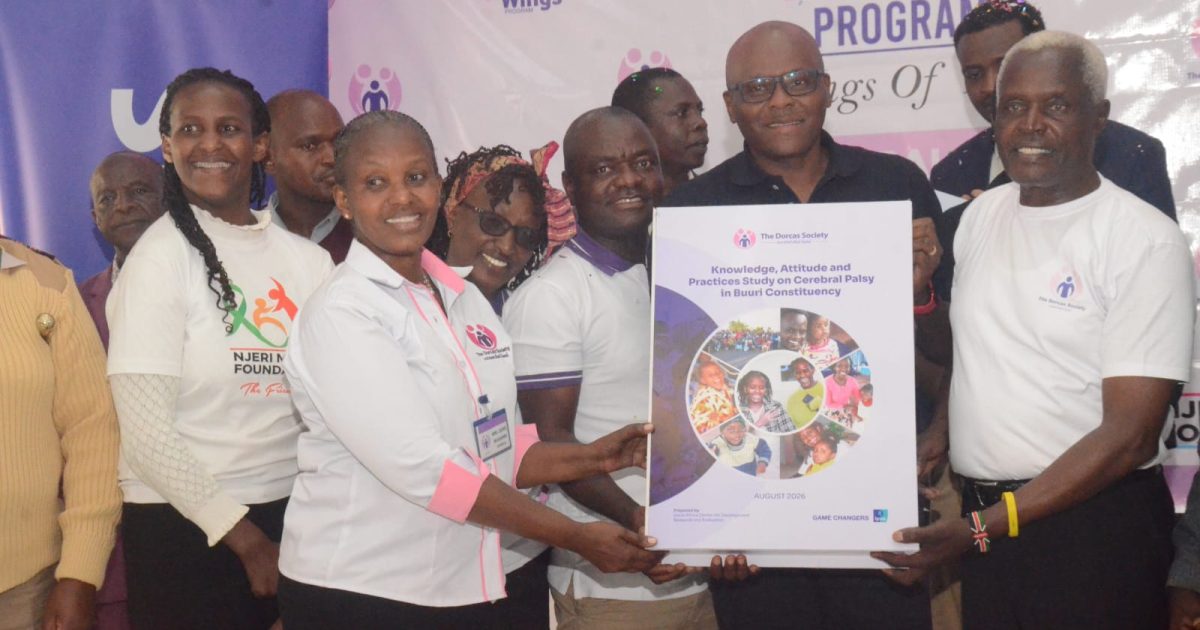
Ipsos Africa, in partnership with the Dorcas Society and Njeri Maria Foundation, has launched a research report examining knowledge, attitudes and practices surrounding Cerebral Palsy in Buuri Constituency.
Dorcas Society founder Doris Mugambi said the Organisation was committed to improving the lives of vulnerable children through sustainable community interventions.
The Report highlight persistent gaps in awareness, healthcare access, caregiver support and social inclusion.
“Knowledge, Attitudes and Practices Study on Cerebral Palsy in Buuri Constituency,” is the culmination of two years of research involving qualitative and quantitative studies conducted in 2024 and 2026.
Through its Eagle’s Wings programme, the society provides therapy, rehabilitation, caregiver support and advocacy for children living with Cerebral Palsy.
Mugambi said that since 2023, in partnership with the Njeri Maria Foundation, the Organisation had conducted 24 therapy camps, reaching more than 130 children with Cerebral Palsy in Buuri Constituency.
She said the research findings would provide evidence to strengthen early diagnosis, rehabilitation services, referral systems and multidisciplinary care while informing policy and promoting disability-inclusive healthcare.
Buuri Member of Parliament, Mugambi Rindikiiri, said the Report marked the beginning of a journey towards formally recognising and addressing the needs of children living with special needs in the constituency.
“It is biblical to take care of the children,” Rindikiiri said, adding that development should not only focus on roads, water and electricity but also on social transformation and the wellbeing of vulnerable members of society.
He said the launch would help the constituency identify facilities required to support children with special needs, including the possibility of establishing a special school in Buuri.
Rindikiiri said he would follow up on the report’s recommendations and escalate the matter to President William Ruto.
“We have all let our people down by not addressing the real issues affecting children with special needs,” he said, urging residents to identify children with special needs in their villages and support them.
The MP also pledged to make support for people with special needs a campaign issue and called for civic education to improve community understanding of disability.
He said the constituency would continue working with Community Health Promoters to identify cases at village level and explore special empowerment programmes for persons with disabilities.
Rindikiiri further criticised the abandonment of caregiving responsibilities by some men, saying families affected by Cerebral Palsy, required stronger support from both parents and the wider community.
Ipsos Kenya Managing Director, Chris Githaiga, said the research would not have been possible without the contribution of caregivers, families, healthcare providers, local leaders and community members who shared their experiences.
He said Ipsos Kenya, through its #IpsosCares initiative, had supported both the research and Cerebral Palsy therapy camps as part of its commitment to addressing issues affecting communities.
Githaiga acknowledged the Dorcas Society for organising Cerebral Palsy therapy camps and creating support systems for children living with the condition and their families, noting that its partnership with the Njeri Maria Foundation enabled the two phases of the research.
He also thanked the Africa Centre for Development, Research and Evaluation (ACDRE) team at Ipsos Kenya for leading the data collection and analysis, as well as County and National government officials, caregivers, families and healthcare workers who participated in the study.
The study found significant improvement in awareness of Cerebral Palsy between 2024 and 2026. While caregivers and local leaders in 2024 said the condition had no commonly recognised local name and was often attributed to witchcraft, curses or divine punishment, awareness of the term rose to 97 per cent among caregivers in the 2026 survey.
However, knowledge of the medical causes remained limited, with only 29 per cent and 26 per cent of respondents correctly identifying genetic factors and prenatal infections respectively, while 48 per cent continued to provide non-medical explanations.
The Report recommends culturally appropriate and medically accurate information materials in Meru and Kiswahili, focusing not only on identifying Cerebral Palsy but also explaining its causes, treatment and available support.
Researchers also recommended prioritising social media, which was identified by 51 per cent of caregivers as their preferred source of future information, while equipping family members and peer caregivers to act as reliable sources of information.
The research established that families continue to face challenges accessing specialised Cerebral Palsy services.
In 2024, healthcare providers reported the absence of a local neurologist and said families were forced to travel to Embu, Nairobi or Meru for specialist diagnosis.
In 2026, only 42 per cent of caregivers who were not connected to the Dorcas Society programme knew that assessment and therapy services were available, while only 21 per cent were aware of assistive devices.
The report recommends establishing mobile clinics and scheduled outreach services to bring assessment and therapy closer to families, coupled with training of local healthcare workers in early detection and a structured referral system supported by telemedicine.
The study also highlighted a significant gender imbalance in caregiving responsibilities.
According to the report, women were perceived as responsible for domestic chores by 88 per cent of respondents, childcare by 91 per cent, healthcare decisions by 87 per cent, and caring for sick or disabled family members by 80 per cent.
At the same time, 57 per cent of respondents viewed men as controlling major financial decisions, while 46 per cent of caregivers said they were providing care alone without a support system.
The researchers recommended expanding caregiver support groups, respite care and economic empowerment programmes, including vocational training, microfinance, table banking and daycare services designed around caregivers’ responsibilities.
Although attitudes towards the rights of people living with Cerebral Palsy had improved significantly, the report found that stigma and exclusion persisted.
Between 95 and 99 per cent of quantitative respondents agreed with core rights of people living with Cerebral Palsy.
However, 33 per cent still believed people with the condition should remain solely under the care of their caregivers, while 21 per cent believed mothers should be the only acceptable caregivers.
The study also found that 23 per cent of households had experienced social exclusion, with disability cited as the reason in 66 per cent of those cases.
The report recommends targeted anti-stigma interventions involving peer caregivers and religious and community leaders, alongside inclusive sporting, artistic and church-based activities.
The study further identified gaps in government support, education and access to disability services.
Only 41 per cent of caregivers who were not affiliated with the Dorcas Society knew of any local Cerebral Palsy support resource, while 38 per cent had participated in a Cerebral Palsy-related programme.
The researchers recommended the establishment of a coordinating mechanism bringing together the Ministry of Health, county government, Dorcas Society, Njeri Maria Foundation and other organisations working with people living with Cerebral Palsy.
They also called on Members of Parliament and County leaders to advocate for increased government funding for Cerebral Palsy services, assistive equipment and expansion of disability cash-transfer programmes.
The Report noted that neither the 2024 qualitative study nor the 2026 quantitative survey used randomised household enumeration and, therefore, the studies could not establish a scientifically defensible prevalence rate of Cerebral Palsy in Buuri.
The researchers recommended a dedicated randomised household study, preferably conducted jointly with county health authorities, to establish the prevalence of Cerebral Palsy among children aged 0–18 years.
They further proposed standardising key knowledge, attitudes and practices indicators to allow stakeholders to periodically measure progress.
By Dickson Mwiti