Nakuru County is implementing a Sh3.8 billion project towards embracing the “sponge city” concept as a possible solution to minimizing the frequency and severity of floods and improving water quality within the County.
The County Government is partnering with Netherlands under the Water as Leverage (WaL) program, the UN-Habitat, the Netherlands Enterprise Agency (RVO) and Vitens Evides International (VEI) to adopt the Sponge City concept aimed at making the city withstand variable temperatures, drought and heavy rainfall.
County Executive Committee Member (CECM) for Water, Environment, Energy, Climate Change, and Natural Resources Dr Nelson Maara said the initiative aims to address the devastating effects of flooding which he said was being occasioned by a ballooning population, haphazard urbanization, uncontrolled land-filling, disorganized disposal of waste, and encroachment of lakes, canals, and rivers.\
Dr Maara explained that a sponge city is one that is built to passively absorb, clean, and use rainfall in an environmentally friendly manner, reducing polluting and hazardous run-off.
Sponge cities rely on natural resources such as lakes, rivers, grass, and soil to create absorbent ground surfaces that allow rainwater to be stored.
He stated that the approach also comprises permeable roadways, rooftop gardens, rainwater harvesting, rain gardens, green spaces, and blue spaces such as ponds, rivers and lakes.
Nakuru’s sponge city program, the official explained, aims to use porous pavements, rain gardens, green roofs, urban wetlands, and other innovations to absorb water during storms.
The soil is said to purify the water and gradually releases it – much like a sponge.
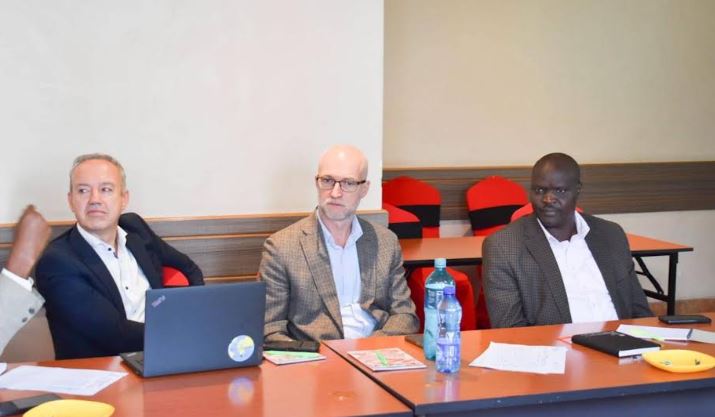
Dr Maara spoke at a Nakuru hotel during a meeting with a delegation from VEI (Dutch Water Operators) the Wageningen University of Netherlands (WUR) and international consortium of partners at a workshop on climate resilient and water Management.
Dr. Maara commended the partnership between the County Government, VEI and WUR university which he said will promote sustainable urban water management, climate resilience initiatives and regenerative programs such as water as Leverage (WAL).
He further thanked VEI for its partnership in advancing water projects through the Nakuru Water and Sanitation Services Company Limited (Nawassco), the Naivasha Water and Sanitation Company Limited (Naivawasco) and Nakuru Rural Water and Sanitation Company Limited (Naruwasco)water utilities.
Through WAL, Nakuru becomes the first City in Africa to have a sponge city model that will combat urban water flooding to regeneration and re use in homes and farms.
Through Public-Private partnerships, the CECM said they were putting in place a sponge city system that allows water to seep into the soil whenever it rains, rather than directing it away.
He said the sponge city concept significantly contribute to mitigating the negative effects of climate change, where green spaces set aside in sponge city’s design absorb carbon dioxide and consequently contribute to a lower amount of the greenhouse gas in the atmosphere.
By creating large spaces to hold water in the city center — such as parks and ponds —, the CECM explained that storm water could be retained on site, helping prevent floods.
Sponge infrastructure, he added, offers ways for water to seep down and recharge groundwater for times of drought.
“The idea of a sponge city is to recover and give water more space”, he added.
The WaL Program is an initiative of the Government of the Netherlands that promotes sustainable social, economic, and water climate resilience to accelerate climate change adaptation.
The WaL team has committed to develop innovative, climate-resilient water-related infrastructure solutions for Nakuru that will contribute to addressing urgent water and climate adaptation needs.
The project targets three high vulnerability zones identified for their impact on water retention and flood mitigation, this includes Menengai Crater Reforestation, Nakuru City Centre Urban Greening that will Introduce permeable pavements and urban greening solutions to reduce flash floods, as well as the Njoro River restoration program.
Dr Maara noted that as highways, buildings, and other infrastructure pave over land and shrink green space, surface flooding has emerged as the most serious water-related problem in Kenya, with floods affecting scores of the country’s cities each year.
“We want to have ground surfaces that mimic sponges and absorb rainwater, which is then naturally filtered by the soil and can recharge urban aquifers. The collected water can be extracted through urban or peri-urban wells, treated, and reused for the city’s water supply,” noted the CECM.
He observed that urban drainage systems in most Kenyan cities are insufficient to cope with rising urban flood risk” amid climate change, adding that Sponge City is an innovative initiative which transforms cities into resilient, water-secure and environmentally sustainable urban centres.
He said they sustainably absorb, store and filter flood waters as well as supply water efficiently during the dry season.
WaL Program sponge city concept promotes a more harmonious relationship between humans and nature that in effect gives water more room to soak in and pool in urban areas – such as parks that are dry in some seasons and become shallow ponds or channels in rainy seasons.
“Floods are not enemies; we can make friends with floods,” Dr Maara said.
The CECM indicated that the Sponge system cuts the amount of rainwater that enters sewage systems, something that has been a problem for the city and reduces the need to manually remove water without installing large-scale infrastructure like sewage pipes.
The concept was first introduced in China in the early 2000s to address surface-level flooding in urban areas. In 2014, pilot projects were initiated in several Chinese cities.
As climate change leads to more extreme weather events like heavy rainfall and droughts, it has become crucial to integrate floodwater management systems in cities. The World Meteorological Organization reported that around 44 per cent of global weather-related disasters in August 2023 were linked to flooding.
This highlights the growing global phenomenon of flooding and the urgent need for preventive measures.
Moreover, the World Economic Forum (WEF) found that ‘nature-based solutions to climate change’ were up to 50 per cent more cost-effective than engineered alternatives
County Executive Committee Member (CECM) for Youth, Sports, Gender, Social Services Ms Elga Adoyo Riaga observed that the concept of sponge cities is still relatively new, and each urban area faces unique challenges that require tailored solutions based on the region’s needs and biodiversity.
However, she said the underlying principle remains the same: utilizing nature-based solutions to tackle flooding.
She said by transforming cities into sponge cities, the County could create more resilient urban environments, better manage flood risks, and protect communities from the increasing threats of climate change.
According to the CECM, while emergency response teams like the National Disaster Management Unit (NDMU) are in place, there is a growing need for proactive measures to prevent disasters.
Ms Riaga explained that this is where sponge cities come in, offering a potential solution to control the damage caused by floods.
“A city’s ability to absorb water – referred to as its “sponginess” – is one key to withstanding climate shocks, with sponginess dependent on the amount of greenery and other water storage available, “she added.
By Esther Mwangi and Jefther Afuyo