Technical and Vocational Education Training (TVET) is no longer a second-choice pathway but the strategic lane to industrialization, job creation, and inclusive growth.
The Cabinet Secretary (CS) for Education, Migos Ogamba, said under the Bottom-up Economic and Transformation Agenda (BETA), TVETs are no longer being treated as a residual option but as a central pillar of the country’s economic blueprint.
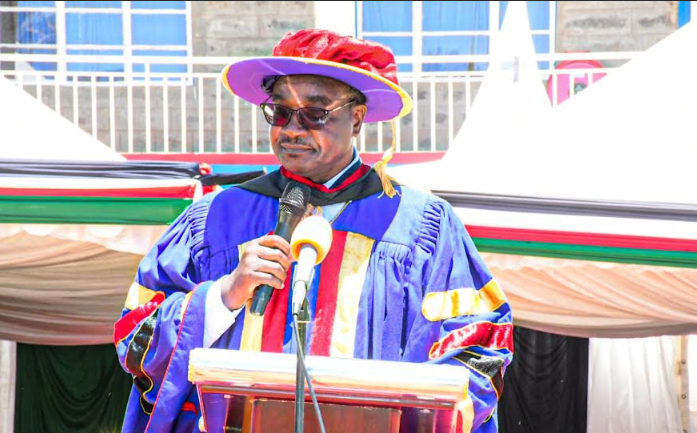
Speaking when he presided over the first graduation of Kipsoen National Polytechnic in Keiyo North Sub-county, the CS said Kenya, being a developing country, requires technicians, artisans, innovators, and entrepreneurs who can build, maintain, design, programme, manufacture, and create value.

The CS said the government had expanded access, reformed the curricula, and strengthened the link between training and the workplace to produce graduates who can do the work that the economy requires and who can create opportunities where none exist.
He challenged the 983 graduands not to measure their success by the jobs that they will secure but by the problems they will solve and the value they will create, saying the country still faces challenges in agriculture, construction, manufacturing, energy, ICT, transport, and the creative economy.
The CS told the graduands that each of the challenges was an opening for a skilled person with initiative, saying the certificate they acquired was not a decoration to be stored away but a tool that can be used to set up a business to employ another young Kenyan or to improve the community.
He reiterated that the success of a national polytechnic is measured not just by the certificates issued but by the enterprises started, innovations commercialised, jobs created, and communities strengthened.
“Do not wait for perfect conditions; start where you are with what you have, practice honesty, invest in continuous learning, and embrace integrity. This will open doors that credentials may not,” he said.
Ogamba said under the Competency Based Curriculum (CBC), training programmes have been modularized into shorter units so that learners can acquire market skills faster and progress flexibly, adding that the policy of integrating industry into the training process ensures that students spend meaningful time in the real workplace.
He added that recognition of prior learning is opening a formal pathway for the many Kenyans who have acquired skills informally, adding that equipment in TVETs has been upgraded, more trainers recruited, and partnerships with industries are being deepened across the country.
Following the investment by the government, the CS said enrolment in TVET institutions has more than doubled, adding that they were targeting to train two million Kenyans by the end of this year.
Ogamba said the government is working on a new law that will support tertiary education so that all students will be fully funded by the government, saying the government had realized that education is an investment and there were many partners willing to offer support in raising resources required to fully fund students.
“Once the law is passed, no student will fail to undertake a course or a programme because of their background,” he said.
The Principal, Joseph Bittok, called on the Ministry of Education to fund a state-of-the-art engineering complex to maximize the institution’s newly elevated status and scale up its capacity for grassroots industrial innovation.
Keiyo North Member of Parliament (MP), Adams Kipsanai, backed the focus on technical skills, telling the graduates that in a fast-evolving technological landscape, continuous learning and strict discipline are their only safety nets to remain globally competitive.
The MP specifically urged graduates trained in agricultural extension to move swiftly into local villages and to educate farmers on modern farming.
Kipsanai thanked the national government for funding the construction of modern student hostels, which are set to be commissioned within the next two months, and urged the Ministry of Education to urgently purchase more land to facilitate the polytechnic’s expansion.
By Alice Wanjiru