Deputy President Prof. Kithure Kindiki has said the government’s Sh350 billion National Infrastructure Fund will leverage up to Sh3.5 trillion in additional investment through Public-Private Partnerships (PPPs) to accelerate development of critical infrastructure across the country.
Kindiki said the fund, whose seed capital is held at the Central Bank of Kenya, would provide resources to complete stalled projects and support the expansion of roads, water systems, railways, and other infrastructure.
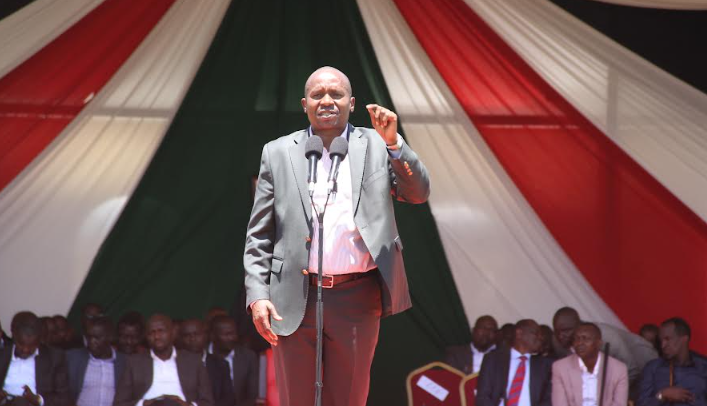
Speaking during an Interdenominational Sunday Worship Service at Kipsamoo Primary School in Kapseret Sub-County, Uasin Gishu County, the Deputy President said the government would use the fund as seed capital to attract private investment.
He said every Sh1 from the National Infrastructure Fund was expected to leverage an additional Sh10 from private investors, translating to a potential Sh3.5 trillion in investments.
“The National Infrastructure Fund has Sh350 billion in the account at the Central Bank of Kenya, and that money is going to be the seed money to attract Public-Private Partnerships. For every one shilling, we will attract another 10 shillings,” he said.
Kindiki said the initiative would transform Kenya’s infrastructure landscape and help complete projects that had remained unfinished for years.
“Through the National Infrastructure Fund, we are going to change the face of Kenya. The roads that have defeated us, we are going to complete them, and the water projects that have challenged us for 60 years will be addressed,” he said.
He said other major projects were also ongoing, including expansion of the railway network, construction of roads, and development of a new airport in Nairobi.
Kindiki cited the Isiolo-Mandera Road, which he said was more than 60 per cent complete, describing it as a major milestone that would open up the North Eastern region and improve movement of people and goods.
He added that the Government was considering extending the railway network to Malaba to facilitate trade and enhance regional connectivity.
On healthcare, Kindiki said reforms under the Social Health Authority (SHA) had increased the number of Kenyans covered by medical insurance from eight million under the National Hospital Insurance Fund (NHIF) to 32 million.
“Today, I can face the people of Kenya and say that it does not matter whether you have a business or not. As long as you are a Kenyan, you are entitled to a medical cover,” he said.
The Deputy President said the Government had also increased cancer treatment coverage from Sh500,000 to Sh800,000 per patient and introduced emergency ambulance services as part of efforts to improve access to healthcare.
He said the Government was constructing a new Moi Teaching and Referral Hospital (MTRH) in Eldoret, which he described as one of the largest planned health facilities in East Africa.
Kindiki said the first phase of the facility would have more than 2,000 beds, while the second phase was expected to add another 2,000 beds, bringing the planned capacity to 4,000 beds.
He added that the Government was supporting 107,000 Community Health Promoters (CHPs), who conduct household visits and help identify conditions such as hypertension and diabetes at an early stage.
On agriculture, Kindiki said the Government had reduced the price of fertilizer from Sh2,500 to Sh2,000 for a 50-kilogramme bag, while certified seed prices had been reduced by 50 per cent.
He said the measures were aimed at reducing production costs, supporting farmers affected by inadequate rainfall and declining agricultural incomes, and boosting national food production.
“The President has said we must support farmers. Even if it means reducing the price of seeds further, we will do so to enable farmers to produce enough food to feed the nation,” he said.
On education, Kindiki said the Government had employed 120,000 teachers since 2022 and recruited 3,300 instructors for Technical and Vocational Education and Training (TVET) institutions.
He said the Government was also investing in youth empowerment through the National Youth Opportunities Towards Advancement (NYOTA) programme.
Kindiki said NYOTA had so far provided Sh50,000 grants to more than 122,000 young people and would be expanded to benefit more youth once additional resources were secured.
He said the Government’s affordable housing programme had created employment opportunities for about one million young people through the construction of houses, markets, and student hostels.
The Deputy President also highlighted investments in sports infrastructure, including the construction of the 60,000-seater Talanta Sports City in Nairobi and 33 other stadiums across the country.
On security, Kindiki commended Interior Cabinet Secretary Kipchumba Murkomen for efforts to restore peace in the Kerio Valley, saying the region had recorded significant improvement in the fight against banditry.
“He has done it even better than I would have done it myself. The situation in Kerio Valley has improved, and firearms are now beginning to be surrendered,” Kindiki said.
Turning to politics, Kindiki challenged leaders seeking to unseat President William Ruto in the 2027 General Election to present Kenyans with clear policy alternatives instead of relying on ethnic politics, slogans and inflammatory rhetoric.
He said political competition should be based on development records, policies, and competing visions for the country.
Kindiki urged presidential aspirants to explain what they would do differently from the Kenya Kwanza administration and outline their programmes in key sectors, including healthcare, education, employment, roads and the economy.
“I know there are people who want to run for president, and that is their democratic right. My request is that those competing with President William Ruto should come with their policies and vision for the nation of Kenya,” he said.
He challenged political leaders to engage voters on their programmes rather than concentrating on rallies and political rhetoric.
“Let us stop the politics of jumping from one meeting to another and focus on policies. We are ready. President Ruto is ready. Our team is ready. Let us go to the field and face each other with our policies and records, and let Kenyans decide,” Kindiki said.
The Deputy President warned politicians against inciting young people to engage in violence during political campaigns, saying the Government would take action against leaders who threaten national peace and security.
He also urged politicians to stop making the Independent Electoral and Boundaries Commission (IEBC) the centre of political campaigns, saying elections were ultimately decided by voters.
Kindiki called on the electoral body to discharge its mandate independently and without intimidation, while urging political leaders to respect institutions established under the Constitution.
He called for peaceful political competition, saying political differences should not be allowed to undermine national cohesion, development and security.
Also present were Interior and National Administration Cabinet Secretary Kipchumba Murkomen; Governors Jonathan Bii of Uasin Gishu, Stephen Sang of Nandi and Patrick Ole Ntutu of Narok; Principal Secretaries Prof. Julius Bitok of Tourism and Dr Belio Kipsang of Immigration.
Others were COTU Secretary-General Dr. Francis Atwoli; Senators Jackson Mandago of Uasin Gishu and Kiprono Chemitei of Baringo; Members of Parliament Oscar Sudi of Kapseret, Reuben Kiborek of Mogotio, William Kamket of Tiaty, among other leaders and members of the clergy.
By Fredrick Maritim